A Spanish tourist couple remains indifferent on the beach sand next to the lifeless body of an undocumented immigrant who had drowned during a shipwreck. The photo, titled “Death at the Gates of Heaven,” was taken by photographer Javier Bauluz and won the Pulitzer Prize, causing enormous controversy at the time under the frivolous accusation that it had been manipulated or even staged. In response, Bauluz himself, irritated by the accusations, decided to reveal the full story behind the photograph.
The True Story Behind the Photo Titled “Death at the Gates of Heaven”
Bauluz was covering the assistance provided to undocumented immigrants who had been rescued off the Spanish coast of Andalusia after their boat sank on September 2, 2000. The immigrants, many of them soaked and injured, received care at a local sports center. Many survivors wept and knelt with their hands raised to the sky, giving thanks for their survival, according to Javier Bauluz, who was taking photographs at the scene.
Shortly thereafter, the photographer received a call informing him that there was a corpse on Zahara beach, 20 km away, and he promptly headed there. Around 5 p.m., the photographer arrived at the beach, which was still crowded with people swimming in the warm water and enjoying the strong European summer sun. When Bauluz reached the far end of the beach, in addition to spotting a *cameraman*, journalists with notebooks in hand, and another photographer, he was astonished by the indifference of a couple sitting under a beach umbrella, just a few meters from where the body lay, and decided to document the scene.
Humanity in a Plastic Bag
Next to the body of the immigrant, who was of African origin, authorities found a toothbrush, a hairbrush, a 5000 peseta note (the former Spanish currency), a photo of the Pope, a Bob Marley CD, and a measuring tape. According to the photographer himself, the ignored immigrant had experienced love and dreams in life, was someone’s son, had been a Christian who loved Marley, a clean, poor, and hardworking person. The Civil Guard also found several photographs wrapped in plastic. Several were of himself and one was of his likely parents, who would never know what happened to their son, who would be buried as an indigent.
“The ignored immigrant had experienced love and dreams in life, was someone’s son, had been a Christian who loved Marley, a clean, poor, and hardworking person.” – Javier Bauluz.
Bauluz wanted to capture the image of the immigrant’s corpse contrasting with the beach full of people enjoying themselves, but while searching for the best angle, he was prevented by a Civil Guard officer from completing the shot, even after identifying himself as a journalist. Javier remained at the scene for several hours, even observing the work of the local police. Furthermore, the photographer also witnessed other scenes of indifference displayed by tourists toward the lifeless body.
The Psychology of Indifference: The Bystander Effect
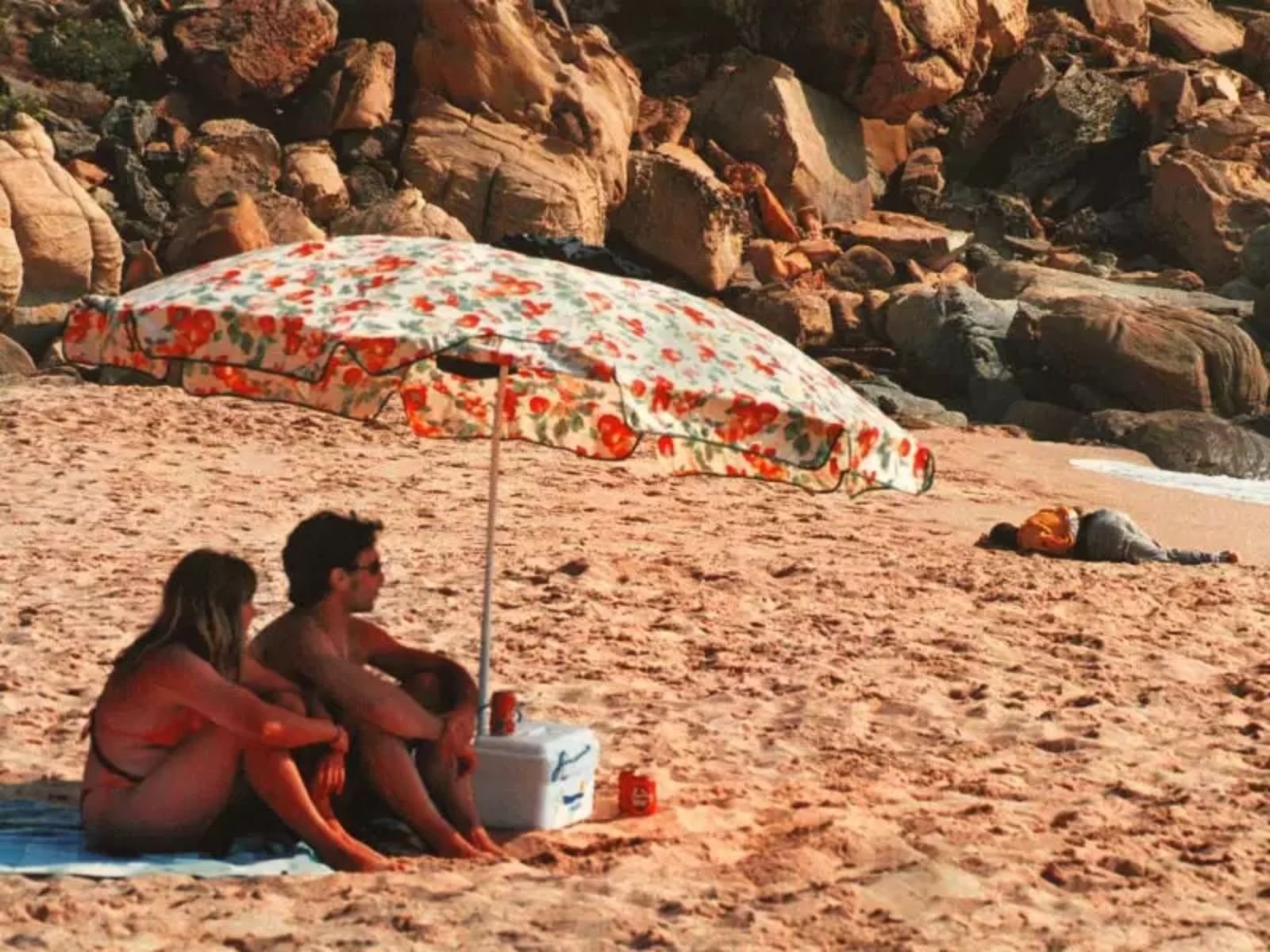
A Spanish tourist couple remains indifferent on the beach sand next to the lifeless body of an undocumented immigrant who had drowned during a shipwreck. The photo, titled “Death at the Gates of Heaven,” was taken by photographer Javier Bauluz and won the Pulitzer Prize, causing enormous controversy at the time under the frivolous accusation that it had been manipulated or even staged. In response, Bauluz himself, irritated by the accusations, decided to reveal the full story behind the photograph.
The scene captured by Bauluz is an example of what social psychologists call the “Bystander Effect” or “Genovese Syndrome,” referencing the notorious murder of Kitty Genovese in New York in 1964, where multiple neighbors heard her screams, yet no one intervened. The theory, developed by John Darley and Bibb Latané, posits that the presence of other people inhibits our willingness to help. This phenomenon is fueled by two main psychological processes: the diffusion of responsibility and pluralistic ignorance.
Diffusion of responsibility occurs because, in a group, the moral obligation to act does not fall upon a single individual but is diluted among all present. Each bystander assumes that someone else will intervene, or that another person’s responsibility is greater. On Zahara beach, with dozens of sunbathers, journalists, and even the Civil Guard present, the individual responsibility of each person toward the body on the sand was effectively pulverized. The couple under the umbrella might have thought, “Several other people are here; they will take care of it,” or “The police have already been called.”
Pluralistic ignorance, in turn, describes the tendency to look to others in an ambiguous situation for cues on how we should behave. If no one else seems concerned, we conclude that the situation may not be an emergency. The tourists on the beach, seeing others continue to swim and sunbathe, may have interpreted the scene as something “under control” or “none of their business,” creating a cycle of collective inaction. The indifference of one feeds and validates the indifference of the other, resulting in a shocking social paralysis in the face of tragedy.
The Mediterranean as an Open-Air Cemetery
The image captured by Bauluz is not an isolated event but the portrait of an ongoing tragedy. The Mediterranean Sea, the cradle of civilizations and a dream vacation destination for many, has transformed into one of the world’s deadliest migratory routes. Since 2014, the International Organization for Migration (IOM) has recorded over 28,000 deaths and disappearances during this desperate crossing in search of safety and a better life in Europe. In 2024 alone, more than 2,500 lives have been lost in silent shipwrecks, far from the eyes of the majority.
Spain, due to its geographical position, has become one of the main destinations, especially via the so-called Western Mediterranean Route. Migratory pressure intensified starting in 1991, when the country, aligning itself with European Union policies, began requiring visas for citizens of many North African countries, pushing thousands into clandestine routes and into the hands of human traffickers who launch them into the sea in precarious vessels.
Zahara beach, in Andalusia, was not merely a tourist paradise; it was, and continues to be, a point of arrival for those who survive and a cemetery for those who perish along the way.
Javier Bauluz and the Photojournalist’s Dilemma: Document or Intervene?
Bauluz’s action raises a central ethical debate in photojournalism: the duty to document versus the human impulse to intervene. Critics at the time questioned why he did not cover the body or act in some other way. However, the ethics of photojournalism, although complex, prioritize bearing witness. The journalist’s role is to record reality, no matter how harsh, so that society can confront it. As argued in debates on the subject, a powerful image can have a much greater and more lasting impact than a single individual action.
By photographing the scene, Bauluz was not being insensitive; he was fulfilling his function of bringing an inconvenient truth to light. The decision to publish such a disturbing image involves an ethical calculation between potential harm (the family’s pain, public shock) and the greater good (raising awareness about a humanitarian crisis). In this case, the image served as a catalyst for discussion about the migratory crisis and the dehumanization of migrants, fulfilling a fundamental journalistic purpose.
Javier Bauluz, in addition to receiving the Pulitzer Prize, photography’s highest honor, managed to immortalize in a single click the indifference of a large portion of people toward their fellow human beings. He took several photographs that day, he said, with the intention of trying to humanize that corpse about which most people did not care. Javier Bauluz’s photograph transcended the initial controversy to become an icon of the global migratory crisis and a symbol of the “globalization of indifference,” a term coined by Pope Francis.
Author’s Comments
The article about “Death at the Gates of Heaven” shockingly illustrates human indifference: a life fades away in a public place, and the reaction of passersby is minimal or nonexistent. This extreme case serves as a somber parallel to the indifference we frequently observe in daily life. Physical proximity between individuals does not always result in empathy or concrete action. Vulnerable people are often ignored by those walking past, public conflicts are avoided as if they were invisible; distant tragedies, such as the Russian aggression against Ukraine, elicit generalized apathy, illustrating just one of many possible examples.
The image forces the viewer to confront an uncomfortable reality: the juxtaposition of leisure and privilege (the tourist couple) with death and despair (the migrant’s body). The scene captured in the photograph lays bare a recurring flaw in the human condition: the tendency to enclose ourselves in personal realities, building invisible barriers that separate us from the pain of others. Even after more than two decades, the photograph remains painfully relevant — a silent and somber reminder that, for many, the so-called “gates of heaven” are, in fact, revealed as the antechambers of death.
References
- Bauluz, Javier. “Death at the Gates of Heaven.”
- “Mediterranean.” Missing Migrants Project (IOM). https://missingmigrants.iom.int/mediterranean.
- “A Decade after EU’s Migrant Crisis, Hundreds Still Dying in Mediterranean.” Reuters. https://www.reuters.com/world/europe/stranded-sea-decade-after-eus-migrant-crisis-hundreds-still-dying-mediterranean-2025-08-19/.
- “Bystander Effect in Psychology.” Simply Psychology. https://www.simplypsychology.org/bystander-effect.html.
- Darley, John M., and Bibb Latané. “Bystander Intervention in Emergencies: Diffusion of Responsibility.” Journal of Personality and Social Psychology, vol. 8, no. 4, pp. 377–383. https://doi.org/10.1037/h0025589.
- “Documenting Tragedy: The Ethics of Photojournalism.” NPR. https://www.npr.org/2012/12/06/166666261/documenting-tragedy-the-ethics-of-photojournalism.
- Human Rights Watch. Hidden Emergency: Migrant Deaths in the Mediterranean. Human Rights Watch. https://www.hrw.org/news/2012/08/16/hidden-emergency.