In August 2008, the world witnessed what the Kremlin’s propaganda machine skillfully labeled a “peace enforcement operation.” The official Russian narrative, tirelessly repeated by state media, painted a picture of an aggressor Georgia committing “genocide” against tiny South Ossetia, forcing “benevolent” Russia to intervene to protect innocent civilians.
The Five-Day War was a “War of Deceit,” a meticulously constructed farce designed to mask a brutal reality: a premeditated imperialist invasion, the first European war of the 21st century, which would serve as a blueprint for Vladimir Putin’s future aggressions.
Decentralized Information Immune to Russian Propaganda
This article, reworked after being originally written a few years after the events, at a time when decentralized information was not yet fully widespread, is based on concrete facts, independent investigations, and international reports. This will completely deconstruct Russia’s mendacious narrative.
It will be exposed, beyond any doubt, how Putin’s regime orchestrated a campaign of provocation, launched a full-scale invasion under a false pretext, committed war crimes, and implemented ethnic cleansing. All in the name of an expansionist project that echoes the darkest tactics of European history, which even expanded to Ukraine in the following years. The truth about the Five-Day War is not one of humanitarian intervention, but rather one of criminal and unjust aggression that left a trail of destruction, death, and human suffering.
Anatomy of a Lie: Russian Narrative versus Factual Reality
The cornerstone of Russian propaganda was the claim that Georgia launched a surprise and unprovoked attack on the night of August 7-8, 2008, forcing Russia to respond. This is a gross distortion of reality. The truth, confirmed by multiple sources, including the European Union report (known as the Tagliavini Report), is that the Georgian offensive was the culmination of months of intense provocations and a military escalation orchestrated by Russia.
Russian Propaganda Narrative vs. Concrete Factual Reality
Russian Propaganda – Georgia started the war with a surprise attack on August 7.
FACT – Russia and its proxies in South Ossetia began shelling Georgian villages on August 1, breaking the 1992 ceasefire.
Russian Propaganda – Russia intervened to prevent a Georgian “genocide.”
FACT – The accusation of genocide was entirely fabricated. There is no evidence to support it. It was a pretext for the invasion.
Russian Propaganda – Russian troops entered Georgia only after the Georgian attack.
FACT – Units of the Russian 58th Army illegally crossed the border through the Roki Tunnel before the Georgian military response on August 7.
Russian Propaganda – Russia was conducting a “peace operation.”
FACT – Russia conducted a full-scale invasion by land, air, and sea, attacking civilian targets far beyond the conflict zone and occupying Georgian cities.
Russian Propaganda – Russia protected South Ossetian civilians.
FACT – Ossetian militias, with Russian support, carried out a systematic campaign of ethnic cleansing, destroying Georgian villages and expelling the population.
Prelude to the Invasion of Georgia: Years of Russian Provocation
The 2008 aggression did not emerge from a vacuum. It was the culmination of a deliberate Kremlin policy to undermine Georgia’s sovereignty since its independence from the Soviet Union and, especially, after the 2003 Rose Revolution, which brought the pro-Western government of Mikheil Saakashvili to power. Georgia’s rapprochement with NATO and the European Union was seen by Putin as a direct threat to his sphere of influence.
The Kremlin used the separatist regions of Abkhazia and South Ossetia as tools to destabilize Georgia. Russia mass-distributed Russian passports to local populations, a cynical tactic to later justify an intervention under the pretext of “protecting Russian citizens.” It increased military and financial support to separatist regimes, violating international agreements.
Incidents multiplied in the months leading up to the war:
- April 2008 Russia announced the establishment of official ties with the separatist regions, a blatant violation of Georgian sovereignty.
- May 2008 Russia sent additional troops to Abkhazia, under the pretext of “repairing railways,” increasing its illegal military presence on Georgian territory.
- July 2008 Russia conducted a large military exercise, “Caucasus 2008,” which openly simulated an invasion of Georgia. The troops who participated in this exercise were the same ones who, weeks later, invaded the country.
- August 1-6, 2008 South Ossetian separatists, with Russian support, initiated a series of mortar and sniper attacks against ethnically Georgian villages, killing Georgian civilians and police officers. Georgia responded sporadically but sought dialogue, which was rejected.
It became clear that Russia was pushing Georgia into a trap. The goal was to provoke a Georgian military response that could be used as the perfect pretext for a full-scale invasion.
The Russian Invasion of Georgia: The Blueprint of Russian Imperialism in Action
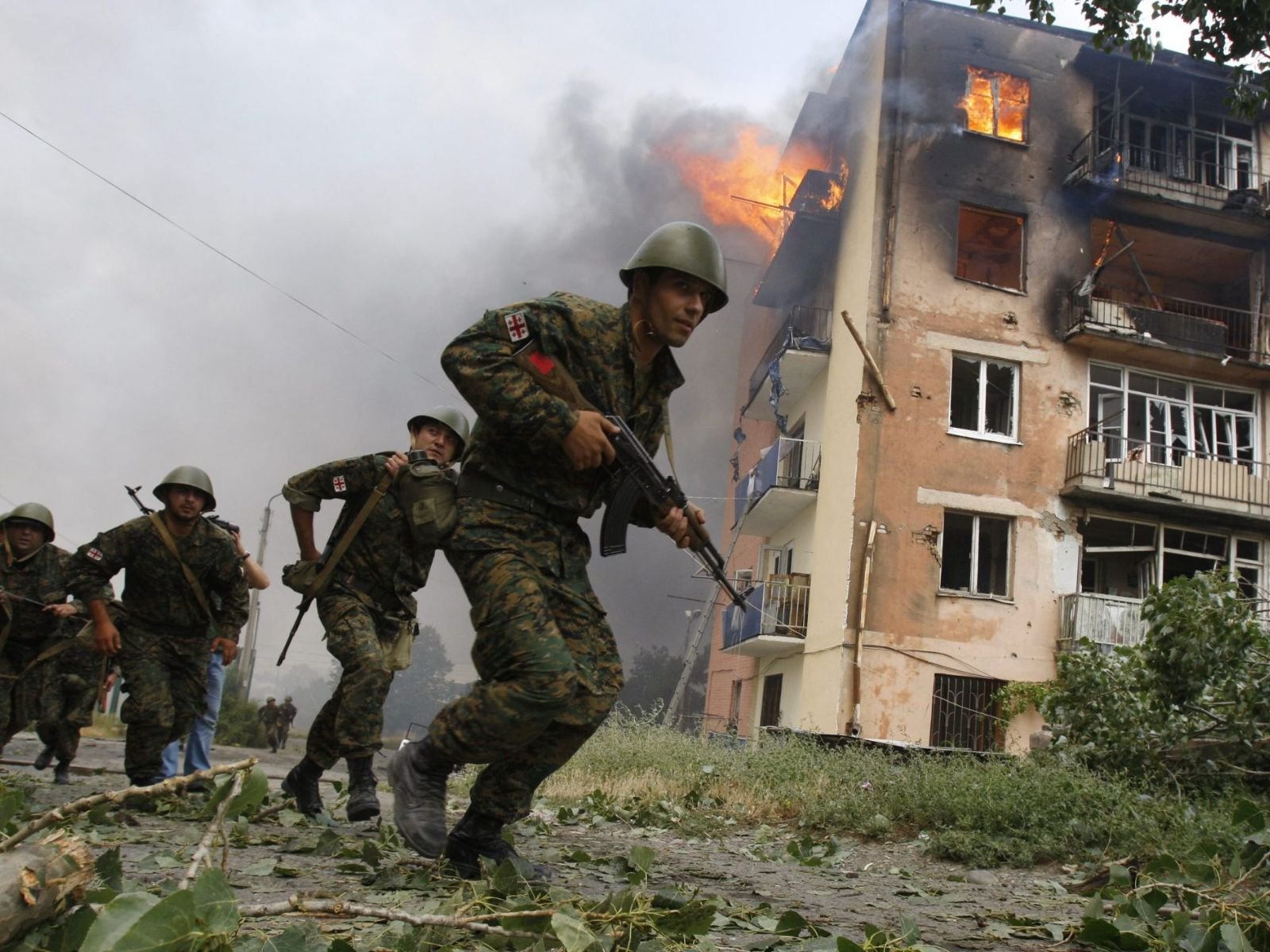
Georgian soldiers run for cover during intense combat in Tskhinvali, the capital of South Ossetia, at the beginning of the conflict. The Georgian response was a reaction to months of provocations and separatist attacks supported by Russia.
On the night of August 7, after days of incessant attacks and with confirmation that regular units of the Russian army were already moving through the Roki Tunnel into its territory, the Georgian government made the desperate decision to launch an operation to restore constitutional order in South Ossetia. It was exactly the *casus belli* Putin was waiting for.
Within hours, Russia launched its “Peace Enforcement Operation.” Tens of thousands of soldiers, hundreds of tanks, and combat aircraft were poured into Georgia. Russia response was entirely disproportionate and went far beyond South Ossetia. The Russian Air Force bombed cities like Gori and Poti, ports, airports, and civilian infrastructure across the country. Russian Navy blockaded the Georgian coast in the Black Sea. It was a total invasion, designed to crush Georgia’s armed forces and terrorize its population.
Destruction in Gori City in Georgia
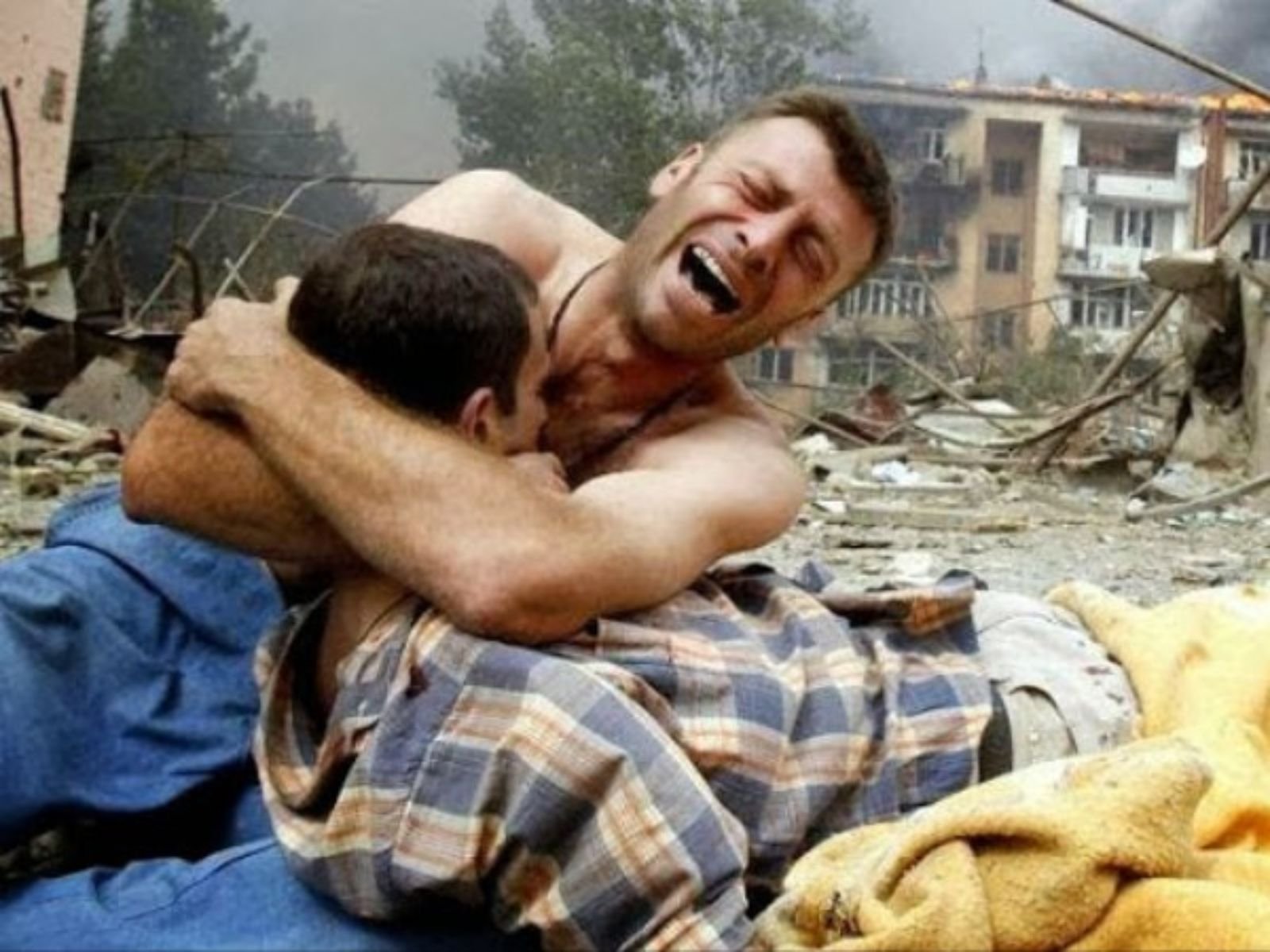
A Georgian man weeps over the death of a relative after a Russian bombing in Gori, 80km from the capital Tbilisi. The photo, by Gleb Garanich (Reuters), became a symbol of human suffering in the war. Gori is, ironically, the birthplace of Josef Stalin.
The world witnessed human suffering in real time. The image of the man weeping in Gori (opening photo) captured the pain of a nation under attack. Civilians fleeing in convoys were targeted. Cluster bombs, indiscriminate weapons, were used in populated areas. The Human Rights Watch report extensively documented these war crimes.
“Russian forces used indiscriminate force in the counter-attack in South Ossetia and in the city of Gori, already inside Georgian territory, apparently targeting convoys of civilians attempting to flee conflict zones.” – Human Rights Watch, August 18, 2008.
As Russian troops advanced, South Ossetian militias, acting under Russian protection, initiated a brutal campaign of ethnic cleansing. Ethnically Georgian villages within and around South Ossetia were systematically looted, burned, and destroyed. The Georgian population was expelled from their homes in a wave of terror. The objective was clear: to erase any Georgian presence from the region, creating a demographic reality that would solidify Russian control.
Battle for Gori: Georgia’s Heart Under Fire
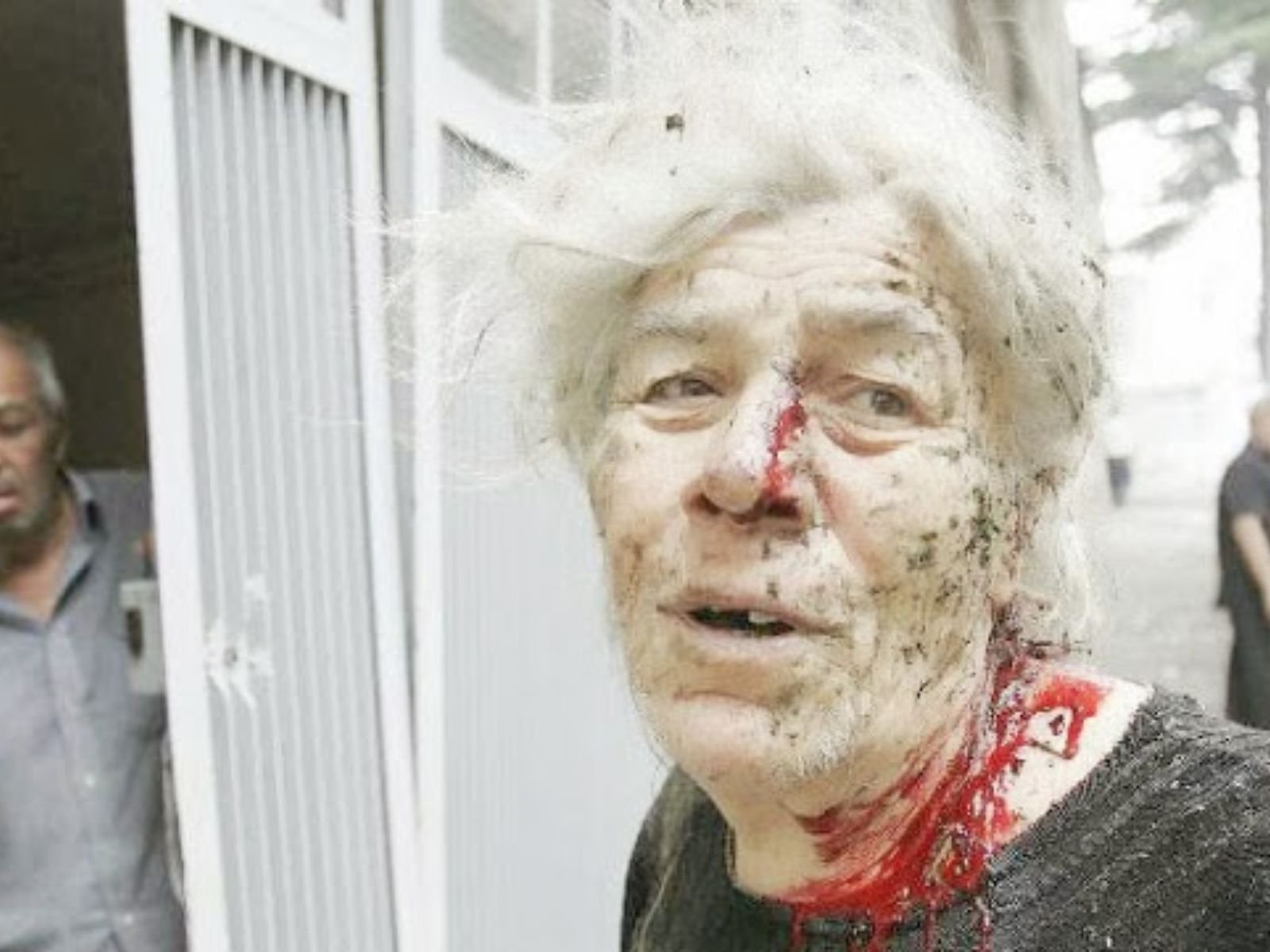
Georgian woman wounded after bombings in the city of Gori, Georgia, during the Five-Day War. Photo: Davi Mdzinarishvilli/Reuters.
Gori, the birthplace of Josef Stalin, became the symbol of Russian brutality in the Five-Day War. Located just 25 kilometers from Tskhinvali and situated on Georgia’s main east-west highway, Gori was a crucial strategic target for Russian plans to “cut the country in half.”
The first Russian bombings against Gori began at 11:00 AM on August 8, when four Russian planes attacked the city. The pattern was clear from the outset: Russia was not interested only in “protecting” South Ossetia, but in terrorizing the Georgian civilian population. Overnight, Russian bombs hit a textile factory and a cell tower, demonstrating that the targets were both military and civilian.
August 9
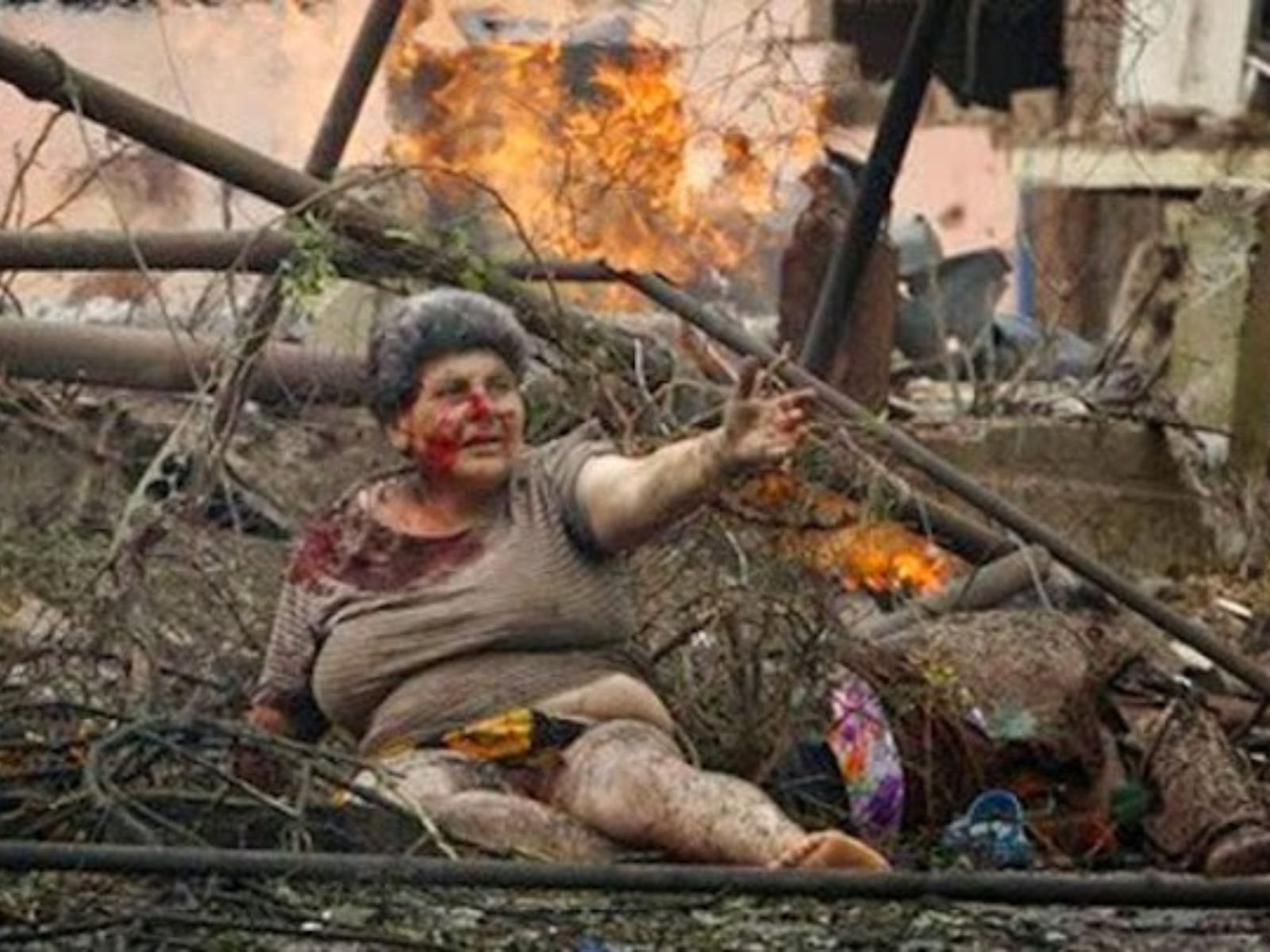
Wounded woman cries in front of an apartment building, bombed during a Russian air attack. The incident occurred in the northern Georgian city of Gori, on August 9, 2008. According to the photographer, the wounded woman was assisted by neighbors and evacuated to a safe area. (AP Photo/George Abdaladze)
The August 9 bombing revealed the true nature of the Russian “peace operation.” At 06:27 GMT, Russian warplanes attacked a Georgian artillery facility near Gori, but the attacks spread to military garrisons, residential buildings, and a school. The Georgian government reported 60 civilians killed on this single day. The Daily Telegraph compared the bombing of Gori to the indiscriminate bombing of Grozny during the Chechen war, establishing a disturbing parallel with the brutal tactics Putin had used against his own people.
August 10
The situation rapidly deteriorated. By August 10, 80% of Gori’s residents had fled, according to UNHCR and World Food Program calculations. The city streets filled with desperate refugees, many carrying only what they could hold in their hands.
A Georgian refugee, in a prophetic statement that would echo years later, said:
“Tomorrow it will be Ukraine and no one in the West is doing anything to stop them”
August 11
The most dramatic moment came on August 11, when Georgian President Mikheil Saakashvili visited Gori wearing a bulletproof vest. During his visit, Russian jets flew over the city, forcing his security detail to tackle him to the ground to protect him. The scene, captured by international cameras, symbolized Georgia’s vulnerability in the face of the Russian war machine.
August 12
The fatal bombing came on August 12, when Russian planes deliberately attacked Gori’s main square. Seven civilians were killed and more than 30 wounded, including Dutch journalist Stan Storimans, who became the first international victim of Russian aggression. The attack had no military objective. It was pure terrorism against civilians, a documented war crime that remains unpunished to this day.
Occupation of Gori: Nine Days of Russian Terror
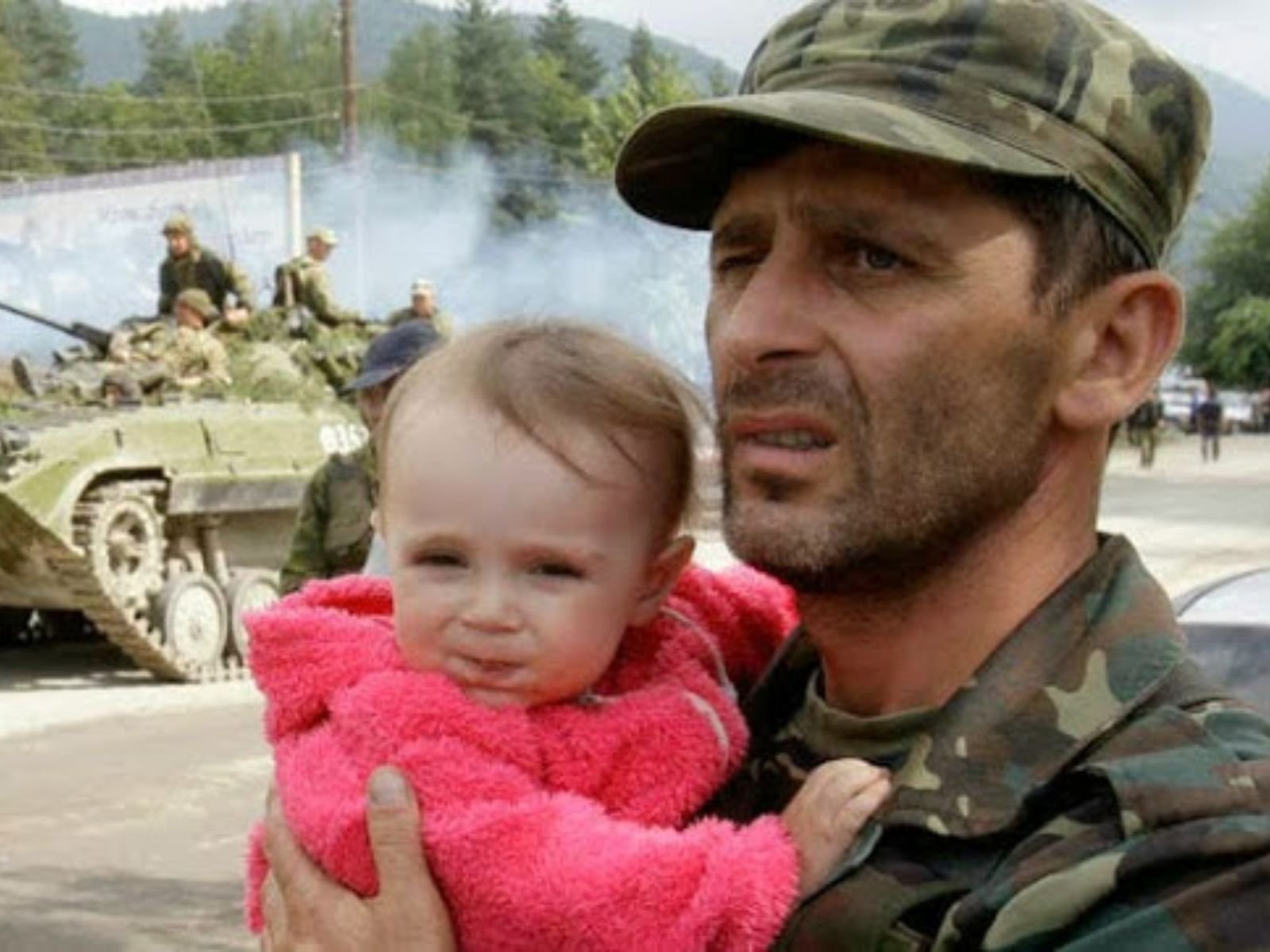
Little girl is evacuated from the conflict area during the Five-Day War. The image shows a Georgian soldier holding a baby dressed in pink, with Georgian army armored personnel carriers (BMPs) visible in the background. Photo: David Mdzinarishvili/Reuters.
On August 13, Russian forces finally occupied Gori, initiating nine days of terror that demonstrated the Kremlin’s true intentions. The occupation was commanded by Generals Vyacheslav Borisov and Sulim Yamadayev, the latter a Chechen notorious for his brutality during the Chechen wars.
The occupation of Gori was not only military but also a demonstration of power intended to terrorize the Georgian population and humiliate Georgia. Russian forces included the 58th Combined Arms Army of Guards, the infamous Vostok Battalion (composed of Chechens loyal to Moscow), and units of the Russian Air Force. During the nine days of occupation, nine Georgian officers were killed and three disappeared, while 14 civilians were murdered and 22 disappeared.
The occupation created at least 56,000 Georgian refugees from Gori alone, entire families forced to abandon their ancestral homes. Many never returned, transforming the temporary occupation into permanent displacement. Russian forces looted properties, destroyed civilian infrastructure, and allowed Ossetian militias to commit atrocities against Georgian civilians.
Advance Towards Tbilisi: Georgia’s Capital Under Threat
As the world watched in horror, Russian forces did not stop in Gori. The Russian army continued advancing towards Tbilisi, reaching just 40 kilometers from the Georgian capital. The strategic objective was clear: to “cut the country in half,” as a Georgian official admitted. If successful, the Russian offensive would have effectively divided Georgia into two parts, isolating the capital from the rest of the country.
The Russian advance towards Tbilisi was accompanied by an occupation campaign on multiple fronts. In the west, Russian forces moving through Abkhazia occupied the strategically important cities of Poti, Zugdidi, and Senaki. Poti, Georgia’s main port on the Black Sea, was particularly crucial, as its occupation cut off Georgian maritime access and demonstrated that Russia was willing to economically strangle the country.
In Poti, Russian forces captured 21 Georgian soldiers and confiscated five American Humvees, taking them to a Russian military base in Senaki. The action was a deliberate humiliation for both Georgia and the United States, demonstrating that not even American military equipment could protect Washington’s allies from Russian aggression.
International Pressure: Diplomacy Under Fire
As Russian forces approached Tbilisi, international pressure finally began to materialize. French President Nicolas Sarkozy, then rotating president of the European Union, flew to Moscow on August 12 to negotiate a ceasefire with Russian President Dmitry Medvedev.
The six-point agreement negotiated by Sarkozy was presented as a diplomatic success, but in reality, it was a victory for Russia. The agreement not only failed to stop the Russian advance immediately but also allowed Russia to claim it could “push deeper into Georgia” to “implement” the ceasefire. The ambiguous language gave Russia a legal justification to continue its military operations.
American Secretary of State Condoleezza Rice flew to Tbilisi as part of American diplomatic efforts. The combined pressure from the United States and the European Union was finally decisive in stopping the Russian invasion, but the damage was already done. Russia had demonstrated that it could invade a sovereign country, occupy its *de facto* capital, and face only diplomatic protests.
War Casualties: The Human Price of Russian Aggression
The official casualty figures reveal the devastating scale of Russian aggression. On the Georgian side, 170 soldiers, 14 police officers, and 228 civilians were killed, with 1,747 wounded. The total dead and wounded reached 2,232 people – a devastating number for a conflict that lasted only five days.
Official Russian casualties were 67 soldiers killed, but the figures hide an embarrassing reality for the Russian army. According to later analyses, up to 40% of Russian casualties resulted from traffic accidents en route to the fighting, revealing serious problems with logistics and military preparedness. Russia also lost six aircraft, although only two were shot down by Georgian forces, with the others apparently victims of “friendly fire.”
Population displacement was perhaps the most devastating aspect of the war. A total of 192,000 civilians were displaced, with Georgian estimates reaching at least 230,000. From Gori alone, 56,000 people became refugees. More tragically, 22,000 ethnic Georgians were permanently expelled from South Ossetia through a systematic campaign of ethnic cleansing that continues to this day.
Dark Legacy: Occupation, Ethnic Cleansing, and the Precedent for Ukraine
After five days of fighting, a ceasefire was negotiated by French President Nicolas Sarkozy. The agreement required the withdrawal of Russian troops to pre-conflict positions. Russia violated the agreement almost immediately. Instead of withdrawing, it consolidated its military presence and, on August 26, 2008, recognized the “independence” of Abkhazia and South Ossetia, formalizing the annexation of 20% of Georgia’s sovereign territory.
Since then, Russia maintains thousands of soldiers in illegal military bases in these regions, transforming them into Kremlin protectorates. An artificial “border,” marked by barbed wire fences, was erected, dividing families and communities. This creeping “borderization” continues to this day, with Russian occupation forces advancing the demarcation line meter by meter, swallowing more Georgian territory.
The human suffering was immense:
- Killed: Hundreds of civilians and military personnel on both sides.
- Ethnic Cleansing: Tens of thousands of ethnic Georgians were permanently expelled from Abkhazia and South Ossetia.
- Refugees: Nearly 200,000 people were displaced from their homes.
More than Georgia’s tragedy, the 2008 war was a watershed moment for European security. It was the moment when Putin’s Russia demonstrated that it was willing to use brutal military force to redraw borders in Europe and impose its will on its neighbors. The timid Western response, focused more on “not provoking” Russia than on punishing it for its aggression, was a catastrophic mistake.
The blueprint used in Georgia was repeated almost to the letter in Ukraine in 2014 and again in 2022:
- Internal destabilization using local proxies.
- Distribution of passports to create a pretext of “citizen protection.”
- Massive disinformation campaign and false accusations of “genocide.”
- Military invasion under the guise of a “special” or “humanitarian” operation.
- Annexation of territory through the recognition of “independent republics.”
The Five-Day War was not an isolated event. The blueprint of aggression used in Georgia was first developed and tested in the Second Chechen War (1999-2009), where Putin established the pillars of his imperial strategy.
Truth as a Weapon
The history of the 2008 Russo-Georgian War is a brutal lesson on the nature of Putin’s regime and the importance of confronting aggression with strength and determination. The Russian narrative of a “war of lies” crumbles under the weight of facts. There was no Georgian genocide. There was a premeditated Russian invasion. There was no peace operation. There was a war of conquest that resulted in war crimes and ethnic cleansing.
Remembering the truth about the Five-Day War is to expose to the world the criminal *modus operandi* of the Russian State. As long as 20% of Georgia’s territory remains under Russian occupation, and as long as Russia continues to use force to subjugate its neighbors, peace in Europe will remain under threat. The first casualty of war is truth, and the first weapon against tyranny is to restore it.
Bibliographical References
- Human Rights Watch. Up in Flames: Humanitarian Law Violations and Civilian Victims in the Conflict over South Ossetia. Human Rights Watch, 2009. https://www.hrw.org/report/2009/01/23/flames/humanitarian-law-violations-and-civilian-victims-conflict-over-south.
- Independent International Fact-Finding Mission on the Conflict in Georgia (IIFFMCG). Report. Vols. I–III. 2009. https://www.mpil.de/files/pdf4/IIFFMCG_Volume_II1.pdf.
- Carnegie Endowment for International Peace. The Still-Topical Tagliavini Report. Carnegie Endowment for International Peace, 2015.
- Institute for the Study of War. The Kremlin’s Playbook: The 2008 Russo-Georgian War. Institute for the Study of War, 2023.
- “Russia’s War in Georgia: The Truth behind the Lies.” The Guardian, 2008. Link.
- Amnesty International. Civilians in the Line of Fire: The Georgia–Russia Conflict. Amnesty International, 2008.
- “Russian Influence Operations in Georgia: A Threat to Democracy and Regional Stability.” Foreign Policy Research Institute, 2025. https://www.fpri.org/article/2025/03/russian-influence-operations-in-georgia-a-threat-to-democracy-and-regional-stability/.
- Jamestown Foundation. The Guns of August 2008: Russia’s War in Georgia. Jamestown Foundation, 2008.
- International Crisis Group. Russia vs Georgia: The Fallout. International Crisis Group, 2008.