At 9:02 on the morning of April 19, 1995, the shockwave of the Oklahoma City bombing tore through the heart of the United States. A rented Ryder truck, parked in front of the Alfred P. Murrah Federal Building in Oklahoma City, exploded with the force of 4,800 pounds of ammonium nitrate and fuel oil. The blast ripped away a third of the building, turning its facade into a pile of twisted concrete and steel.
The attack, the deadliest act of terrorism on American soil up to that point, killed 168 people, including 19 children, 15 of them in the second-floor day care center. Yet what shocked the nation most was not only the scale of the carnage but its origin: the terrorist was not a foreign enemy but an American, a decorated war veteran named Timothy James McVeigh.
Seeds of Hatred: The Ruby Ridge Siege and the Waco Massacre
The Oklahoma City bombing was not an isolated act of madness. It was the bloody climax of a decade of growing paranoia, anti-government rage and far-right radicalization, fueled by two events that became battle cries for militias across the country: the Ruby Ridge siege and the Waco massacre. To understand the bomb in Oklahoma, one must first understand the flame that lit it. For many on the far right, these confrontations between citizens and federal agents confirmed their worst suspicions about a tyrannical government.
Ruby Ridge Siege: The First Martyrdom
The first was the Ruby Ridge siege in August 1992. Randy Weaver, a white separatist, came into the crosshairs of the Bureau of Alcohol, Tobacco and Firearms (ATF) after selling sawed-off shotguns to an informant. Weaver resisted the ATF’s pressure to infiltrate the white supremacist group Aryan Nations and failed to appear at his trial on weapons charges, which brought the U.S. Marshals Service to his remote cabin in Idaho. During an 11-day standoff, Weaver’s 14-year-old son, Sammy, and a federal agent were killed in the initial shootout. Later, an FBI sniper killed Weaver’s wife, Vicki, as she held her baby daughter in the doorway of their home.
For McVeigh and other extremists, Ruby Ridge was proof that the federal government was willing to kill citizens, including women and children, to impose its will and disarm the population. The image of a mother shot dead by a federal sniper became a powerful symbol of government tyranny, feeding the paranoia that the government was at war with its own citizens.
Waco Massacre: The Final Motivation for McVeigh
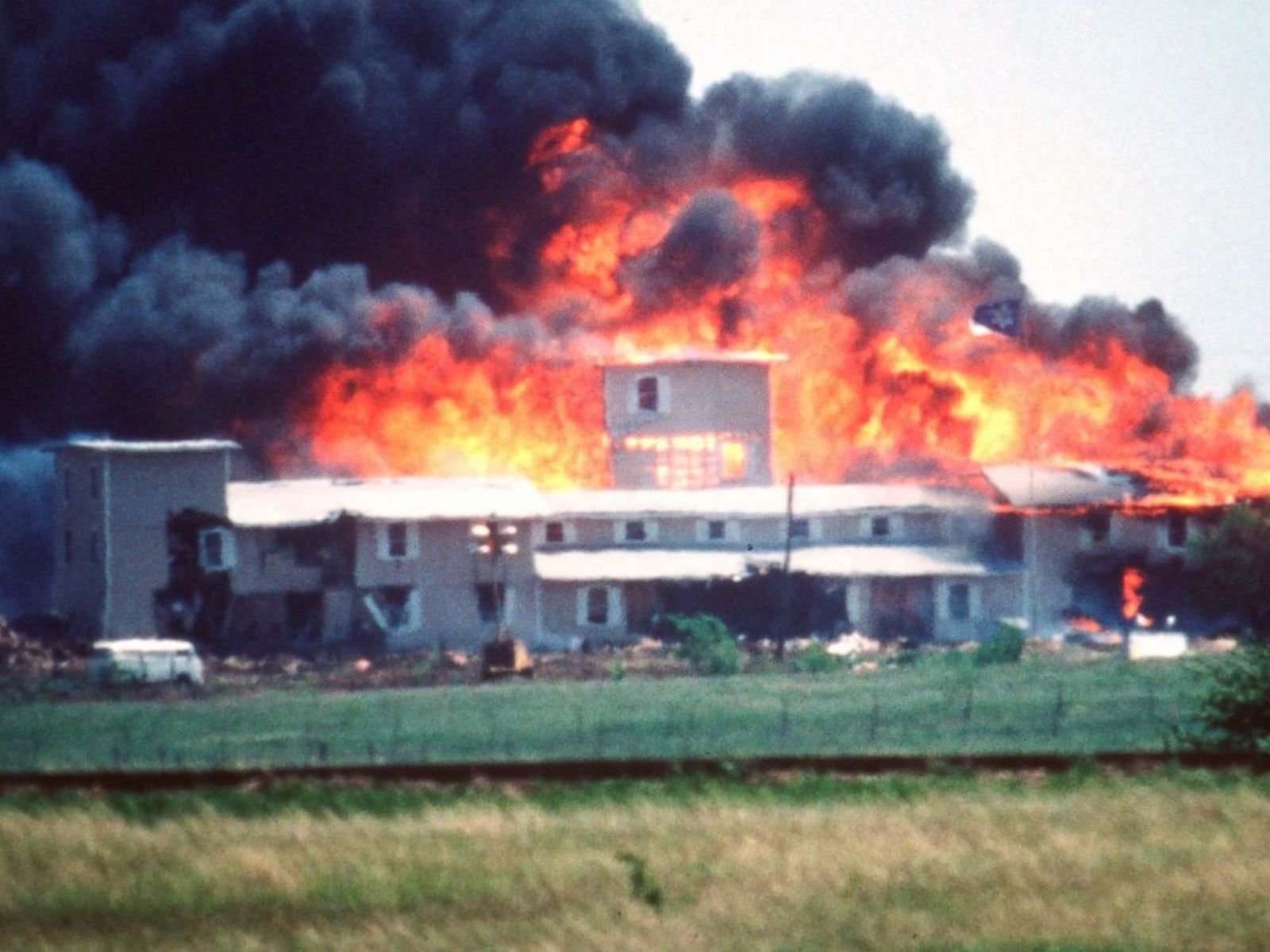
The Branch Davidian compound in Waco, Texas, consumed by flames on April 19, 1993, after a 51-day FBI siege. The fire that killed 76 people, including David Koresh and more than 20 children, was watched on television by Timothy McVeigh, who had visited the site during the siege. The disaster horrified him and drove him to choose exactly the same date for his revenge attack two years later. Source: ABC News.
The second and more powerful catalyst was the Waco siege in 1993. The ATF attempted to raid the compound of a religious sect called the Branch Davidians, led by David Koresh, on suspicion of firearms violations. The initial operation failed catastrophically, leaving four agents and six Davidians dead. What followed was a 51-day FBI siege, broadcast live on television, which ended tragically on April 19, 1993.
A fire whose origin is disputed to this day consumed the compound, killing 76 people, including more than 20 children. McVeigh traveled to Waco during the siege and was appalled by what he saw as a deliberate massacre. The young veteran, already distrustful of the government, watched on television as the flames consumed women and children, and concluded that the government had become the enemy of the American people.
The date of the Oklahoma City bombing was no coincidence: it was chosen to mark the second anniversary of the end of the Waco siege, an act of symbolic revenge against the agencies McVeigh blamed for the carnage.
Oklahoma City Bombing: An Attack on the Heart of America
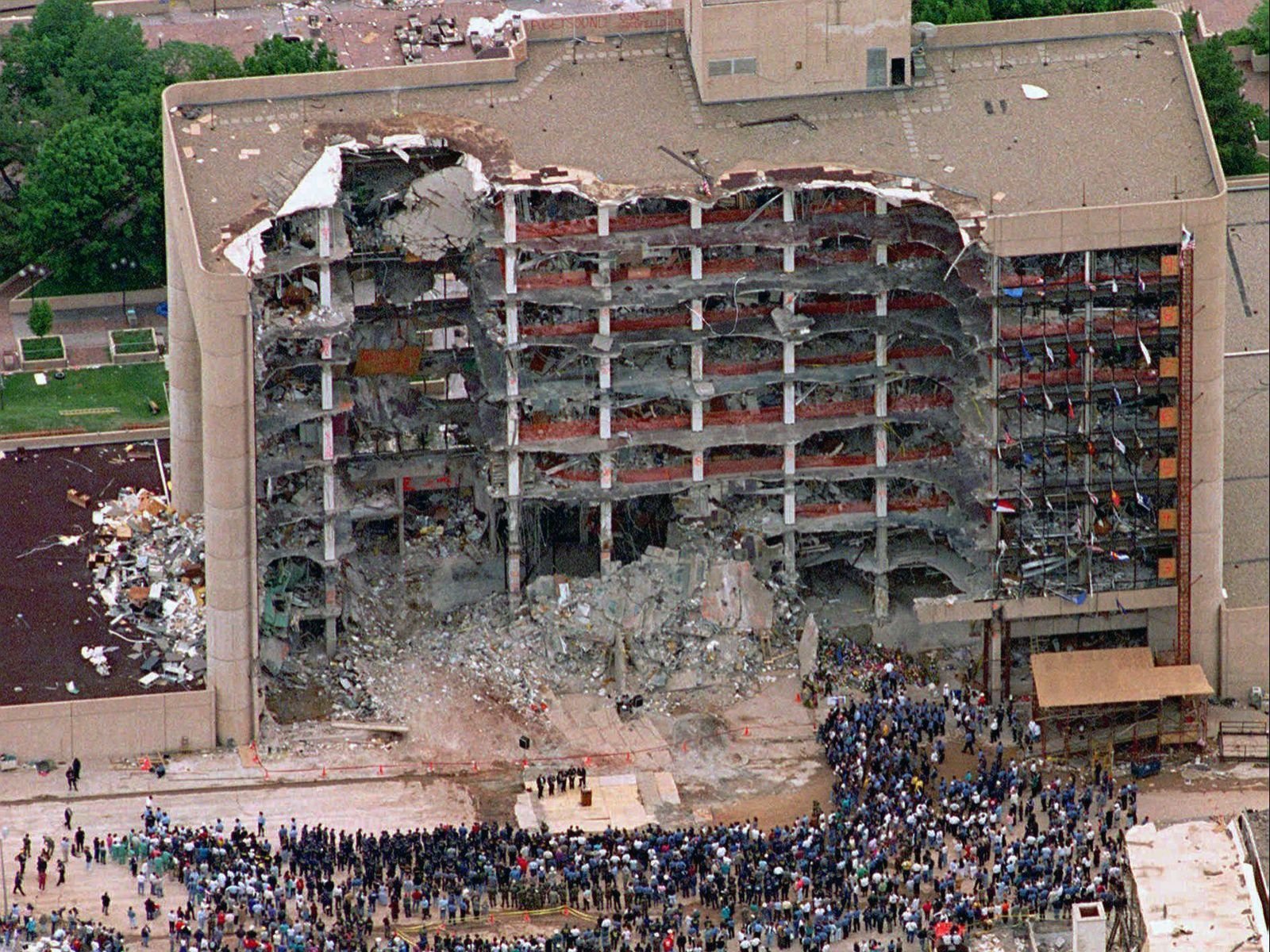
The north facade of the Alfred P. Murrah Federal Building in Oklahoma City, completely destroyed after the truck bomb explosion on April 19, 1995. The image reveals the scale of the devastation caused by Timothy McVeigh’s bomb, which destroyed the north face of the nine-story building housing federal offices and a day care center. Hundreds of people crowd the rubble in rescue operations that lasted for weeks. Source: Britannica.
Driven by a burning desire for revenge against the federal agencies he blamed for Ruby Ridge and Waco, especially the ATF and the FBI, both with offices in the Murrah building, McVeigh planned his attack with military precision. With the help of his accomplices, Terry Nichols and Michael Fortier, veterans like himself, he built a devastating bomb using agricultural fertilizer, diesel fuel and racing fuel. The bomb was hidden in a yellow Ryder truck rented under a false name.
The Moment of Destruction
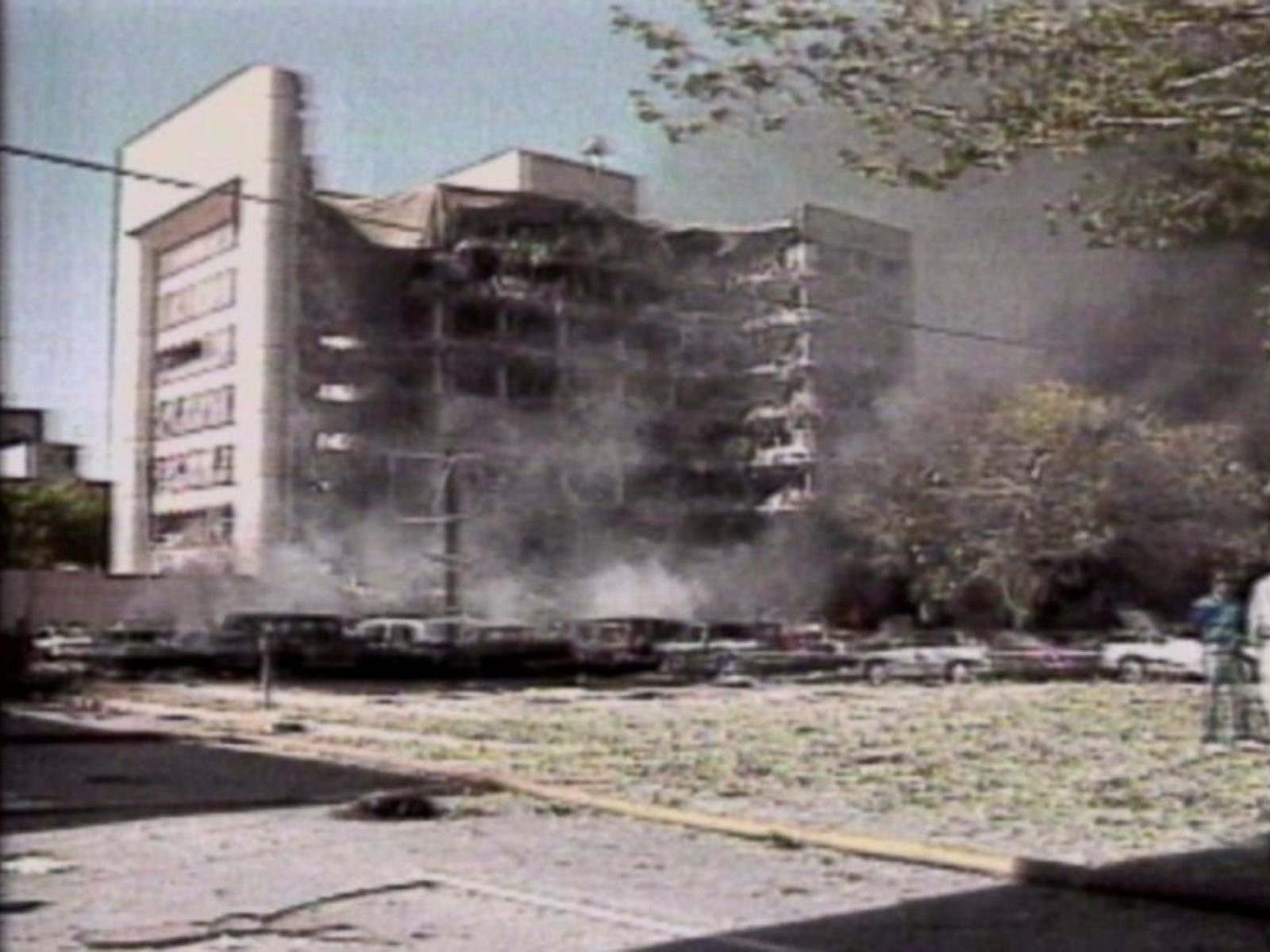
Image captured at the moment of the Murrah Building explosion in Oklahoma City, at 9:02 on the morning of April 19, 1995. The cloud of smoke and debris rises over the city, marking the exact moment Timothy McVeigh carried out the worst act of domestic terrorism in American history, killing 168 people, including 19 children. Source: ABC News.
On the morning of April 19, McVeigh calmly drove through the streets of Oklahoma City, parked the truck in front of the federal building and lit a five-minute fuse. At 9:02 a.m., as hundreds of federal employees began another day of work and children played in the second-floor day care center, the explosion echoed for miles. The sound was so powerful that it registered as a magnitude 3.0 earthquake on the region’s seismographs.
The blast was so devastating that it completely tore off the north facade of the nine-story building. Tons of concrete and steel collapsed, crushing cars in the parking lot and creating a mountain of rubble where a symbol of federal authority had stood. The initial flash, visible for miles, was followed by a cloud of dust and debris that wrapped the city center in an apocalyptic haze.
Rescue and Horror
At the scene, the devastation was absolute. Bleeding survivors staggered out of the rubble, many in shock, unable to grasp what had happened. Rescue teams rushed into the shattered building, facing the constant risk of structural collapse to save lives. For days, firefighters, police officers and volunteers dug through the debris with their bare hands, searching for survivors and, increasingly, for bodies.
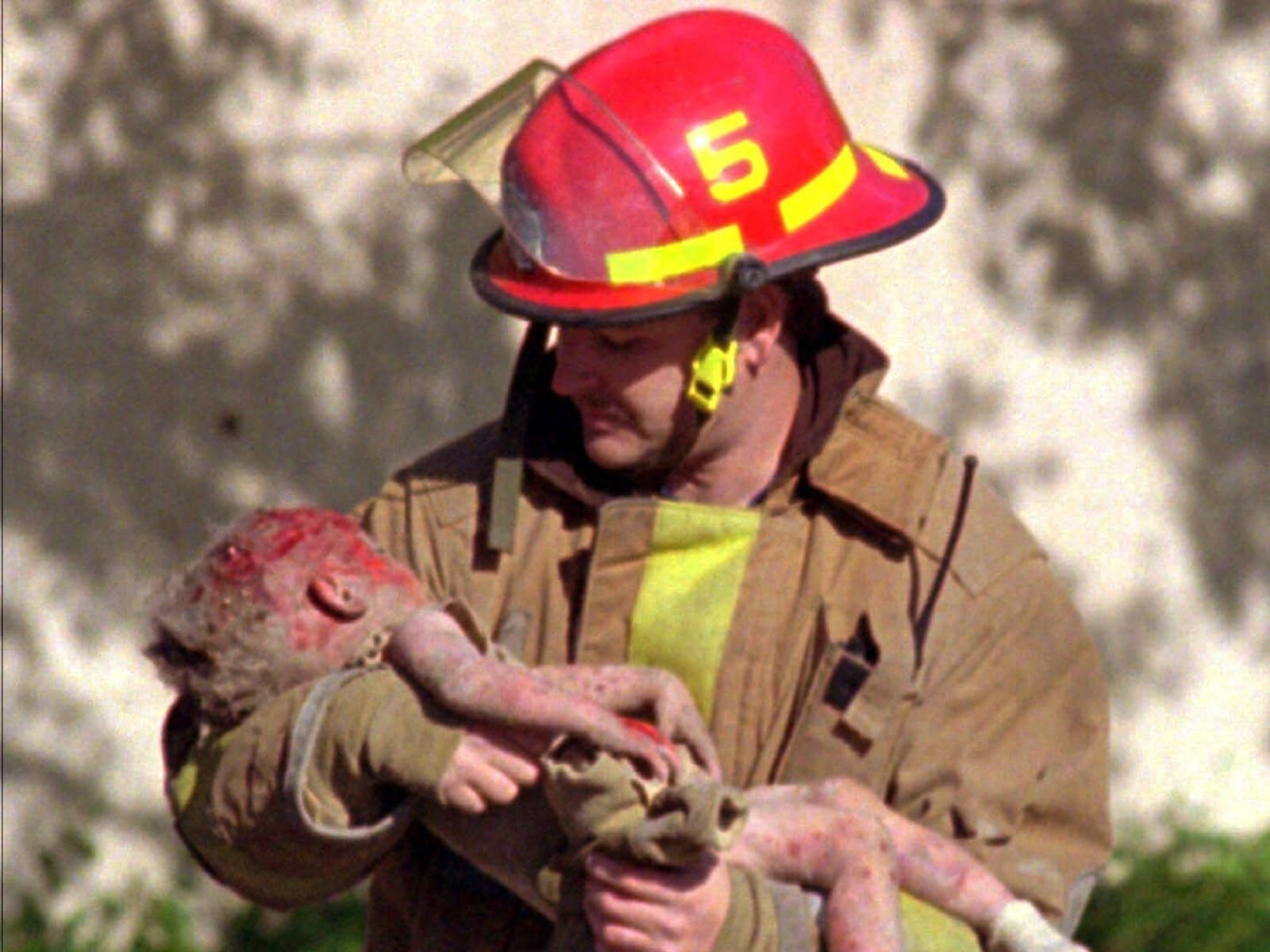
The most iconic image of the tragedy, firefighter Chris Fields holding the lifeless body of one-year-old Baylee Almon, captured the lost innocence and brutality of the attack. The photograph, which traveled around the world, became an indelible symbol of the human suffering caused by extremist hatred. Among the 168 victims were federal employees, visitors and 19 children, 15 of them from the America’s Kids day care center, all killed by a fanatic who believed he was fighting for freedom.
Oklahoma City: The Manhunt, the Trial and Changes in the Law
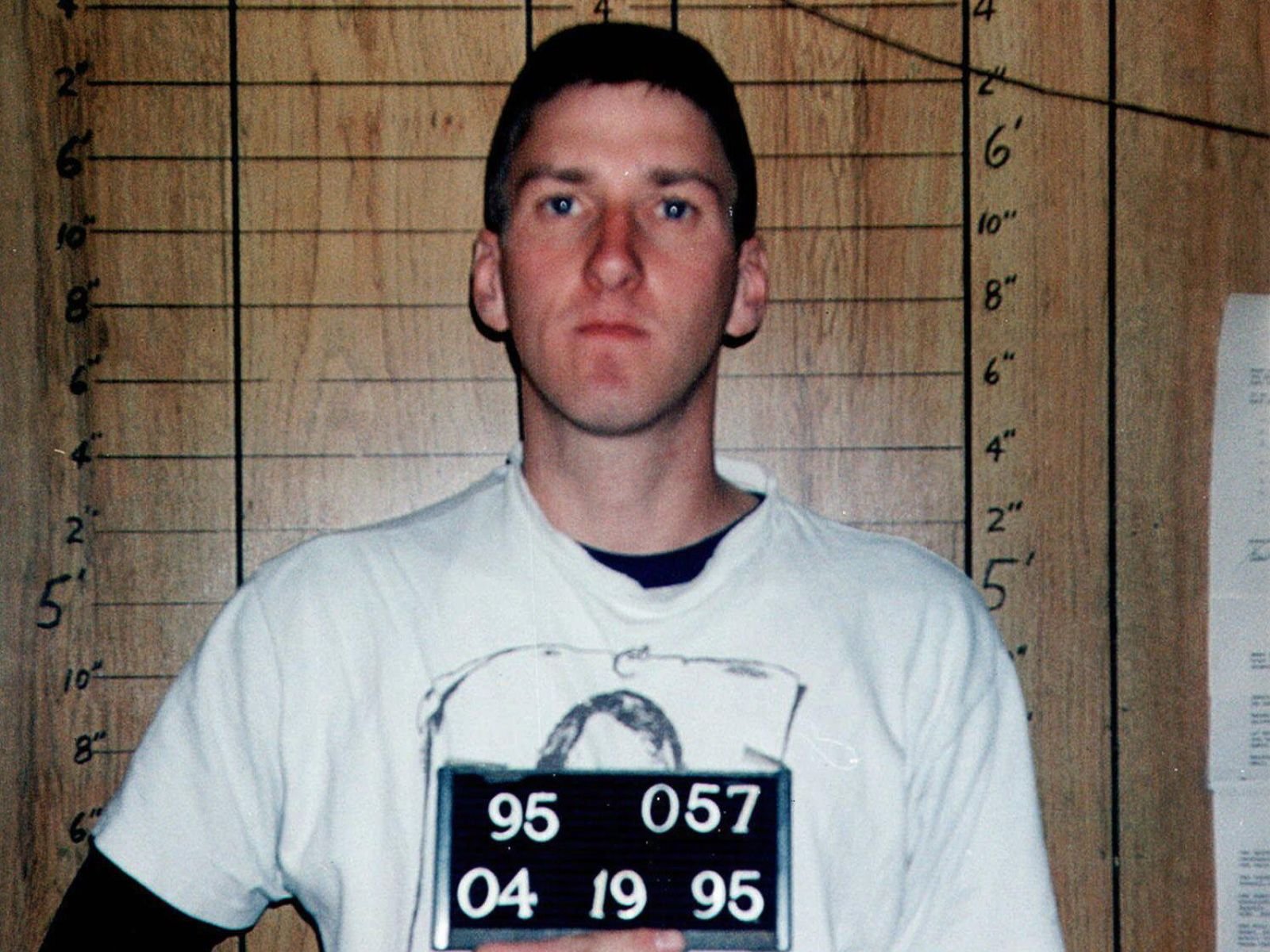
Timothy James McVeigh photographed after his arrest on April 19, 1995, just 90 minutes after the explosion. The 26-year-old Gulf War veteran was pulled over by trooper Charlie Hanger for driving without a license plate, showing no sign of nervousness. McVeigh believed he was fighting as a patriot soldier against a tyrannical federal government. Source: Oklahoma Police Department.
The authorities’ response was swift and efficient. Just 90 minutes after the explosion, McVeigh was pulled over by a state highway patrolman, Charlie Hanger, for driving without a license plate, and arrested for illegally carrying a weapon. The 26-year-old veteran was calmly driving away from the city when he was stopped, showing no sign of nervousness. Only later, when investigators found fragments of the Ryder truck’s rear axle bearing its serial number, was the connection to the bombing established.
The Largest Investigation in FBI History
The investigation that followed was one of the largest in FBI history, involving more than 28,000 interviews and the analysis of tons of evidence. The case, codenamed OKBOMB, led to the convictions of McVeigh and Nichols, while Fortier cooperated with the authorities in exchange for a reduced sentence. McVeigh was executed by lethal injection on June 11, 2001, holding until the end to his conviction that he had acted as a soldier in a war against a tyrannical government.
The Antiterrorism Act of 1996
In direct response to the bombing, the U.S. Congress passed the Antiterrorism and Effective Death Penalty Act (AEDPA) of 1996. This legislation, signed by President Bill Clinton on April 24, 1996, significantly expanded the federal government’s powers to investigate and prosecute terrorism. The law restricted habeas corpus appeals for prisoners, allowed the use of secret evidence in deportation cases, increased penalties for terrorist crimes and made it easier to conduct surveillance of suspected groups.
For the first time with such intensity, the nation’s focus turned to the threat of domestic terrorism. The FBI created specialized units to monitor militias and right-wing extremist groups, expanding its domestic intelligence operations on a scale unseen since the 1960s.
A Forgotten Lesson: From the Domestic Terror of Oklahoma City to 9/11
The lessons of Oklahoma City were only partially learned. While the American government sharpened its tools against domestic terrorism, a new threat, international in origin, was growing in the shadows. The intense focus on far-right groups after 1995 may, ironically, have created a fatal blind spot for the threat posed by Osama bin Laden’s Al-Qaeda and other international terrorist groups.
Intelligence Failures
Reports by the 9/11 Commission revealed critical intelligence failures in the years leading up to the 2001 attacks. Agencies such as the FBI and the CIA did not share information effectively, operating in bureaucratic silos that prevented the detection of emerging threats. The famous “Phoenix Memo”, a July 2001 memorandum by FBI agent Kenneth Williams warning about a suspicious number of Middle Eastern students at American flight schools, was largely ignored by his superiors.
The national security system, which had been reconfigured to hunt domestic militiamen, failed to connect the dots of a global conspiracy that would culminate in the fall of the Twin Towers. The obsession with far-right terrorism, though justified by the events of Oklahoma City, left the country vulnerable to a threat coming from an entirely different direction.
Echoes in the Present: The Continuity of Political Violence
Decades later, the shadow of Oklahoma City still hangs over the United States. Although the threat of large organized militias has diminished, the ideology of anti-government extremism and political violence has not disappeared; it has merely transformed and adapted to the digital age. The rise of “lone wolves” radicalized online and growing political polarization have created new fertile ground for hatred and violence. This tendency is not exclusive to the far right: radicalized far-left groups have also turned to political violence, responsible for some of the most serious episodes of recent years.
The Attempts Against Trump and the Assassination of Charlie Kirk
It is impossible to draw a straight line from McVeigh to recent events, but the thematic parallels are undeniable and disturbing. The attempted assassination of Donald Trump in July 2024 in Butler, Pennsylvania, was investigated by the FBI as potential domestic terrorism, echoing the same concerns that arose after Oklahoma City. Likewise, the assassination of conservative activist Charlie Kirk in September 2025 at Utah Valley University was described by prosecutors as an act of political violence committed by a lone gunman, Tyler Robinson.
In both cases, the authorities treated the attacks as political violence, a sign that the willingness to kill for political reasons has not only persisted but has become normalized in certain circles. Robinson, a 22-year-old raised in a Republican family, acted as a sniper, a dark echo of the marksman at Ruby Ridge: tactics and targets evolve, but the fundamental logic of political violence remains unchanged.
The Normalization of Violence
These recent events show that the wound opened by Oklahoma City never fully healed. The belief that violence is a legitimate tool for settling political disputes, once relegated to the fringes of society, has become dangerously normalized across broad sectors of the American population. Timothy McVeigh’s legacy is not only the destroyed building and the 168 lives lost, but the poisonous idea that political rage justifies mass murder. Sadly, that idea continues to haunt American democracy.
A Memory That Cannot Be Forgotten
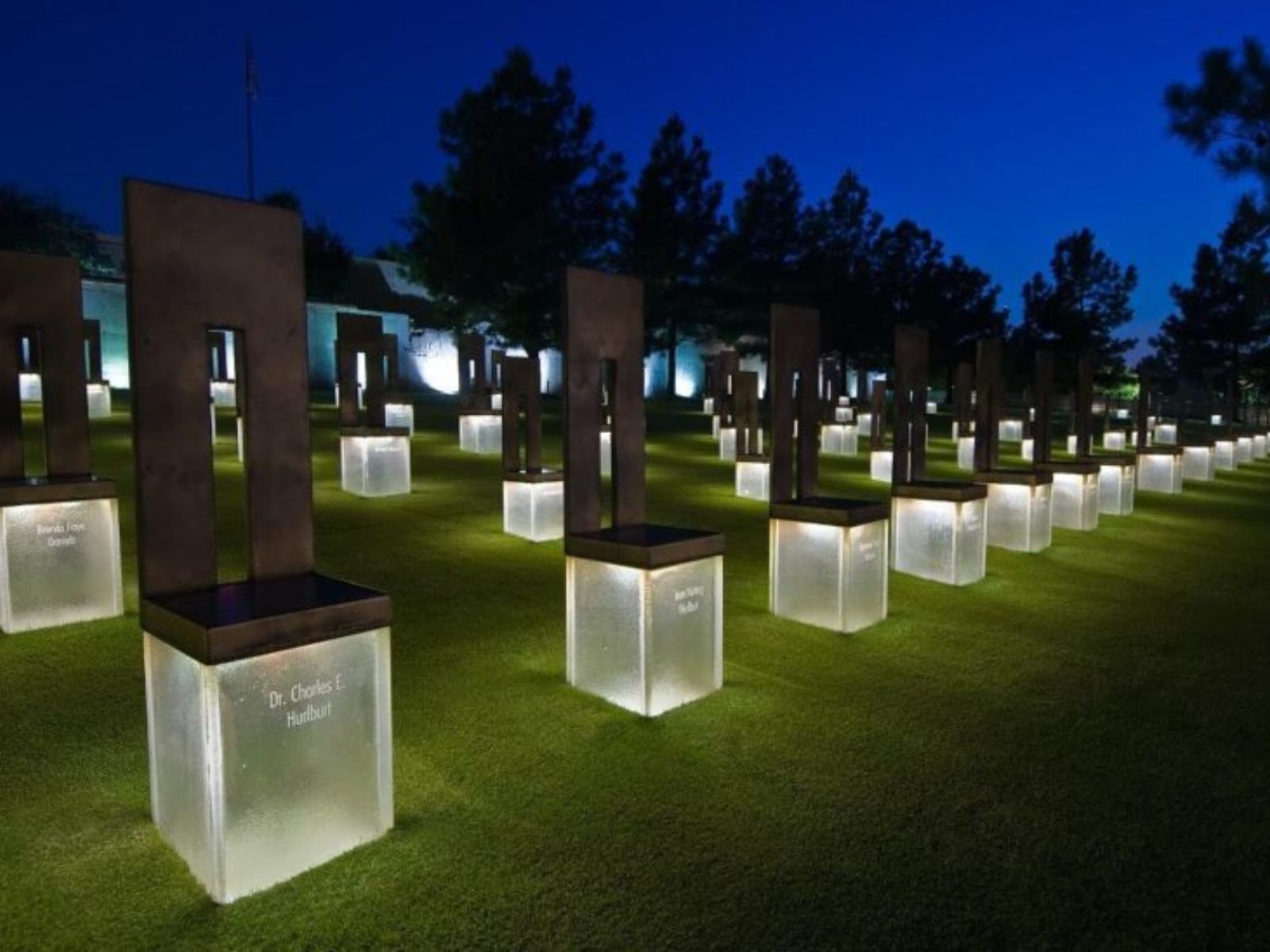
The Oklahoma City National Memorial, where 168 empty chairs of bronze and stone represent each life lost in the April 19, 1995 bombing. The 19 smaller chairs symbolize the children killed, arranged in nine rows corresponding to the floors of the destroyed building. Each chair bears a victim’s name engraved on its base, creating a silent sanctuary that serves as a perpetual reminder of the human cost of extremist hatred and normalized political violence. Source: The Journal Record.
The Oklahoma City bombing was a brutal awakening for the United States. It revealed that the nation’s greatest enemy could, at times, be itself. The attack forced the country to confront the darkness lurking beneath the surface of its own society, a darkness fed by disinformation, paranoia and a distorted interpretation of patriotism.
The Memorial
Today, the site of the Murrah Building is a solemn and powerful memorial. One hundred and sixty-eight empty chairs, one for each life lost, stand in silent rows, a perpetual reminder of the human cost of extremist hatred. Each chair bears the name of a victim, and the 19 smaller chairs represent the children killed, an image that pierces the heart of every visitor.
The story of Oklahoma City is more than the record of a heinous crime; it is a perpetual and urgent warning. A warning that when dialogue fails, when trust in institutions erodes and when violence is seen as a solution, the result is a tragedy that scars a nation forever.
Read Also
Bibliographic References
- “Oklahoma City Bombing.” Federal Bureau of Investigation (FBI). https://www.fbi.gov/history/famous-cases/oklahoma-city-bombing.
- “How Ruby Ridge and Waco Led to the Oklahoma City Bombing.” History. https://www.history.com/articles/how-ruby-ridge-and-waco-led-to-the-oklahoma-city-bombing.
- “Oklahoma City Bombing.” Wikipedia, The Free Encyclopedia, 2024. https://en.wikipedia.org/wiki/Oklahoma_City_bombing.
- “S.735 — Antiterrorism and Effective Death Penalty Act of 1996.” Congress.gov (U.S. Congress), 1996. https://www.congress.gov/bill/104th-congress/senate-bill/735.
- The 9/11 Commission Report. National Commission on Terrorist Attacks Upon the United States, 2004. https://9-11commission.gov/report/.
- “Update on the FBI Investigation of the Attempted Assassination of Former President Donald Trump.” Federal Bureau of Investigation (FBI), 2024. https://www.fbi.gov/news/press-releases/update-on-the-fbi-investigation-of-the-attempted-assassination-of-former-president-donald-trump.