The Spanish Civil War (1936-1939) was a bloody military uprising by the Nationalists against the Republican government of Spain, backed by conservative elements within the country. The conflict, which lasted almost three years, was far more than an internal war: it was the first great armed clash between opposing ideological blocs in the twentieth century, and served as a testing ground for the powers that would soon face each other in the Second World War. The scale and the implications of this conflict were widely underestimated at the time, when more forceful intervention by the Western democracies could have significantly altered the course of European history.
Origins of the Conflict: The Polarisation of the Second Republic
On 18 July 1936, following a declaration of opposition to the elected left-wing government of the Spanish Second Republic, then led by President Manuel Azaña with the socialist Largo Caballero as prime minister, the conflict began that would come to be seen as a preview of the Second World War. Spain was deeply divided between progressive forces that defended social reform, the separation of Church and State and land redistribution, and conservative sectors that saw those changes as a threat to the traditional order.
The Nationalist side, supported by conservatives, monarchists, fascists and the conservative wing of the Catholic Church, was initially led by José Sanjurjo, a veteran officer who had taken part in earlier coup attempts. Sanjurjo was killed in a plane crash while trying to return from his exile in Portugal and was replaced by General Francisco Franco, then 43 and commander of the troops in Spanish Morocco. Fighting broke out across Spanish territory, from the protectorate of Morocco to the hills of Navarre in the north, fragmenting the nation both militarily and politically.
The Ideological Conflict Between Nationalists and Republicans
Major cities such as Barcelona, Bilbao, Madrid, Málaga and Valencia resisted the initial coup and remained under Republican control, becoming centres of resistance. The geography of the conflict revealed the deep divisions in Spanish society: the industrial north and Catalonia stayed Republican, while the rural, conservative regions of the interior backed the Nationalists.
The Nationalists received substantial support from Nazi Germany and Fascist Italy, which saw in Spain an opportunity to test their new military doctrines and extend their influence. The German Condor Legion, with its modern Junkers and Heinkel aircraft, and the Italian Corpo Truppe Volontarie supplied equipment and also combat experience that would prove crucial in the Second World War. The Republicans received aid from the Soviet Union and from the International Brigades, made up mainly of volunteers of various political persuasions from Europe and the United States.
Other countries, such as the United Kingdom and France, chose an official policy of non-intervention, a decision that would prove problematic for the balance of power in Europe. That neutrality, driven by the wish to avoid a wider European war, in practice favoured the Nationalists, who received massive military support from their allied powers. The Nationalists, with broad military backing, above all from powerful Germany and its Condor Legion, advanced systematically against a Republican resistance made up of militias with inferior weapons and inadequate military training.
The Nationalist Offensive on Madrid: The First Great Confrontation
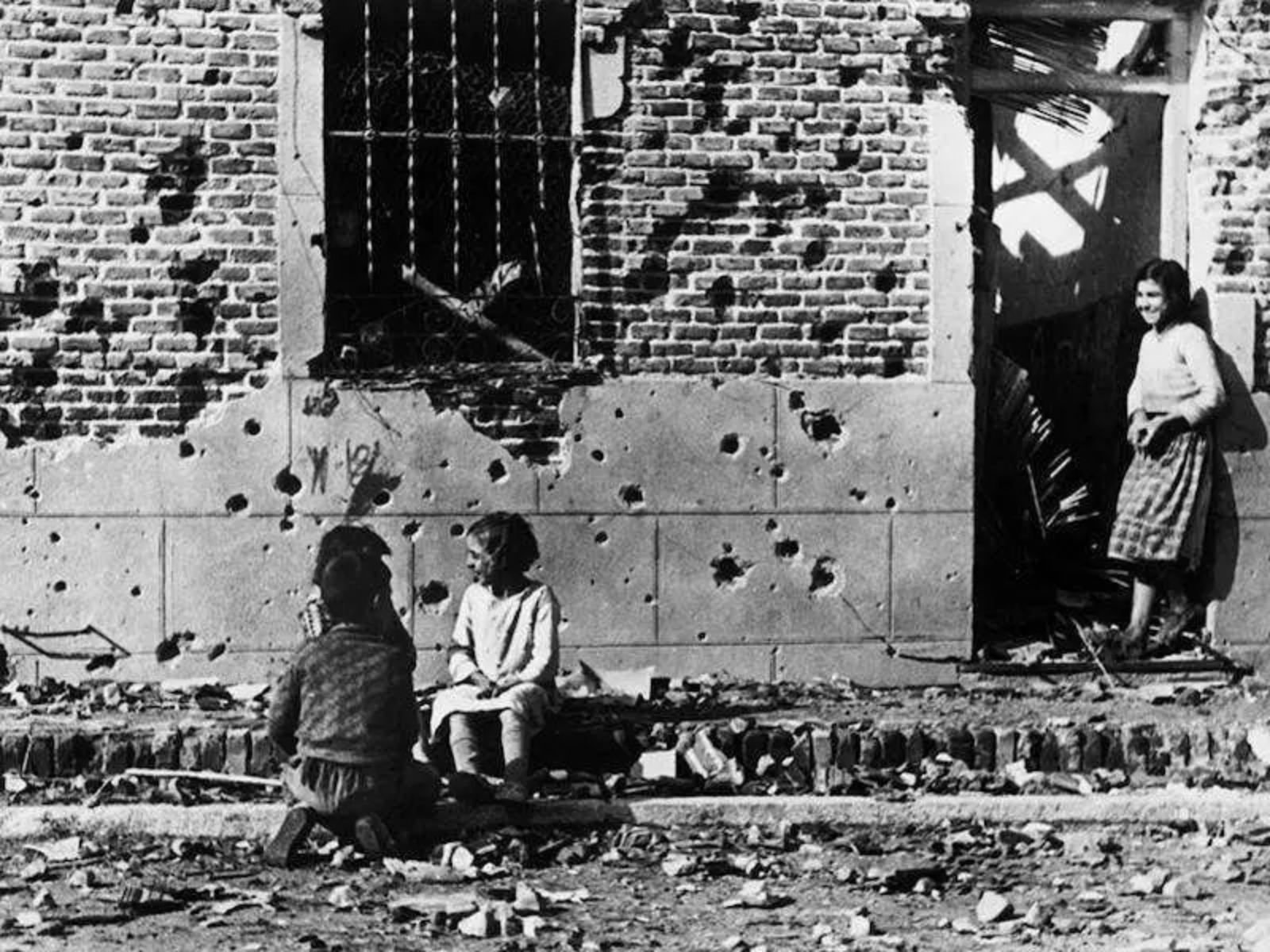
The Nationalist offensive on Madrid, between November 1936 and February 1937, was one of the bloodiest battles of the Spanish Civil War. During that period, Hitler’s Nazi Germany and Mussolini’s Fascist Italy backed the Nationalists, while Stalin’s Soviet Union supported the Popular Front government.
The Nationalist offensive on Madrid, between November 1936 and February 1937, was one of the bloodiest battles of the Spanish Civil War. During that period, Hitler’s Nazi Germany and Mussolini’s Fascist Italy gave massive backing to the Nationalists, while Stalin’s Soviet Union offered limited support to the Republican government. Madrid’s resistance stretched on for months, symbolised in the slogan “No Pasarán” (They Shall Not Pass).
The siege of Madrid revealed the international nature of the conflict. While German aircraft systematically bombed the Spanish capital, the International Brigades arrived to reinforce the Republican defence. The urban battle was marked by house-to-house fighting, with the University City turned into a devastated battlefield. The Republican government, under constant military pressure, was forced to withdraw to Valencia in November 1936, when the capital became untenable because of the heavy bombing and the Nationalist siege.
The Battle of the Alcázar of Toledo: A Symbol of Resistance
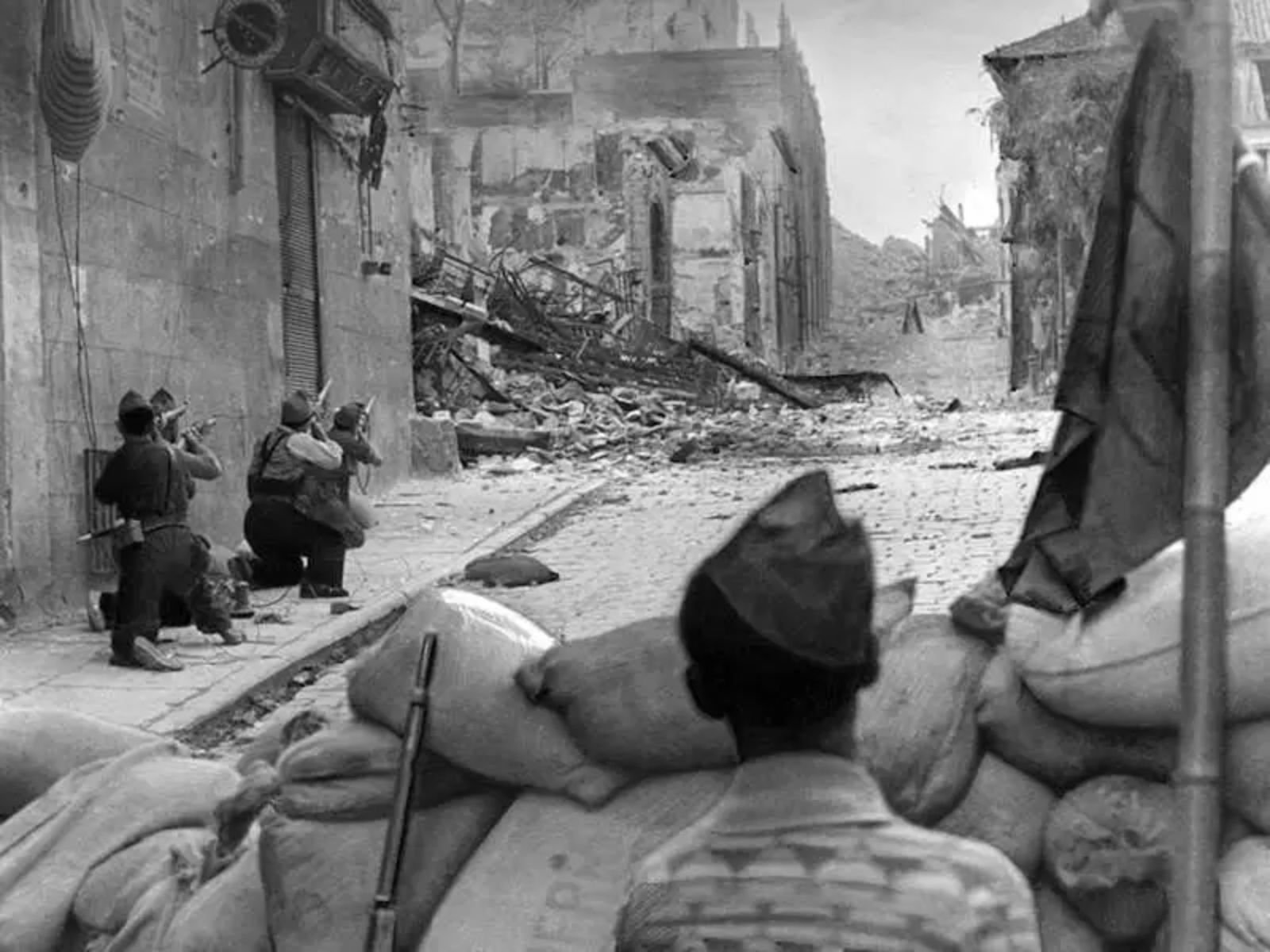
Republican soldiers during the battle for the Alcázar of Toledo, a fortified palace on rock at the highest point of Toledo, Spain, where the rebels had taken shelter, in July 1936. Photo: STF / AFP / Getty Images.
The battle for the Alcázar of Toledo, fought in July 1936, became one of the most emblematic episodes of the first months of the war. The fortified palace, set on rock at the highest point of Toledo, was held by a Nationalist garrison that withstood a long Republican siege. The medieval fortress, with its thick walls and strategic position, offered significant defensive advantages to those inside.
The siege lasted more than two months, with Republican forces trying various tactics to dislodge the defenders, including the use of underground mines to destroy the building’s foundations. The resistance of the Alcázar was heavily exploited by Nationalist propaganda as a symbol of the determination and heroism of its forces. The eventual relief of the garrison by Franco’s troops in September 1936 marked an important symbolic victory for the Nationalists and demonstrated the staying power of well-fortified positions.
“The Falling Soldier”: The Photographic Symbol of the War
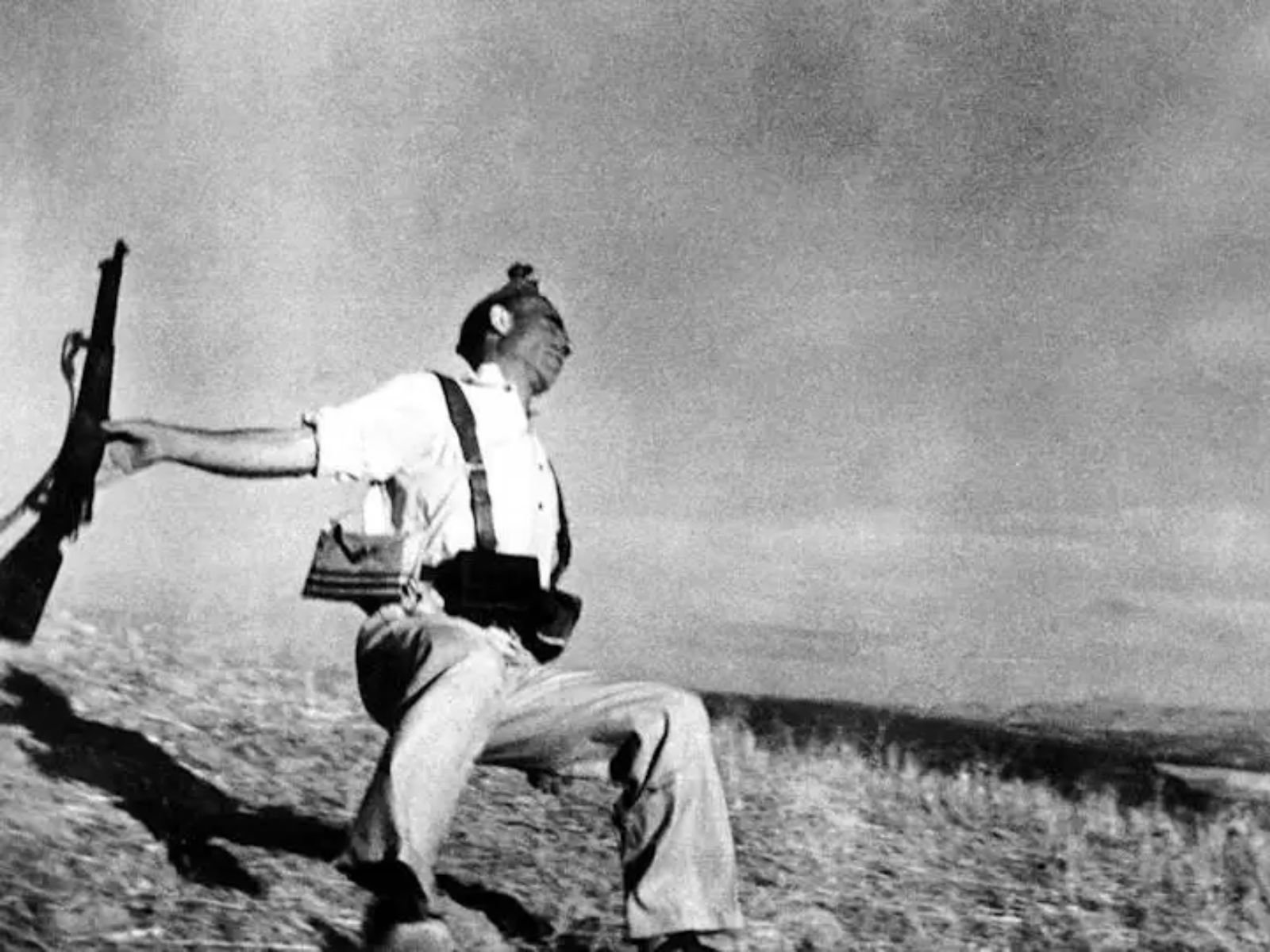
“The Falling Soldier”, the most iconic photograph of the Spanish Civil War. By Robert Capa.
One of the best known and most controversial images of the Spanish Civil War is the photograph titled “The Falling Soldier“, taken by the Hungarian photographer Robert Capa on 5 September 1936. The image shows the Republican militiaman Federico Borrell García at the moment he is supposedly hit fatally during fighting at Cerro Muriano, on the Córdoba front. The photograph became a widely recognised symbol of the brutality of modern war.
The picture of the falling militiaman became famous immediately after its publication in the French magazine “Vu” and later in the American “Life”, establishing Capa as one of the most important war photographers of the twentieth century. The authenticity of the image, however, has been the subject of intense debate among photography specialists and historians.
Some researchers found inconsistencies in the official account: Borrell García’s own comrades reported that he was killed while hiding behind a tree, not in open ground as the image suggests. Later analysis also indicated that the photograph may have been taken in the town of Espejo, some 60 kilometres from Cerro Muriano. Whatever its authenticity, the image captured significant aspects of the conflict and became a lasting icon in the iconography of war.
Robert Capa
Robert Capa, born Endre Ernő Friedmann in Budapest in 1913, had arrived in Spain at the age of 23 as a young photojournalist seeking recognition. Together with his companion Gerda Taro, also a photographer, Capa documented the first months of the Spanish Civil War intensively. His revolutionary approach to war photojournalism, based on the principle that “if your pictures aren’t good enough, you’re not close enough”, led him to capture images of extraordinary closeness and emotional force.
Marina Ginesta: The Young Face of the Revolution
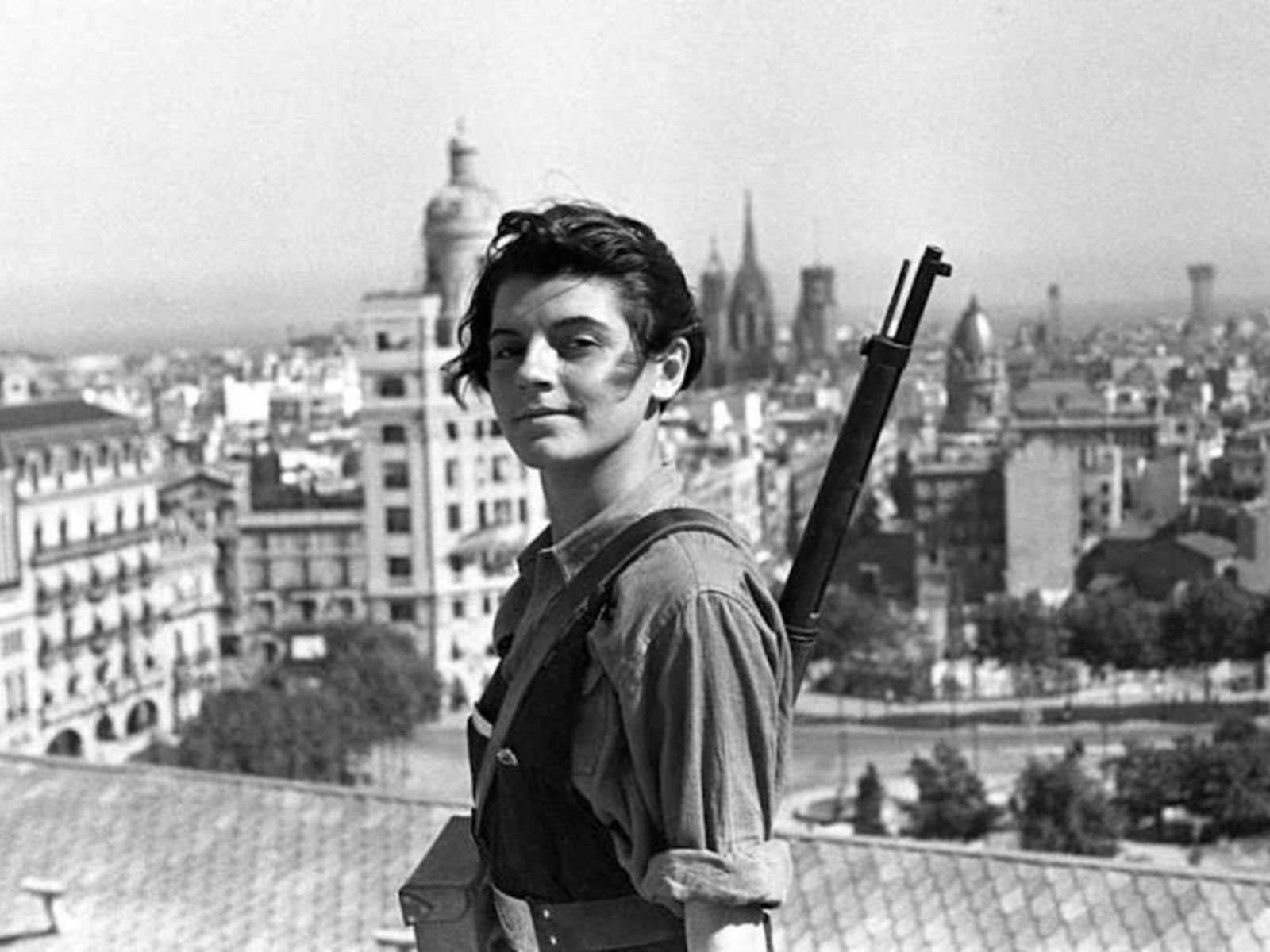
Marina Ginesta, then 17, looks at the camera with a rifle over her shoulder on the roof of the Hotel Colón in Barcelona, on 21 July 1936.
Marina Ginesta became one of the most emblematic figures of the Spanish Civil War through a single photograph. Taken by the German photographer Hans Gutmann (known in Spain as Juan Guzmán) on 21 July 1936, the image shows the young woman, only 17, on top of the old Hotel Colón in Barcelona, a rifle over her shoulder, looking straight at the camera with an expression that came to stand for the participation of the young in the conflict.
Marina Ginesta was born in Toulouse on 29 January 1919, into a politically active working-class family. During the conflict, the Hotel Colón had become the headquarters of the Unified Socialist Party of Catalonia (PSUC), which covered the façade with posters of Lenin and Stalin. According to Ginesta herself, the rifle was handed to her only for the photo session, since “at 17, I was in no condition to fight in the war”. Before the famous photograph, Marina had worked as a journalist and translator for the newspaper Pravda.
After the Republican defeat, Marina moved to France, where the Nazi occupation forced her into exile in Mexico. After the Second World War she settled in Paris, where she died in 2014 at the age of 94. The photograph remained forgotten in the archives of the EFE news agency until 2002, when it was rediscovered by Julio García Bilbao, an agency employee who researched the history of the image. The photo went on to become a book cover and was used in exhibitions in Germany, turning into a widely reproduced historical document.
Ernest Hemingway: The Writer on the Front Line
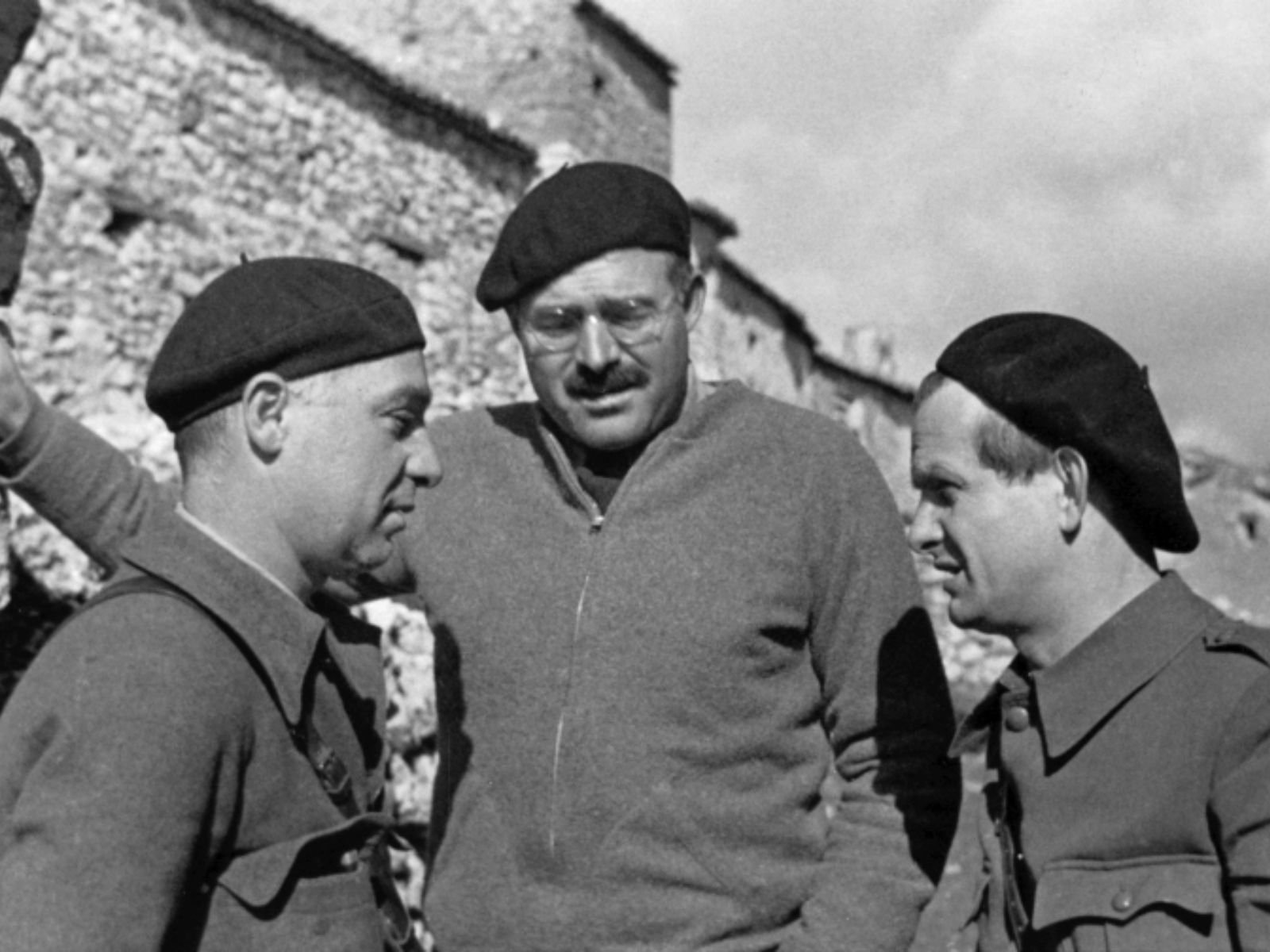
Ernest Hemingway with Ilya Ehrenburg (Soviet writer and journalist, left) and Gustav Regler (German writer and political commissar of the International Brigades, right) during the Spanish Civil War, circa 1937. Hemingway is in the centre wearing a sweater and beret. Source: Hemingway Photograph Collection, John F. Kennedy Presidential Library and Museum, Boston.
The Spanish Civil War drew combatants and also some of the most important writers and intellectuals of the age. Among them, Ernest Hemingway held a singular position, serving at once as a war correspondent and as a participant observer of events. In February 1937, despite the reluctance of his wife Pauline, Hemingway signed a contract with the North American Newspaper Alliance to cover the conflict, leaving New York on 27 February.
During his four trips to Spain between 1937 and 1938, Hemingway produced thirty dispatches informing the American public about the course of the war. His reports described in detail the bombing of Madrid, the plight of refugees and the dynamics of the fighting. In April 1937 he wrote: “It was a lovely false spring day when we started for the front this morning”, capturing the irony of a war unfolding in the middle of the Spanish landscape.
Hemingway’s coverage of the Spanish Civil War fundamentally changed the way war journalism was practised. By covering the war from the front lines, he brought a human and visceral perspective to the conflict, away from the distant, sanitised reporting common at the time.
For Whom the Bell Tolls
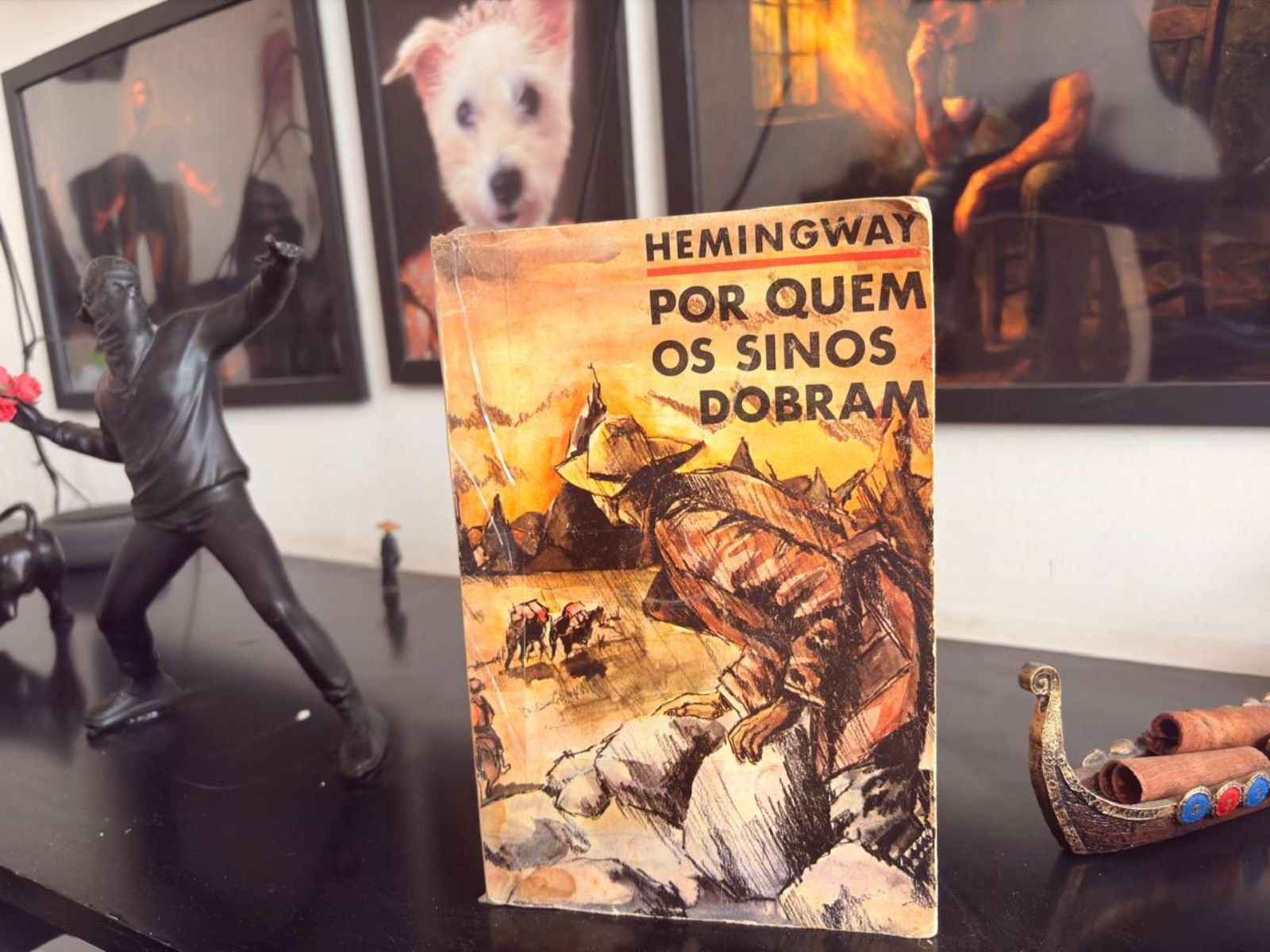
For Whom the Bell Tolls – Ernest Hemingway
The Spanish experience deeply influenced Hemingway’s work. The conflict inspired his novel “For Whom the Bell Tolls” (1940), considered one of the best known accounts of the Spanish Civil War. The book, centred on the story of the American brigade member Robert Jordan, explored the dilemmas of war and the complexity of political divisions within the Republican camp. Hemingway identified the Puente de la Cantina as the real bridge that inspired the fictional bridge in his novel, showing how reality and fiction intertwined in his writing.
Guernica: Picasso’s Masterpiece
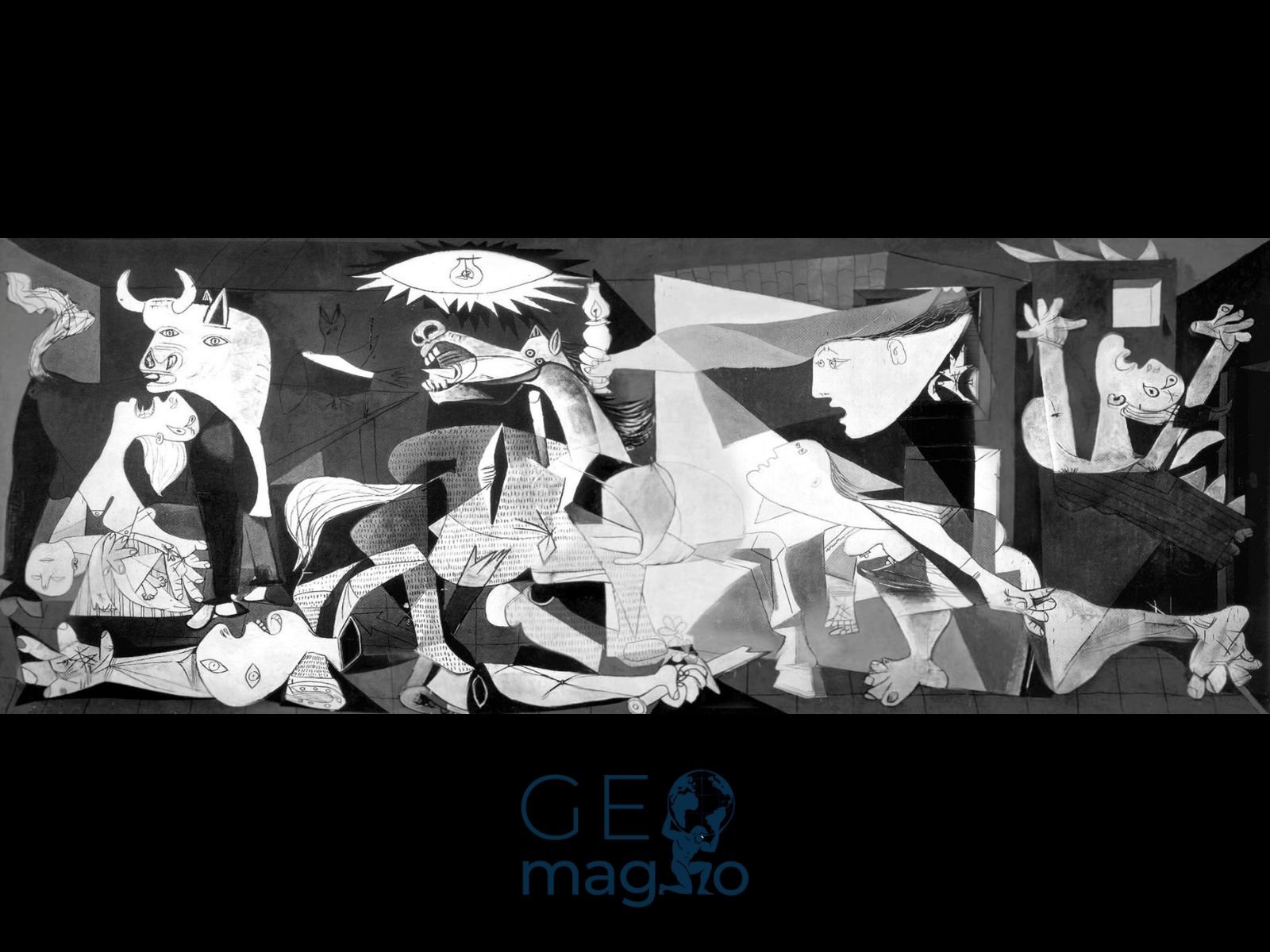
Pablo Picasso’s masterpiece “Guernica” (1937), oil on canvas, 3.49 m × 7.76 m, now in the Reina Sofía Museum in Madrid. The monumental work in black, white and grey depicts the bombing of the Basque town of Guernica on 26 April 1937.
On 26 April 1937, the Basque town of Guernica, in northern Spain, was devastated by an air raid carried out by the German Nazi Condor Legion and the Italian Fascist Aviazione Legionaria, at the request of Francisco Franco’s Nationalist forces. That attack was one of the first saturation bombings of a civilian population in modern history.
The bombing of Guernica was a devastating practice of indiscriminate bombing by the Nazis, who used the town as a testing ground for their air warfare tactics. The attack lasted around three hours and destroyed much of the town, causing hundreds of civilian deaths. Pablo Picasso painted Guernica at his home in Paris as an immediate reaction to the bombing of 26 April 1937. The work was created with remarkable speed, completed in little over a month, and was first shown at the 1937 Paris International Exposition.
Impact and Meaning
Guernica is undoubtedly Picasso’s most powerful political statement, painted as an immediate reaction to the devastating practice of indiscriminate bombing by the Nazis. The painting became the symbol of the bombings during the Spanish war and a condemnation of Franco’s dictatorial oppression. The work transcended its specific historical context to become a universal symbol against war and violence. In 1937, when it was shown to millions of visitors at the Paris World’s Fair, Guernica was already established as one of the most important works of art of the twentieth century.
The Fate of the Work
After the Paris Exposition, Guernica travelled the world on a fundraising tour for refugees of the Spanish Civil War. Picasso declared that the painting should not return to Spain until democracy was restored in the country. The work remained at the Museum of Modern Art (MoMA) in New York for decades, finally returning to Spain in 1981, after Franco’s death and the restoration of democracy. Guernica is now permanently displayed at the Museo Nacional Centro de Arte Reina Sofía in Madrid.
The Brazilian Position: Internal Divisions
The government of Getúlio Vargas officially adopted a position of neutrality during the Spanish Civil War, maintaining diplomatic relations with the government of the Second Republic. Large sections of the Brazilian political elite, however, showed sympathy for the Nationalist rebels. Following an ambiguous policy, Vargas dissuaded his foreign minister, José Carlos de Macedo Soares, from breaking relations with the Republic, while at the same time allowing the discreet shipment of coffee to areas under Nationalist control.
General Franco expressed gratitude for that assistance and promised to keep the collaboration secret. Brazilian diplomacy in Spain was directly affected by the conflict: Alcebíades Peçanha, Brazil’s ambassador in Madrid, was wounded in an attack and had his private art collection confiscated by Republican groups. At least two Brazilian consular officials were involved in espionage activities on behalf of the military rebels. The precarious situation of the civilian population in Barcelona led Carlos da Silveira Martins Ramos, Brazil’s chargé d’affaires in the city, to use his own resources to help dozens of Spanish children.
The Spanish Civil War also affected Brazilian society. Since the late nineteenth century, Brazil had received a large number of Spanish immigrants. Part of that Spanish community, already divided by regional tensions, now found itself divided by political positions relating to the conflict in Spain. Motivated by different ideologies, 39 Brazilians volunteered to serve in the International Brigades. Most came from the army and had taken part in the failed communist revolt of 1935. Artists and intellectuals such as Carlos Drummond de Andrade and Manuel Bandeira used their work to express positions on the conflict, while the Catholic Church and the Brazilian Integralist Action expressed sympathy for the Nationalists.
International Brigades: Volunteers from Around the World
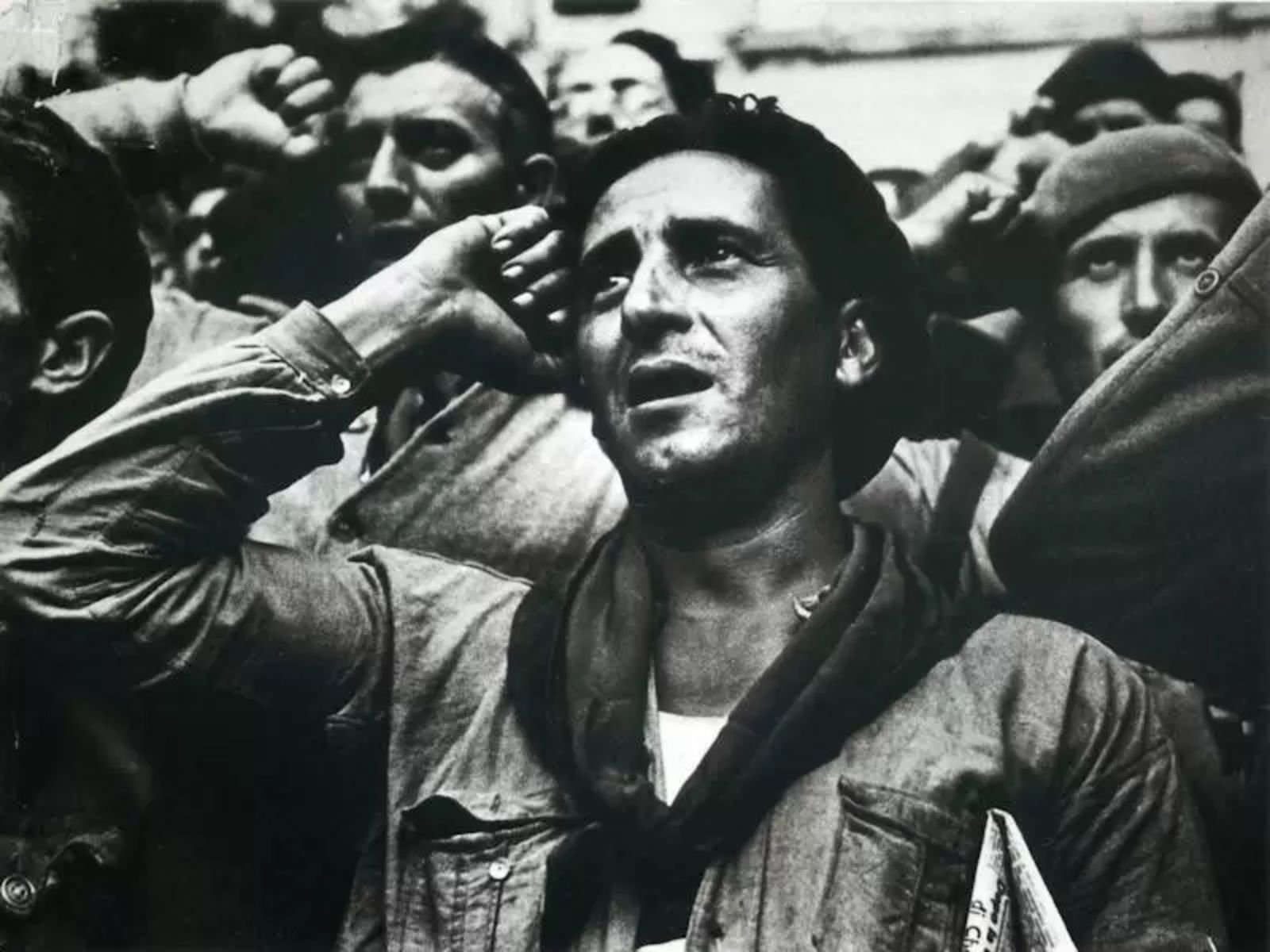
“Salud, hermanos!” (“Health, brothers!”). During a speech in Montblanc, Catalonia, in October 1938, Prime Minister Juan Negrín thanked the fighters of the International Brigades for their services to the Republican cause during the Spanish Civil War (1936-1939). At that point in the conflict, the Nationalists already controlled much of Spanish territory and many Republicans fled seeking refuge in France and other countries. Photo by Robert Capa.
The International Brigades were a significant phenomenon in modern military history: volunteers from more than 50 countries who left their lives behind to take part in the Spanish conflict. Organised by the Communist International, but including fighters of various political persuasions, the Brigades drew some 35,000 volunteers, among them intellectuals, workers, students and veterans of the First World War.
During a speech in Montblanc, Catalonia, in October 1938, Prime Minister Juan Negrín thanked the fighters of the International Brigades for their services to the Republican government. At that point in the conflict, the Nationalists already controlled much of Spanish territory and many Republicans had sought refuge in France and other countries. The withdrawal of the International Brigades, ordered by the Republican government in the hope of obtaining a reciprocal withdrawal of German and Italian troops, marked a decisive phase of the conflict.
Among the volunteers of the International Brigades were figures who would become well known later, such as the writer George Orwell, who served in the POUM (Workers’ Party of Marxist Unification) and documented his experience in “Homage to Catalonia”. The ideological diversity within the Republican forces themselves led to internal conflicts, particularly between orthodox communists and dissident Marxist groups, reflecting the wider political tensions of the period.
The Battle of the Ebro: The Decisive Confrontation
The Battle of the Ebro, fought in Catalonia between July and November 1938, was the bloodiest and most decisive engagement of the entire conflict. This Republican offensive, conceived as an attempt to reverse the course of the war, mobilised the last significant resources of the Republic in an effort to reconnect Catalonia with the rest of Republican territory. For four months, more than 100,000 combatants from both sides faced each other in extreme conditions.
The battle was marked by intensive use of artillery and aircraft, with the German Condor Legion playing a crucial role in supporting the Nationalists. Republican losses were substantial: around 30,000 casualties, including many experienced officers and soldiers. The defeat at the Ebro determined the final outcome of the conflict and sealed the fate of the Spanish Second Republic. Thousands of Spaniards were forced into exile, many seeking refuge in camps in southern France, where they would face precarious conditions.
Nationalist Victory and the Establishment of Francisco Franco’s Dictatorship
With the fall of Catalonia in January 1939 and the occupation of Barcelona, Republican resistance finally collapsed. On 1 April 1939, Franco officially declared the end of the war with a Nationalist victory. A military dictatorship was established under General Francisco Franco, who would govern Spain for the next 36 years, until his death on 20 November 1975.
In the aftermath of the war, all right-wing parties were absorbed into the structure of the dictatorial regime, creating an authoritarian state that combined Catholic, fascist and traditionalist elements. Repression was systematic: it is estimated that between 100,000 and 200,000 people were executed or died in prison in the early years of the Franco regime. Spain isolated itself from democratic Europe for decades, remaining on the margins of the main European political developments until the transition to democracy after Franco’s death.
The Underestimated War: A Military Laboratory Ignored by the Democracies
The Spanish Civil War was widely underestimated in its strategic importance by the democratic powers of the time, a misjudgement with significant consequences. The American ambassador to Spain, Claude Bowers, described the conflict as the “dress rehearsal” for the Second World War, but his analysis was ignored by policymakers in Washington, London and Paris.
The Spanish conflict gave Nazi Germany and Fascist Italy a valuable opportunity to test new military doctrines, equipment and tactics that would later be used in the Second World War. The German Condor Legion experimented with mass bombing techniques, coordination between aircraft and ground forces, and psychological warfare. The bombing of Guernica on 26 April 1937, which completely destroyed the Basque town and caused hundreds of civilian casualties, was the first massive air attack on a civilian population in modern history.
More substantial intervention by the Western democracies against the expansion of the totalitarian powers in Spain could have altered European strategic calculations. Had France and the United Kingdom provided significant military support to the Spanish Republic, the Axis powers might have reconsidered their later expansionist ambitions. A Republican victory would have created a different geopolitical configuration in south-western Europe, complicating German plans for the Second World War.
Historical Legacy: Long-Term Consequences of the Spanish Civil War
The policy of “non-intervention” adopted by the Western democracies proved a problematic strategy that indirectly favoured the totalitarian powers. While Germany and Italy supplied substantial military support to the Nationalists, France and the United Kingdom maintained an arms embargo that mainly harmed the Republic, which depended on imports to equip its forces. That selective neutrality showed how difficult it was for the democracies to assess properly the nature of the conflict and its implications for European security.
The Spanish Civil War was, in many respects, the first confrontation of the Second World War, fought three years before the official start of the global conflict. The lessons not absorbed in Spain, which included questions about the nature of totalitarian regimes, the importance of international coordination and the risks of diplomatic inaction, influenced later developments in Europe. The Spanish conflict demonstrated that democratic stability could not be preserved through passivity in the face of totalitarian expansion.
Read Also
Bibliographic References
- Beevor, Anthony. The Battle for Spain: The Spanish Civil War 1936–1939. Harcourt, 2006.
- Thomas, Hugh. The Spanish Civil War. Modern Library, 2001.
- Preston, Paul. The Spanish Holocaust: Inquisition and Extermination in Twentieth-Century Spain. W. W. Norton & Company, 2012.
- Hemingway, Ernest. Hemingway on War and Its Aftermath. National Archives, 2006.
- “Brazil and the Spanish Civil War.” Virtual Spanish Civil War Museum. https://www.vscw.ca/index.php/en/node/474.
- Jackson, Gabriel. The Spanish Republic and the Civil War, 1931–1939. Princeton University Press, 1965.
- Payne, Stanley G. The Spanish Civil War, the Soviet Union, and Communism. Yale University Press, 2004.
- “Social Revolution and Civil War in Spain.” The National WWII Museum. https://www.nationalww2museum.org/war/articles/social-revolution-spanish-civil-war.