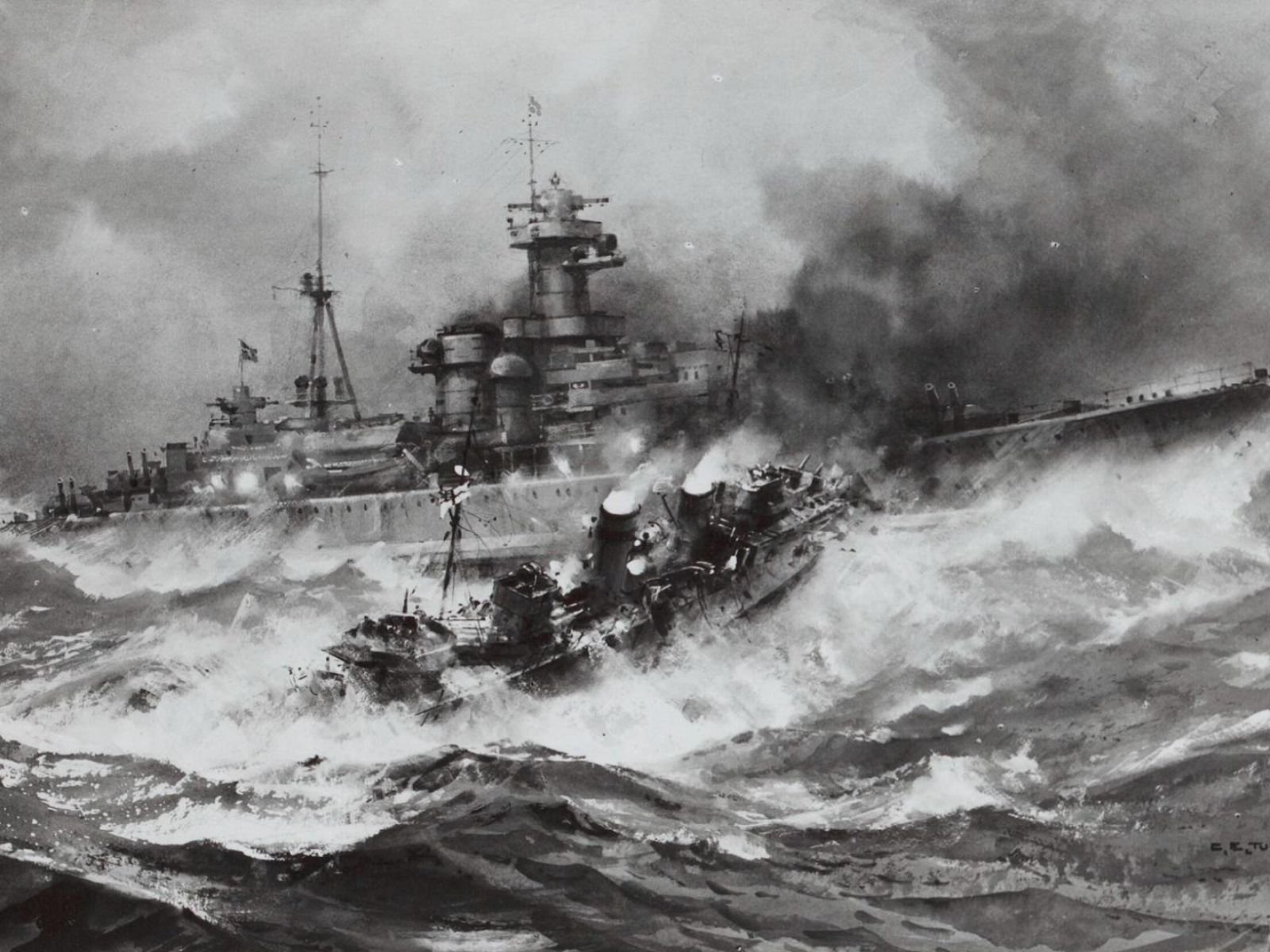
On the morning of 8 April 1940, during the Second World War, the British warship HMS Glowworm, under Lieutenant Commander Gerard Broadmead Roope, was on its way to rejoin the Allied squadron in the West Fjord of Norway when, through the fog of the Norwegian Sea, it sighted and attacked the German destroyers Z11 Bernd von Arnim and Z18 Hans Lüdemann. The attack damaged one of the German vessels, prompting them to signal for help and withdraw to the north.
The HMS Glowworm had become separated from the main squadron the previous night after losing a man overboard during a storm. While searching for the missing sailor, the destroyer was left isolated and, the next morning, found itself alone in hostile waters, sailing through a dense fog that severely limited visibility.
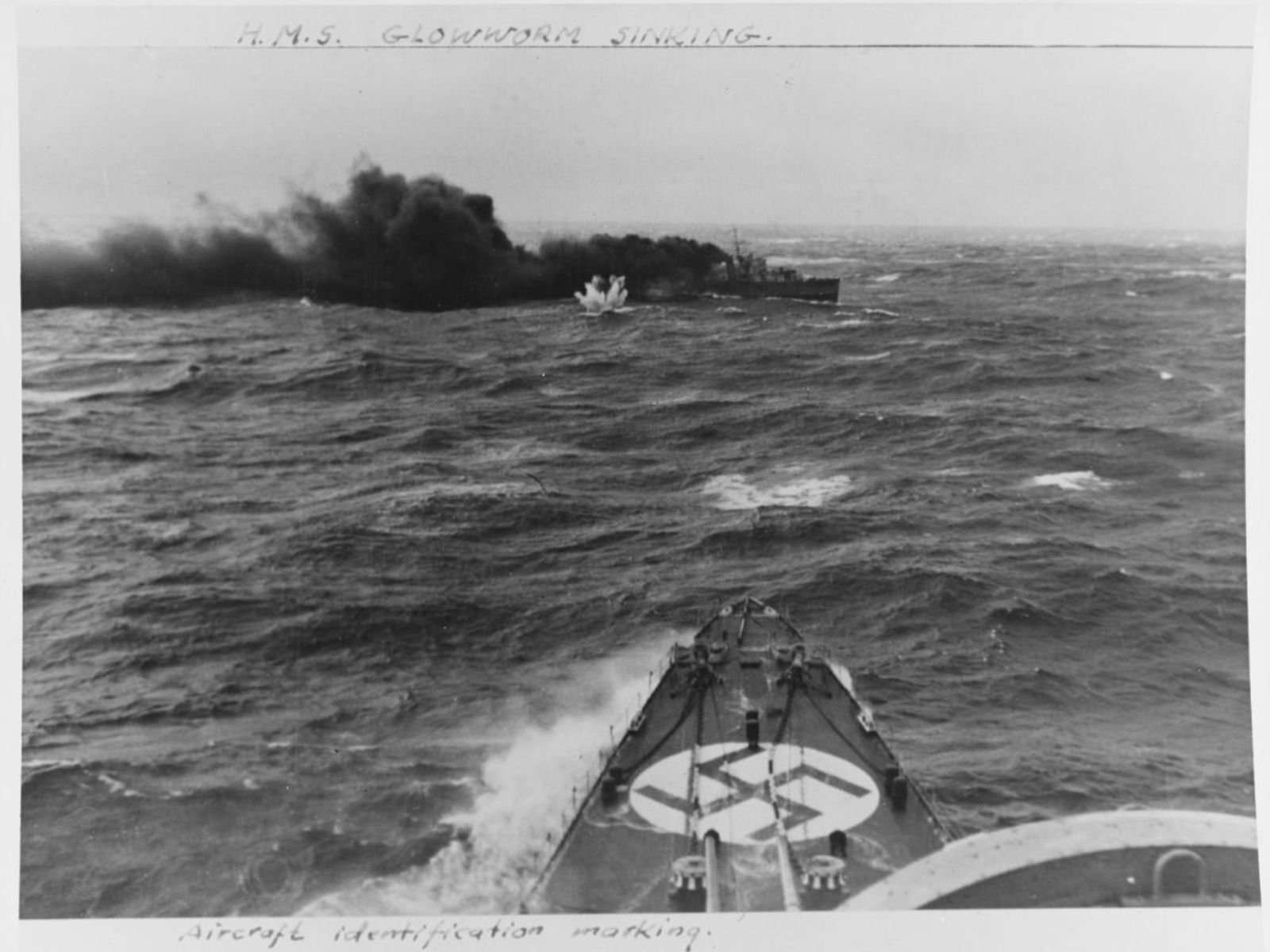
An authentic photograph taken from the bow of the Admiral Hipper during the engagement. It shows HMS Glowworm in the distance, wreathed in black smoke and flames. At the top of the photo is written “H.M.S. GLOWWORM SINKING” and at the bottom “AIRCRAFT IDENTIFICATION MARKING”. This is one of the few genuine photographs of the battle.
Pressing on with the pursuit of the German destroyers, HMS Glowworm, a ship of 1,345 tons, came upon the German heavy cruiser Admiral Hipper, which displaced 14,000 tons, was three times her size and far more heavily armed. Roope knew he was facing an impossible battle, since the destroyer had only four 4.7-inch guns against the eight 8-inch guns of the German cruiser.
Even so, without hesitating, HMS Glowworm opened fire on the German ship and managed to damage her in part. During the engagement Roope fired ten torpedoes at the Admiral Hipper, but none found its mark. The British destroyer was quickly hit by enemy shells and caught fire, with only three of her guns still working.
Realising that his vessel was doomed, Roope took a desperate and courageous decision: he ordered full speed and drove HMS Glowworm straight into the side of the Admiral Hipper. The collision was devastating: the destroyer tore away 120 feet (some 37 metres) of the German cruiser’s hull, also destroying the German ship’s starboard torpedo system.
Late in that dramatic battle, before being fatally struck and sunk, the Royal Navy ship rammed the side of the Admiral Hipper, knocking a German sailor into the sea in the collision. After the impact, HMS Glowworm still managed to fire one last salvo, hitting the German cruiser, before rolling over and sinking.
Of the 149 crew of HMS Glowworm, only one officer and 30 sailors survived the battle and were left adrift in the freezing sea. Even at the risk of exposing himself to attack by any Allied ships nearby, the captain of the Admiral Hipper, Hellmuth Heye, ordered that every survivor be rescued, including the German sailor who had fallen overboard.
The Heroism of Commander Gerard Roope
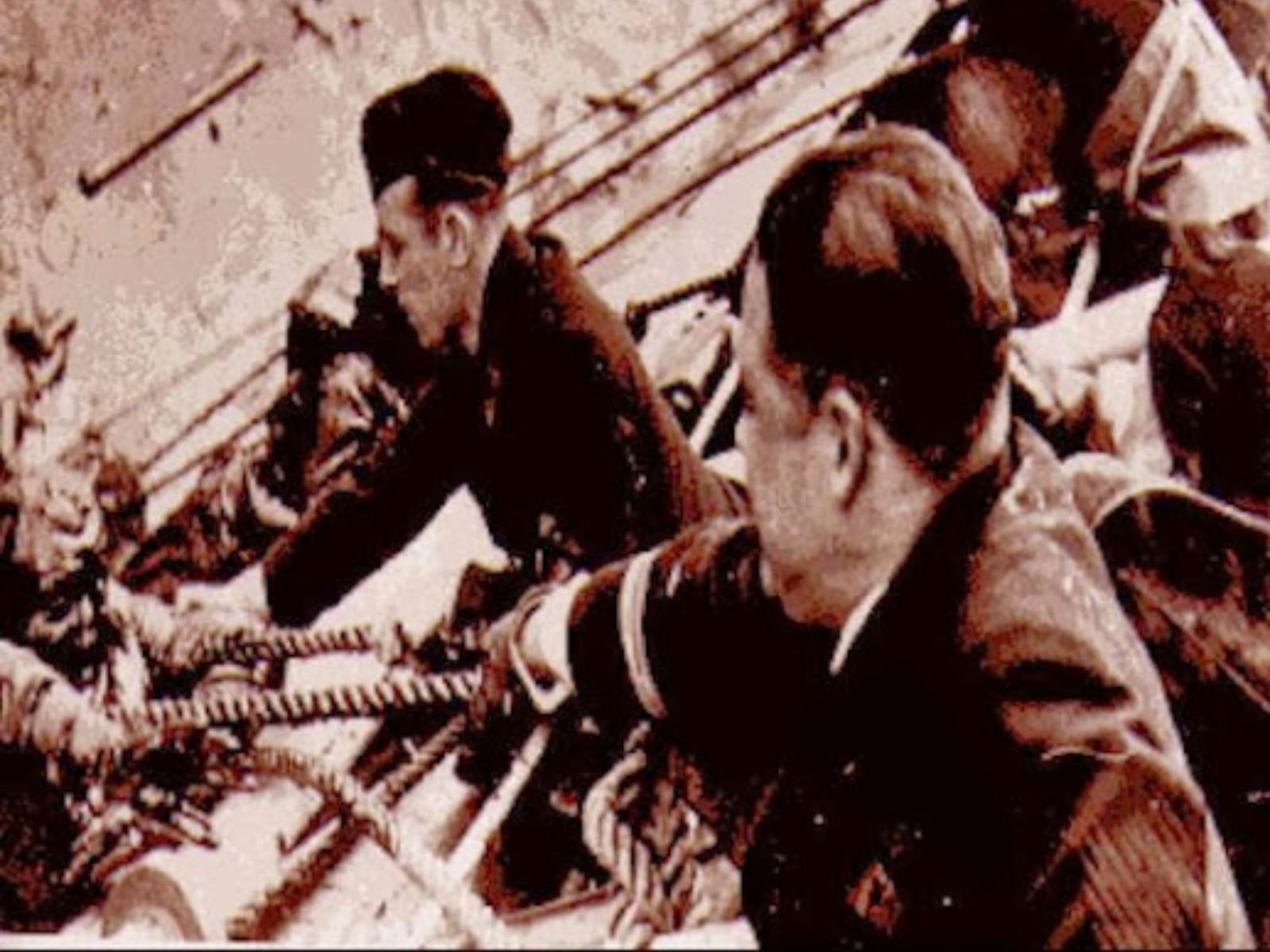
British survivors are helped aboard the Admiral Hipper after the battle.
Lieutenant Commander Gerard Roope was seen helping the survivors into their life jackets, showing leadership to the very last. During the rescue, however, Roope failed to hold on to a rope thrown from the Hipper and drowned in the icy waters of the Norwegian Sea. All the survivors taken aboard were received as equals by the Germans, and the British wounded were given the same treatment as the German wounded. Heye went to meet the survivors in person and praised the bravery the British sailors had shown in combat.
An Act of Honour Without Precedent
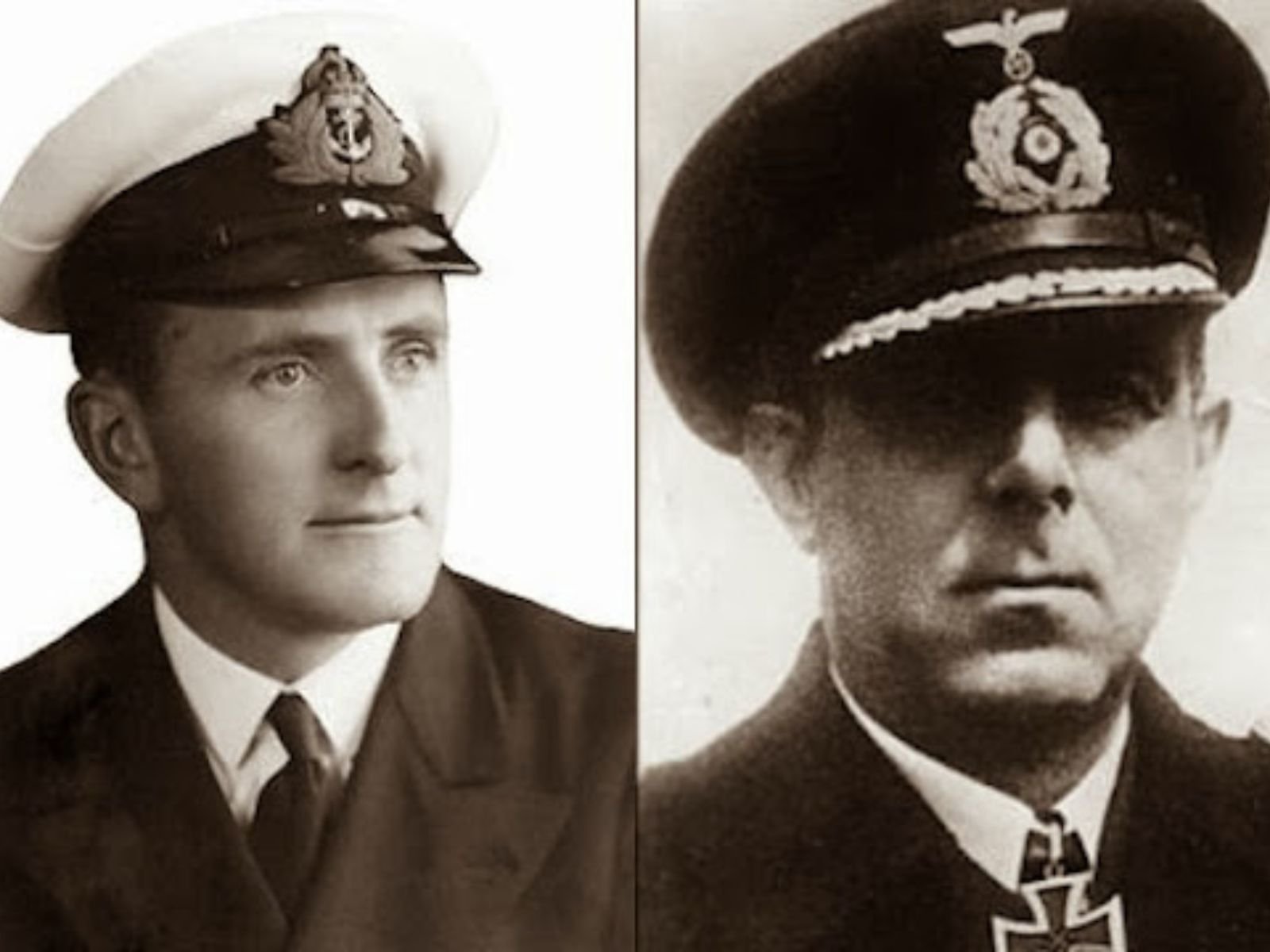
On the left, Gerard Roope, lieutenant commander of HMS Glowworm, and on the right, Hellmuth Heye, captain of the Admiral Hipper.
The German captain Hellmuth Heye went on to write to the British authorities through the Red Cross, recommending the award of the Victoria Cross to Lieutenant Commander Gerard Roope for the extraordinary courage of his opponent in taking on a far superior warship. It was the only time in history that the Victoria Cross was recommended by an enemy, a gesture that transcended the divisions of war and recognised pure courage in the face of impossible odds.
In the letter sent through the Red Cross, Heye wrote of the “exceptional bravery” of Roope and his crew, stressing that he had rarely witnessed such determination and courage in combat. The German captain was particularly struck by Roope’s decision to attack a ship three times his size, knowing that the chances of victory were all but non-existent.
Recognition of Bravery
Roope was the first person to be awarded the Victoria Cross in the Second World War. The award was made posthumously in London on 10 July 1945 and presented on 12 February 1946 at a ceremony held at Buckingham Palace, where King George VI handed the medal to Roope’s widow, accompanied by their son, Michael, who was then serving as a Royal Navy cadet.
Gerard Broadmead Roope was born on 13 March 1905 in Taunton, Somerset, into a family with a naval tradition. Educated at the Royal Naval College at Osborne and later at Dartmouth, he joined the Royal Navy at 17, in January 1923. At 35 he was already an experienced and respected officer, known for his calm leadership and unshakable determination.
The official citation for Roope’s Victoria Cross reads:
“For exceptional bravery in action. On 8 April 1940, HMS Glowworm was proceeding alone in heavy weather towards a rendezvous in the West Fjord, when she met and engaged two enemy destroyers, and later the heavy cruiser Admiral Hipper. Outnumbered and outgunned, and with his ship on fire and severely damaged, he fought his vessel to the end.”
The Fate of the Protagonists
Hellmuth Heye went on fighting in the Second World War and, among various other military honours, received the Knight’s Cross of the Iron Cross on 18 January 1941, the highest decoration awarded by Germany in recognition of acts of bravery in combat or of successful and decisive leadership. Still in 1941 Heye was promoted to vice admiral, and in 1942 he commanded the German naval forces in the Black Sea. At the end of the war he commanded fleets of small craft.
Heye never forgot the encounter with HMS Glowworm and often spoke of the extraordinary courage he had witnessed that day. After the war he kept up a correspondence with some of the British survivors he had rescued, forming friendships that lasted for decades. Hellmuth Heye survived the war and died on 10 November 1970, at the age of 75. To his last days he regarded the recommendation of the Victoria Cross for Gerard Roope as one of the most important acts of his naval career.
A Legacy of Honour
The battle between HMS Glowworm and Admiral Hipper remains one of the purest examples of naval courage in modern history. At a time when the war was growing ever more brutal and inhuman, Heye’s gesture in recommending his enemy for Britain’s highest military decoration showed that honour and mutual respect could still exist in the midst of the most devastating conflict humanity has known.
The story of Gerard Roope and Hellmuth Heye reminds us that even in the darkest circumstances humanity can prevail. Recognition of bravery transcends conflicts, ideologies and nationalities, and stands as a universal tribute to those who face the impossible with unshakable courage.
HMS Glowworm and her 118 lost crew rest at the bottom of the Norwegian Sea, but their story of courage goes on inspiring sailors and ordinary people around the world. It is a reminder that true victory sometimes lies not in winning the battle, but in how we face it.
Read Also
Bibliographic References
- Winton, John. The Victoria Cross at Sea: The Sailors, Marines and Airmen Awarded Britain’s Highest Honour. London: Pen & Sword Maritime, 2016.
- “Gerard Broadmead ROOPE VC — Official Citation and Biography.” Victoria Cross and George Cross Association. https://vcgca.org/our-people/profile/1625/Gerard-Broadmead-ROOPE.
- “ADM 1/10584: HMS Glowworm — Action with German Cruiser Admiral Hipper, 8 April 1940.” The National Archives, Kew.
- Koop, Gerhard, and Klaus-Peter Schmolke. Heavy Cruisers of the Admiral Hipper Class: Warships of the Kriegsmarine. Barnsley: Seaforth Publishing, 2014.
- “Lieutenant-Commander Gerard Broadmead Roope VC — Official Records.” Commonwealth War Graves Commission.
- “RM 7/1024: KTB Admiral Hipper, April 1940.” Bundesarchiv–Militärarchiv, Freiburg.