In the heart of Europe, at the very end of the twentieth century, a conflict of almost inconceivable brutality broke out, leaving an indelible scar on the continent’s conscience. The Bosnian War, fought officially between 6 April 1992 and 14 December 1995, was far more than a military confrontation; it was a descent into the hell of ethnic cleansing, concentration camps and genocide, on a scale Europe had not seen since the Holocaust.
With an estimated death toll of between 100,000 and 200,000 and more than two million refugees, the war disintegrated not only a country but the very notion of humanity, turning neighbours into executioners and playgrounds into cemeteries. This is the story of a conflict forgotten by many, yet whose lessons about hatred, indifference and human resilience should never be ignored.
The Balkan Powder Keg: A Peace Undone
The Socialist Republic of Bosnia and Herzegovina, part of the former Yugoslavia, was a mosaic of ethnicities and religions where Bosniak Muslims (44%), Orthodox Serbs (31%) and Catholic Croats (17%) coexisted under the motto of “Brotherhood and Unity”. With the collapse of communism and the end of the Cold War, however, fissures long held in check began to widen. Nationalism, suppressed for decades by Tito’s regime, resurfaced with overwhelming force.
On 29 February 1992 a referendum on Bosnian independence was held. With turnout overwhelmingly Bosniak and Croat, the result was a resounding “yes”. The Bosnian Serbs, who had boycotted the vote, saw the result as an existential threat, the first step towards their marginalisation in a new state dominated by Muslims. The peace, already fragile, was about to shatter.
Three Milestones at the Start of the War: The Fractured Narratives of a Conflict
Each of these three events reveals how Bosnia’s different communities interpreted the beginning of the war through their own lenses of victimhood and justification. The Croats saw Ravno as proof of Serb aggression. The Serbs saw the attack on the wedding party as evidence that they were not welcome in the new Bosnia. The Bosniak Muslims saw Bijeljina as the opening of a genocidal campaign.
The tragedy is that each side had legitimate reasons to feel threatened, but those perceptions of threat were manipulated by nationalist leaders to justify ever greater atrocities. What began as local incidents of violence escalated rapidly into total war, fuelled by narratives of victimhood that turned every act of violence into a justified “response” to some earlier “provocation”.
These three milestones defined the start of the war and foreshadowed its nature: a conflict in which the distinction between civilians and combatants would be deliberately erased, in which violence against non-combatants would be tolerated and, more than that, systematically organised, and in which every act of brutality would be justified as a necessary answer to the brutalities of the “other side”.
The darkest lesson of these three events is how quickly neighbours can become enemies when narratives of fear and hatred are deliberately cultivated and exploited by those who profit from conflict.
Croats (Homeland War)
For the Croats, the “Homeland War” began with the systematic destruction of the village of Ravno, in eastern Herzegovina, on 1 October 1991. The attack, carried out by the Yugoslav People’s Army (JNA) along with reservists from Montenegro and Herzegovina, was the first act of direct aggression against a Croat community in Bosnia and Herzegovina. For the Croats, Ravno was the moment it became clear that peaceful coexistence in Yugoslavia had come to an end.
Ravno
Ravno was a small Croat village of around 400 inhabitants, sitting strategically on the route between Serbia and Dubrovnik. The attack was not an isolated act of violence but part of a larger military campaign to establish a territorial corridor linking Serbia to the siege of Dubrovnik, in Croatia. JNA forces, backed by local Serb paramilitaries, systematically shelled and burned every Croat house in the village.
What made Ravno particularly significant for the Croat narrative was the premeditated, systematic nature of the destruction. There was no real military engagement. The village was simply razed. Houses were burned one by one, livestock was killed, and the symbols of Croat identity, including the Catholic church, were deliberately destroyed. Inhabitants who could not flee in time were killed or deported.
Serbs (Defensive-Fatherland War)
For the Bosnian Serbs, the “Defensive-Fatherland War” began with what they regard as a cowardly, premeditated attack on innocent civilians in Sarajevo. At around 2.30 pm on Sunday 1 March 1992, a Serb wedding procession passing through the historic Muslim quarter of Baščaršija was fired upon, killing Nikola Gardović, the groom’s father, and seriously wounding the Orthodox priest Radenko Mirović.
The Attack on the Wedding Procession
The attack took place on the final day of the contested referendum on Bosnian independence, which the Serbs had boycotted. The wedding procession, following Serb tradition, carried Serb flags and sang traditional songs as it celebrated through the streets of Sarajevo. For many Serbs, the procession was a fundamental right, a celebration of their culture in a city they had considered home for generations.
The gunman was identified as Ramiz Delalić, a known criminal with a history of violence and psychiatric problems. What most enraged the Serb community, however, was the apparent protection Delalić received from the Bosnian Muslim authorities. Despite an outstanding arrest warrant for other crimes, including rape, the authorities made little effort to arrest him before the attack.
Crime and Impunity
Most disturbing for the Serb narrative was that Delalić later admitted publicly, in a televised interview, that he had shot at the wedding guests. He escaped immediate punishment and was even allowed to form a paramilitary militia during the siege of Sarajevo, attacking Serbs and Bosniak Muslims alike. The authorities only moved against him in 1993, when his militia began attacking non-Serbs as well.
For the Serbs, the attack on the wedding represented an act of violence and, above all, a declaration that they were not welcome in the new independent Bosnia. It was the moment many Bosnian Serbs became convinced that they had to defend themselves against what they saw as a Muslim-Croat conspiracy to marginalise them. The image of a father killed on the day of his son’s wedding, the victim of an apparently random attack, became a powerful symbol for the Serbs.
Bosniaks (Aggression against Bosnia and Herzegovina)
For the Bosniaks, the “Aggression against Bosnia and Herzegovina” began on 1 April 1992, when Serb paramilitaries acting on the orders of Jovica Stanišić, head of Slobodan Milošević’s secret service, crossed the border and carried out the first massacre of Muslim civilians in Bijeljina. Whatever the date, the result was the same: a spiral of violence that would swallow the country.
Bijeljina
Bijeljina, a town of around 96,000 inhabitants on the border with Serbia, had been declared the capital of a “Serbian Autonomous Oblast” in September 1991. The town had a mixed population, but Serbs were the majority. In response to mounting tensions a small Muslim paramilitary group, the Patriotic League, had formed, but it was poorly organised and poorly equipped.
On 31 March 1992, local Serb paramilitaries known as “Mirko’s Chetniks” deliberately provoked a confrontation with the Patriotic League. The following day, 1 April, the Serb Volunteer Guard (SDG), known as “Arkan’s Tigers” and led by the war criminal Željko Ražnatović (Arkan), crossed the border from Serbia with the support of the Yugoslav People’s Army.
The Bijeljina Massacre
What followed was a systematic massacre. Arkan’s Tigers, together with local paramilitaries, killed Patriotic League fighters and began executing Muslim civilians indiscriminately. Men were separated from their families and executed. Women were raped. Muslim homes were looted and burned. The photojournalist Ron Haviv captured one of the war’s most shocking images: a Serb paramilitary kicking a dying Muslim woman.
The Bijeljina massacre was particularly significant because it established the template for the “ethnic cleansing” that would be applied throughout Bosnia. It was not merely a matter of conquering territory but of systematically eliminating the Muslim presence. Every mosque in the town was destroyed. Nine detention camps were set up. Many Muslims who survived the initial massacre were later deported or killed.
A War Crime in Bosnia
The most sinister aspect was the attempt to cover up the crimes. By the time a Bosnian government delegation arrived to investigate, the victims’ bodies had already been removed. Many deaths were never officially recorded as war casualties, with death certificates claiming the victims had “died of natural causes”.
The International Criminal Tribunal for the former Yugoslavia was able to verify between 48 and 78 deaths during the initial massacre, but post-war investigations documented the deaths of more than 250 civilians of all ethnicities in the municipality over the course of the war. Of a pre-war population of 30,000 Bosniak Muslims, fewer than 2,700 remained when the war ended.
The Siege of Sarajevo: 1,425 Days of Agony
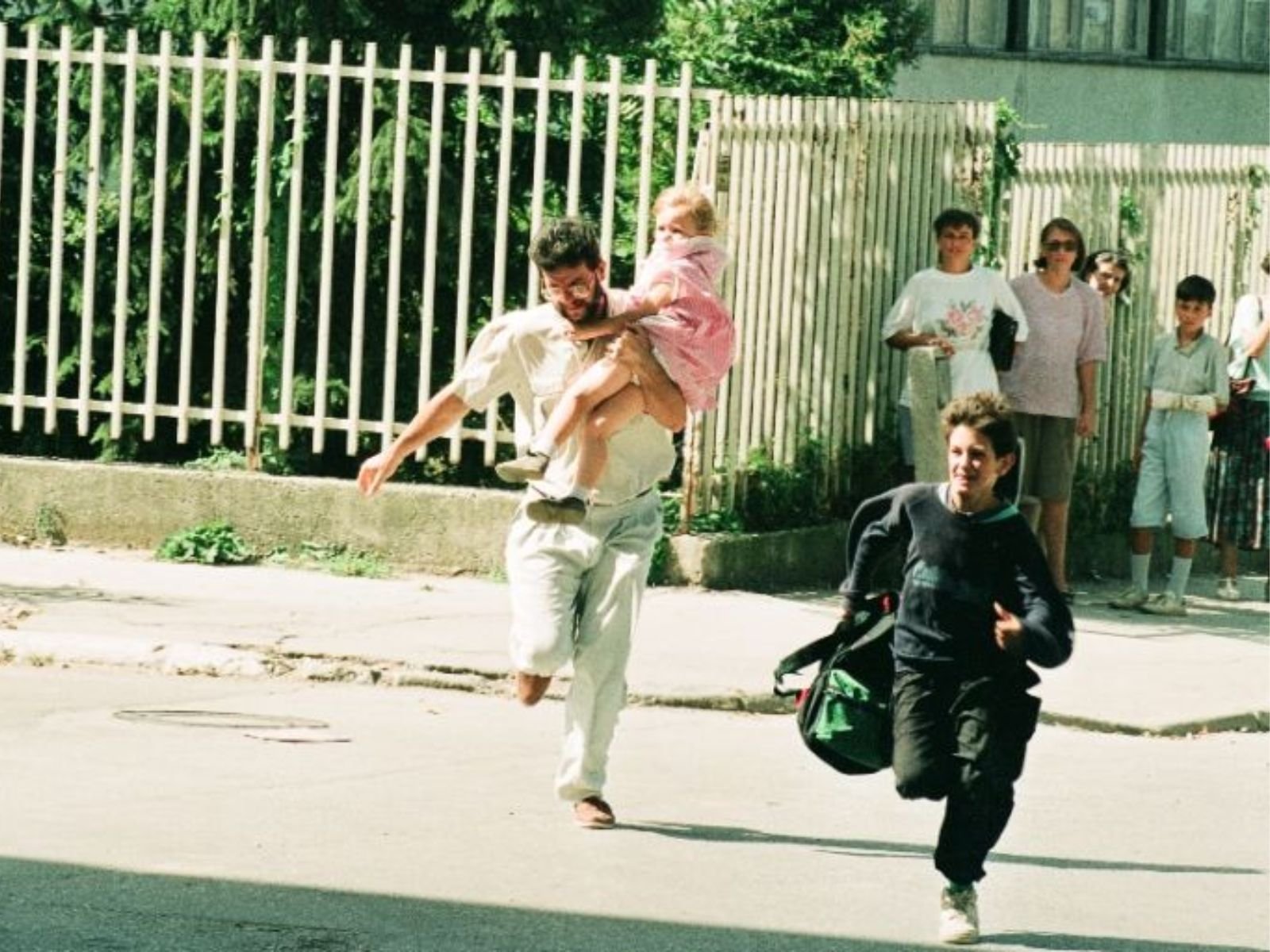
A father runs desperately carrying his small daughter in his arms during an attack in Sarajevo.
Nowhere symbolises the suffering of the Bosnian War more than its capital, Sarajevo. The city, once vibrant as host of the 1984 Winter Olympics and a multicultural centre, was subjected to the longest siege in modern history, lasting 1,425 days. From April 1992 to February 1996, Bosnian Serb forces positioned in the hills around the city relentlessly shelled the civilian population. Life in Sarajevo became a daily struggle for survival.
Maja Pašović, who was only five when the war began, recalls how her childhood was transformed: “Years that should have been filled with freedom, joy, laughter and carefree living turned into four years of constant fear, pain, loss and devastation”. Her childhood, like that of thousands of other children, became “an endless stream of shelling, air raid sirens, screams and suffering”.
Basements and shelters became the new homes, playgrounds and classrooms. “Sniper Alley” became a deadly game of Russian roulette, where crossing the street was an act of desperate courage. More than 11,000 people, including 1,600 children, were killed during the siege. The city, starving and terrorised, became a symbol of international inaction, a place where hope was the only possession the mortars could not destroy.
The Destruction of Sarajevo
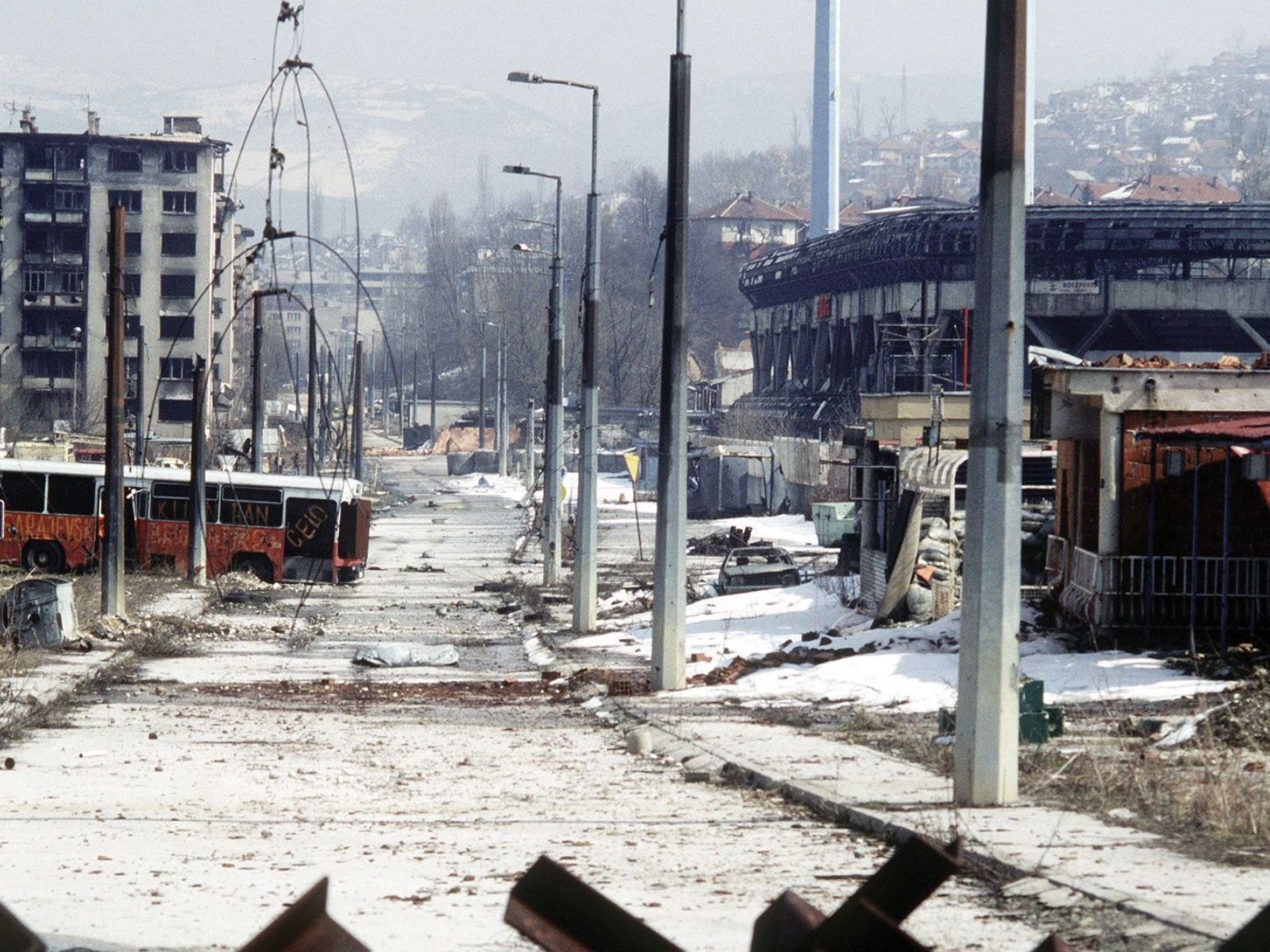
Apartment buildings in Sarajevo reduced to empty shells after years of relentless shelling during the longest siege of a capital city in modern history (1992-1996).
The systematic destruction of Sarajevo’s civilian infrastructure was not accidental collateral damage but a deliberate strategy of ethnic cleansing and psychological terror. Bosnian Serb forces, positioned in the surrounding hills with a clear tactical advantage, bombarded the city with heavy artillery, mortars and rockets for 1,425 consecutive days. The average was 329 shells a day, but on days of intense bombardment thousands of shells rained down on residential areas, markets, hospitals, schools and even cemeteries.
Nowhere was safe. Apartment buildings, once the homes of ordinary families, were turned into perforated ruins. Residents who stayed in the besieged city lived in unimaginable conditions: no electricity, no heating through the harsh Balkan winters (temperatures often below freezing), no running water, not enough food. Families burned furniture, books and even the parquet from their floors to keep warm.
A Multicultural City
Children grew up knowing nothing but war, learning to tell the sounds of different weapons apart before they learned to read. The physical destruction of Sarajevo went hand in hand with the destruction of its multicultural fabric. Before the war, Sarajevo was known as the “Jerusalem of Europe”, a city where mosques, Catholic churches, Orthodox churches and synagogues coexisted harmoniously. Muslims, Serbs, Croats and Jews lived as friends, colleagues and neighbours. The war destroyed that coexistence.
After reconstruction, shell marks in the pavements were filled with red resin, creating “Sarajevo Roses” as permanent memorials to the places where civilians were killed.
The Death of Multiculturalism
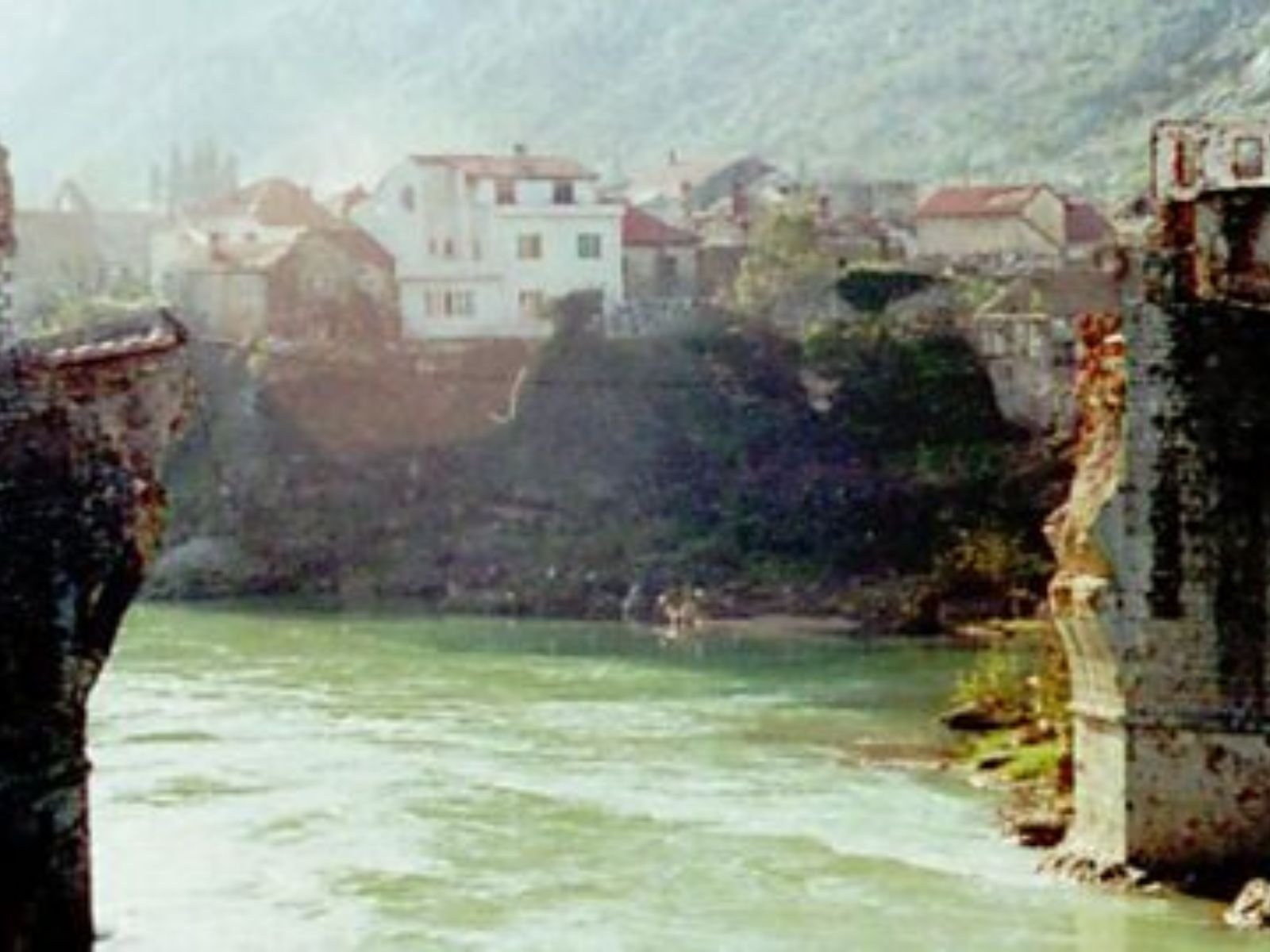
The exact moment when the Old Bridge (Stari Most) of Mostar, a 427-year-old masterpiece of Ottoman architecture, collapses into the Neretva river after systematic shelling by Croat forces (HVO).
9 November 1993, 10.15 in the morning. The exact moment when the Old Bridge (Stari Most) of Mostar, a 427-year-old masterpiece of Ottoman architecture, collapsed into the Neretva river after systematic shelling by Croat forces (HVO). The image captures the precise instant in which a 427-year-old symbol of multicultural coexistence was deliberately destroyed. The bridge had withstood earthquakes, floods and two world wars, but it did not survive the ethnic hatred of the 1990s. Witnesses described watching it as witnessing a murder.
After 60 direct hits from artillery and tanks, the limestone structure finally gave way and collapsed into the waters of the Neretva. The sound of the collapse echoed through the hills of Mostar, and many residents wept openly. The destruction of the bridge was not accidental collateral damage but a calculated attack on cultural identity and shared memory.
Stari Most (The Old Bridge)
Built in 1566 by the Ottoman architect Mimar Hayruddin, the bridge connected the Croat and Muslim communities of Mostar, serving as a physical and metaphorical symbol of union. Its single 29-metre arch, built without mortar (only perfectly fitted stones), was a marvel of engineering. For centuries local young men demonstrated their courage by jumping from the 24-metre-high bridge into the freezing waters of the Neretva, a tradition that became part of the city’s cultural identity.
The destruction of the bridge was recognised by the International Criminal Tribunal for the former Yugoslavia as a war crime. The Croat commander Slobodan Praljak was convicted of the intentional destruction of cultural and historical monuments. The bridge was meticulously rebuilt between 2001 and 2004, using traditional techniques and original stones recovered from the river. It was reopened on 23 July 2004 and declared a UNESCO World Heritage Site in 2005.
Human Rights Abuses and Crimes against Humanity
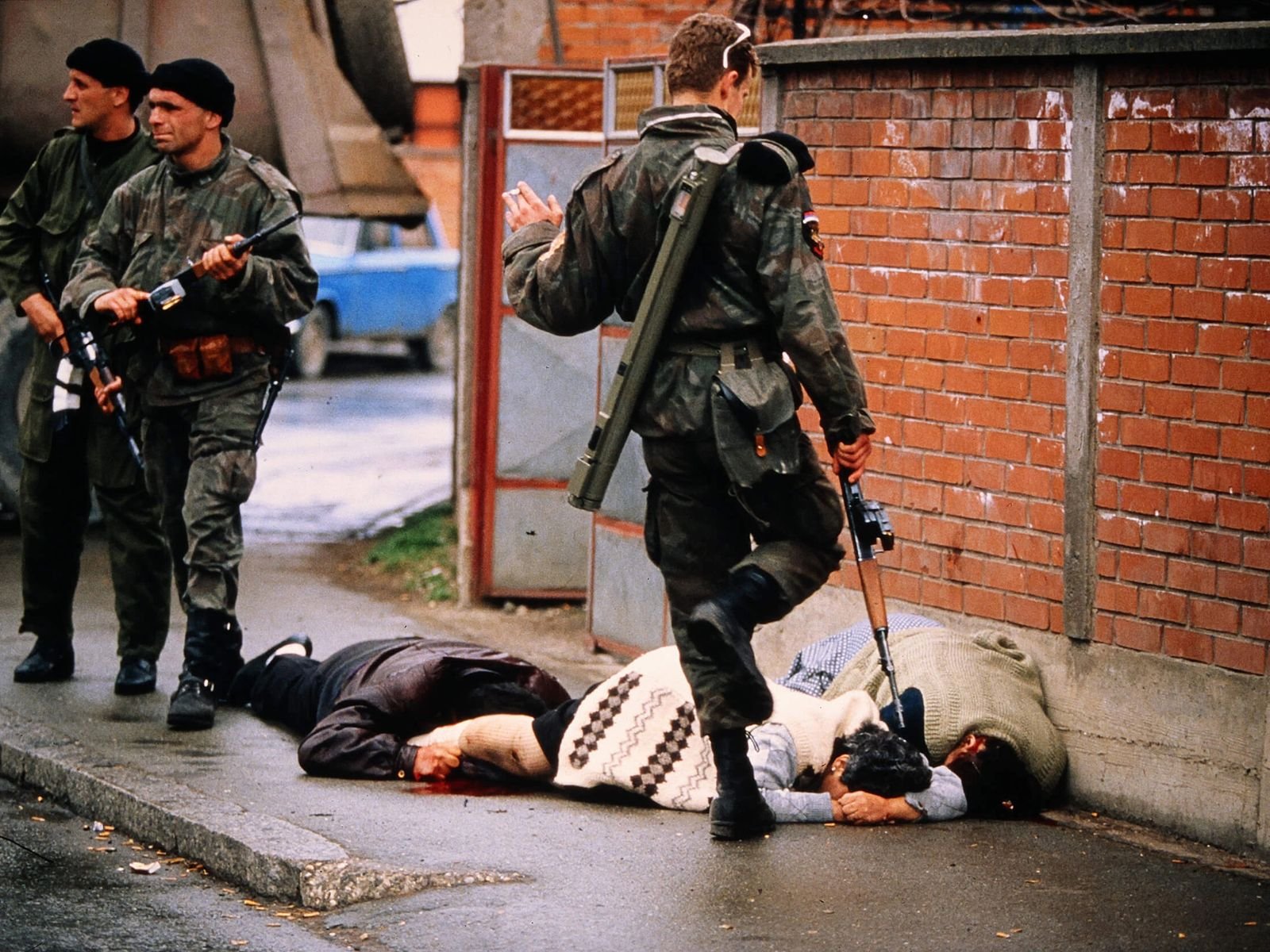
The scene of a war crime during the Bosnian War, showing the bodies of executed victims. This image documents the brutality of the war crimes committed during the conflict, including mass killings, summary executions and massacres of civilians that characterised the systematic ethnic cleansing.
During the Bosnian War (1992-1995) an estimated 100,000 people were killed, roughly 80% of them civilians. Massacres of civilians took place across the country, carried out mainly by Bosnian Serb forces but also by Croat forces and, on a smaller scale, by Bosniak forces. Methods of execution varied: mass shootings (as at Srebrenica), individual executions of civilians in their homes, killings during the “cleansing” of villages, and deaths in concentration camps.
Images like this one served as crucial evidence in war crimes trials. Photographers and journalists who documented atrocities risked their lives to ensure the world knew what was happening and that the perpetrators could not deny their crimes. This photograph is a silent testimony to one of the darkest pages in recent European history and a reminder that genocide and ethnic cleansing are not merely relics of the past but present threats that demand constant vigilance.
The Horror of the Camps in Bosnia: Omarska, Trnopolje and the Face of Evil
Sarajevo was the symbol of suffering in the open air, but the concentration camps were the fullest expression of human depravity hidden behind barbed wire. In the summer of 1992 the world was shocked by images of skeletal men imprisoned in camps such as Omarska, Keraterm and Trnopolje. Those images, which evoked the worst memories of the Holocaust, revealed the true nature of the Serb campaign: not a war for territory but a campaign of extermination.
Kemal Pervanic, a survivor of the notorious Omarska camp, describes the inhuman conditions: “very little food, no room to sit down, and only two toilets for a thousand people”. The most terrifying thing, however, was the familiarity of the evil. “One of the guards was my former language teacher, another was a former classmate”, he recounts. Violence was everywhere. “People were often taken away and tortured. Some never came back”. To survive, Kemal had to suppress his emotions, becoming able to “watch someone being slaughtered like a pig without crying”.
Beyond torture and murder, the camps were the setting for systematic, brutal sexual violence. An estimated 20,000 to 50,000 women, most of them Bosniak Muslims, were raped during the war. In places such as Višegrad and Foča, hotels and gymnasiums were turned into “rape camps”, where women and girls were held as sexual slaves. Rape was not a by-product of the war but a deliberate weapon, used to terrorise, humiliate and destroy the social fabric of a community, a tool of ethnic cleansing as effective as bullets.
Srebrenica: The Peak of Genocide in the Bosnian War
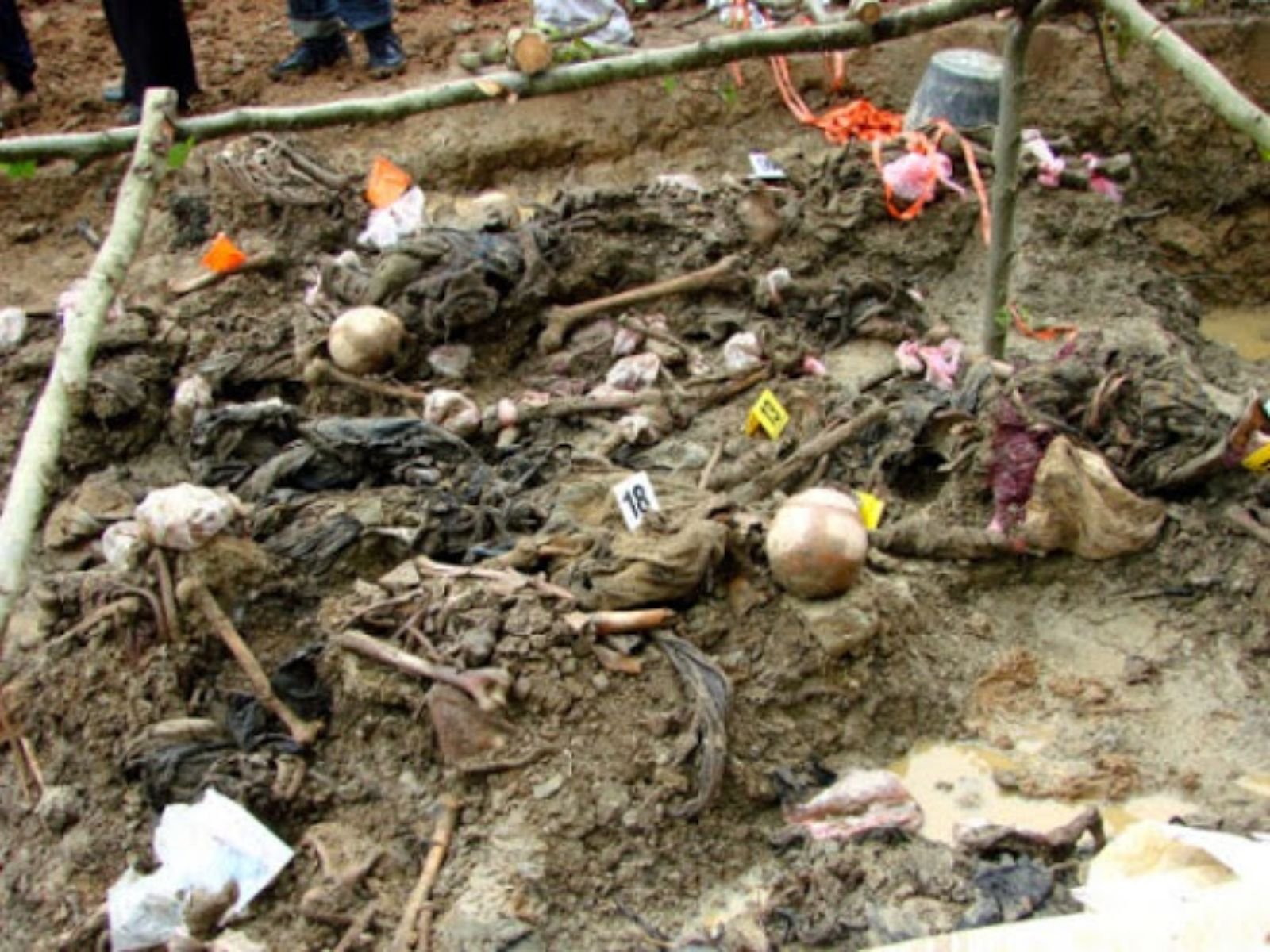
Mass grave in Srebrenica, exhumed in 2007. Photo: Adam Jones
In July 1995 the cruelty of the war reached its peak in the enclave of Srebrenica, an area declared “safe” by the United Nations. Within days, Bosnian Serb forces under the command of General Ratko Mladić systematically murdered more than 8,000 Bosniak Muslim men and boys. The Srebrenica massacre was the largest mass killing in Europe since the Second World War and was formally classified as genocide by the International Criminal Tribunal for the former Yugoslavia.
The scenes from Srebrenica are a testament to the failure of the international community. Fathers saying goodbye to their sons, men being separated from their families and led away to their deaths, and the UN blue helmets, too few in number and with too weak a mandate, watching helplessly.
The fall of Srebrenica was not only a Bosnian tragedy; it was a global disgrace, a moment when the promise of “never again” rang hollow. The connection between the policy of ethnic cleansing that swept Bosnia and the genocidal climax at Srebrenica is direct and undeniable. Srebrenica was the logical consequence of an ideology of hatred that had been allowed to grow unchecked.
War Crimes and Crimes against Humanity
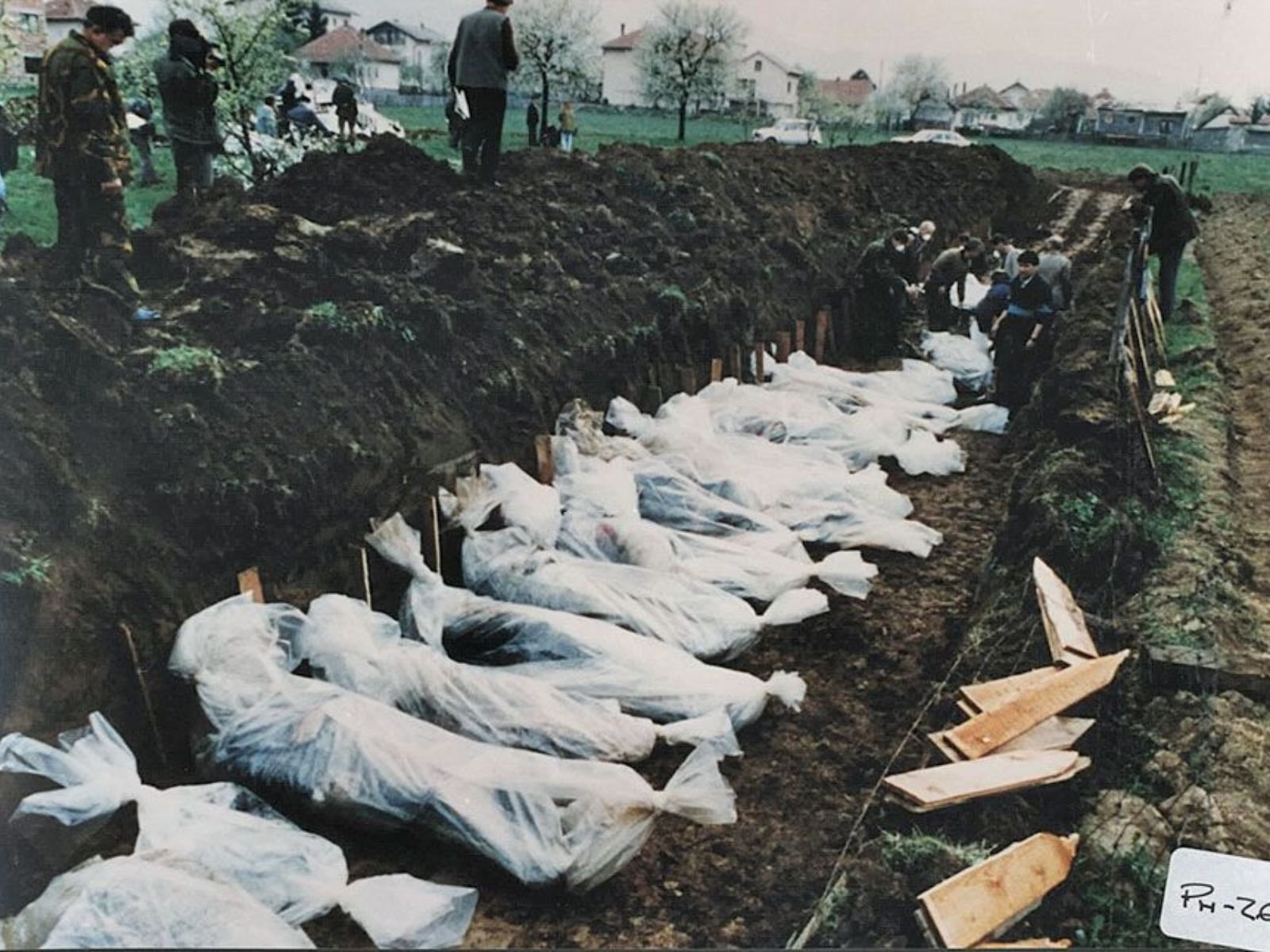
Mass burial of Bosnian War victims in a collective grave. Dozens of bodies wrapped in white bags and plastic are laid side by side in a trench dug in open ground, while forensic investigators and workers document and supervise the process. The code “PR-261” visible in the bottom right corner suggests this is a forensic archive photograph, probably part of war crimes investigations. Each white bag represents a life cut short, a family destroyed, a story never told. The peaceful village in the background contrasts brutally with the horror of the collective grave in the foreground.
During the Bosnian War (1992-1995) an estimated 100,000 people were killed, and thousands of bodies were buried in collective graves. Some graves were created by perpetrators trying to conceal evidence of massacres, others by local authorities overwhelmed by the number of dead. After the war ended, the process of exhuming, identifying and reburying the victims with dignity became one of the most painful and complex tasks of the post-conflict transition.
The International Commission on Missing Persons (ICMP)
The International Commission on Missing Persons (ICMP) was established in 1996 to help locate and identify missing people. As of 2024, more than 30,000 people were still listed as missing from the Bosnian War and related conflicts in the former Yugoslavia. Identification is carried out through DNA analysis, comparing samples from remains with blood samples from relatives. Forensic teams exhume mass graves, catalogue every bone fragment, item of clothing and personal effect, and try to reconstruct identities from remains that are often fragmented and mixed together.
Many victims were buried in primary graves, then exhumed by the perpetrators and redistributed among secondary graves to hinder identification (a tactic used particularly after the Srebrenica massacre). This means the remains of a single person may be scattered across multiple sites, making identification even more complex. Many mothers, wives and daughters of the missing died before learning the fate of their loved ones. Some buried only fragments.
The International Criminal Tribunal for the former Yugoslavia (ICTY)
The International Criminal Tribunal for the former Yugoslavia (ICTY) prosecuted 161 individuals for crimes committed during the Yugoslav Wars, including genocide, crimes against humanity and war crimes. Senior political and military leaders were convicted:
- Radovan Karadžić (Bosnian Serb political leader) was sentenced to life imprisonment for genocide at Srebrenica and crimes against humanity;
- Ratko Mladić (Bosnian Serb military commander) was sentenced to life imprisonment for genocide, crimes against humanity and war crimes.
- Slobodan Milošević (president of Serbia) died in 2006 before his trial concluded.
The Bosnian War: The Legacy of a Forgotten Conflict
The war ended officially with the Dayton Agreement in 1995, which divided Bosnia and Herzegovina into two entities: the Federation of Bosnia and Herzegovina (Croat-Muslim) and Republika Srpska (Serb). The agreement brought peace but cemented the ethnic divisions the war had created. Today Bosnia is a country still wrestling with the scars of the past. The trauma is visible in the rebuilt cities, in the cemeteries that dot the landscape and in the hearts of a generation that grew up amid terror.
Three decades after the genocide, the struggle for memory and against denial remains a daily battle in Bosnia and Herzegovina and across the Balkans. While the Mothers of Srebrenica and other victims’ associations work tirelessly to keep the memory of the dead alive and to find the remains of the missing, historical revisionism and the glorification of war criminals persist in some political and social circles in the region.
The Bosnian War is a grim reminder that civilisation is a thin layer that can easily be torn. It teaches us that genocide is not a spontaneous act of madness but the result of an ideology of hatred, of the dehumanisation of the “other” and of the indifference of those with the power to intervene. Three decades on, laboratories are still cross-matching DNA samples to give a name back to fragments of bone, and there are families burying their dead piece by piece, one exhumation at a time. As long as there are people who call Mladić a hero, that account will stay open.
Read Also
Bibliographic References
- “Survivor Stories.” Remembering Srebrenica. https://srebrenica.org.uk/category/survivor-stories.
- “Kemal Pervanic.” The Forgiveness Project. https://www.theforgivenessproject.com/stories-library/kemal-pervanic/.
- “Notes from a War-Torn Childhood in Bosnia.” Think Global Health. https://www.thinkglobalhealth.org/article/notes-war-torn-childhood-bosnia.
- “Sexual Violence in Bosnia.” Remembering Srebrenica. https://srebrenica.org.uk/what-happened/sexual-violence-bosnia.
- “Massacre de Srebrenica.” Geomagno. https://geomagno.com/massacre-de-srebrenica/.
- “Bosnia-Herzegovina Timeline.” BBC News.
- Finlan, Alastair. The Collapse of Yugoslavia: 1991–99. Osprey Publishing, 2004. https://archive.org/details/collapseofyugosl00alas.