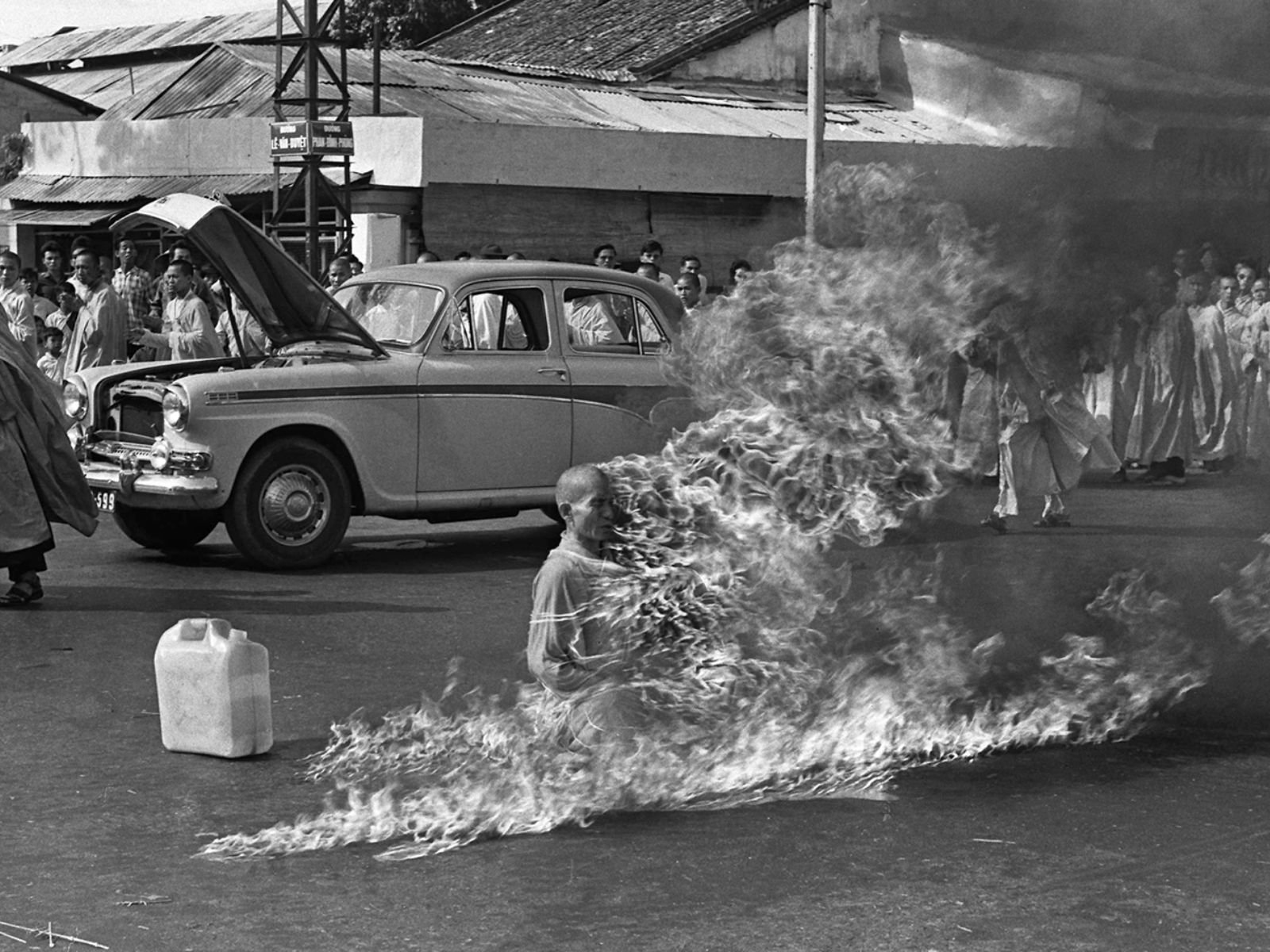
On 11 June 1963, at a busy crossroads in Saigon, the world witnessed an act of protest so extreme and visually shocking that its image became one of the most enduring symbols of the twentieth century. Thích Quảng Đức, a 66-year-old Mahayana Buddhist monk, calmly sat down in the lotus position, was doused in petrol by a fellow monk and set himself alight. As the flames consumed him, he remained motionless, a statue of serenity in the middle of an inferno.
Pulitzer Prize
The photograph of that moment, taken by Malcolm Browne of the Associated Press, won the Pulitzer Prize and also exposed the brutality of the South Vietnamese regime, forcing a shift in American foreign policy and altering the course of the Vietnam War. This was not an act of despair but a calculated sacrifice, the culmination of a long struggle for religious freedom and a silent cry that echoed louder than any bomb.
The Cauldron of Oppression: Vietnam under Ngô Đình Diệm
To understand the sacrifice of Thích Quảng Đức, one has to understand the climate of religious oppression in South Vietnam in 1963. The country, where between 70 and 90 per cent of the population was Buddhist, was governed by Ngô Đình Diệm, a devout Catholic who led an authoritarian and nepotistic regime. Diệm’s administration openly favoured the Catholic minority in every aspect of public life: land allocation, government posts, business concessions and military promotions.
The Catholic Church was the largest landowner in the country and enjoyed tax exemptions, while Buddhism, the religion of the vast majority, was treated as a “private” entity requiring official permission to hold public events. The Vatican flag was frequently flown at official events, a constant symbol of the disproportionate power of the Catholic minority. Systematic discrimination created a deep resentment that was about to explode.
The Spark in Huế: The Ban on the Buddhist Flag
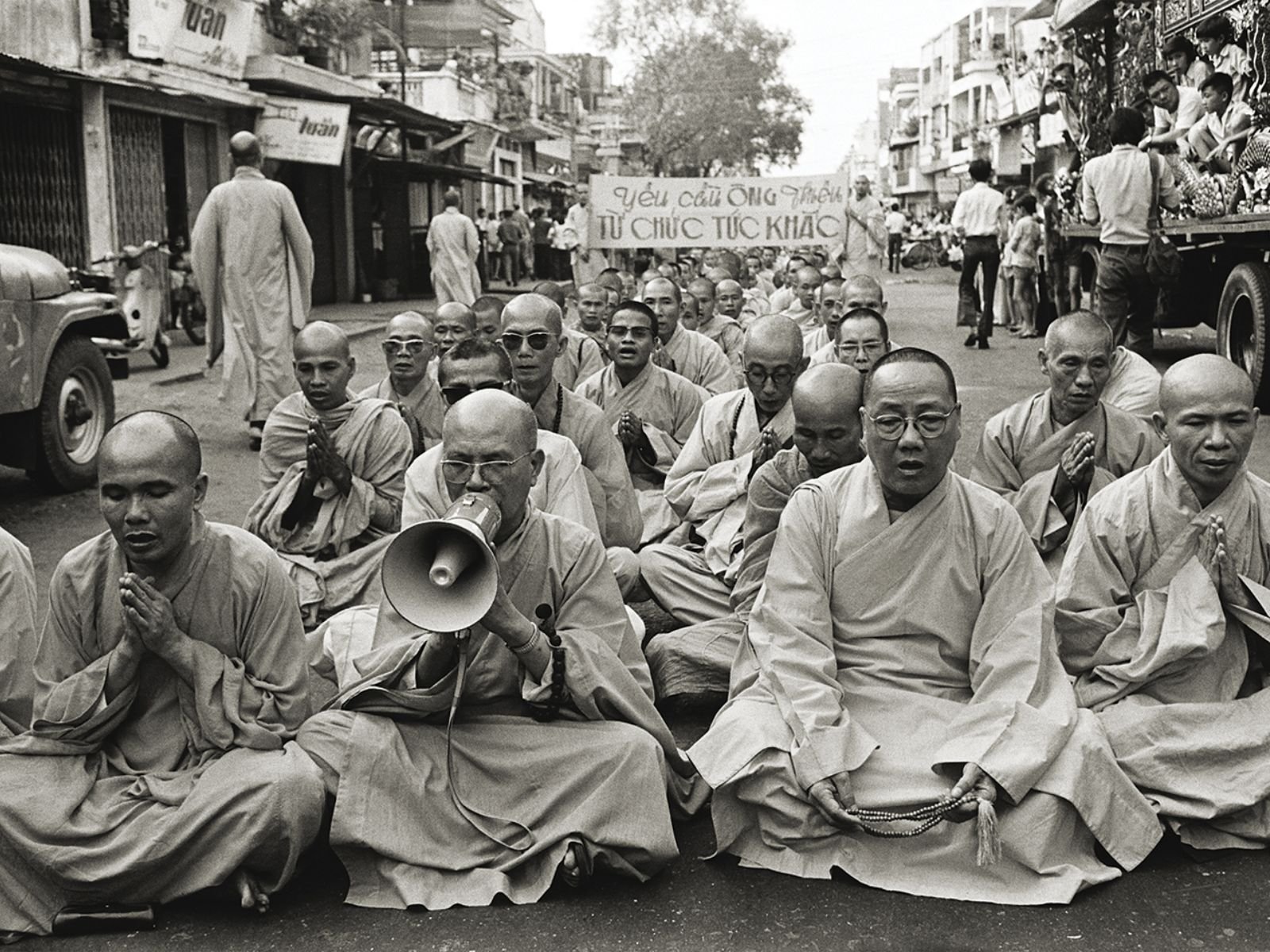
Buddhist leaders protesting publicly during the 1963 demonstrations.
The crisis erupted in May 1963. The government invoked an obscure 1958 law to ban the display of religious flags, preventing Buddhists from flying their flag during Vesak, the celebration of the Buddha’s birthday. The outrage was immense, since only a week earlier Catholics had been encouraged to display Vatican flags at a celebration for Diệm’s brother, Archbishop Ngô Đình Thục.
On 8 May, in the city of Huế, a crowd of Buddhists protested peacefully against the ban. The regime’s response was brutal: police and army opened fire and threw grenades at the unarmed demonstrators, killing nine people. Rather than take responsibility, Diệm blamed the Viet Cong for the massacre, deepening the wound and uniting the Buddhist community in resolute opposition.
The Supreme Act: The Sacrifice of the Monk Thích Quảng Đức
Faced with the government’s intransigence, the Buddhist leadership, headed by monks such as Thích Trí Quang, decided that drastic action was needed to draw the world’s attention. Self-immolation was chosen as the form of protest, a practice with precedents in the Mahayana Buddhist tradition for honouring the dharma. Thích Quảng Đức, a monk respected for his life of devotion and for building temples, offered himself for the sacrifice.
On the morning of 11 June, after a ceremony, a procession of cars set out from the Xá Lợi pagoda. At the junction of Phan Đình Phùng and Lê Văn Duyệt streets, the monk stepped out of the car, sat down calmly in the lotus position and, while other monks formed a circle to shield him from the police, struck the match. The photographer Malcolm Browne, who had been tipped off about a “significant event”, was there to capture the scene. His image, showing the monk engulfed in flames yet completely serene, shocked the world.
The Heart That Would Not Burn and Madame Nhu’s Reaction
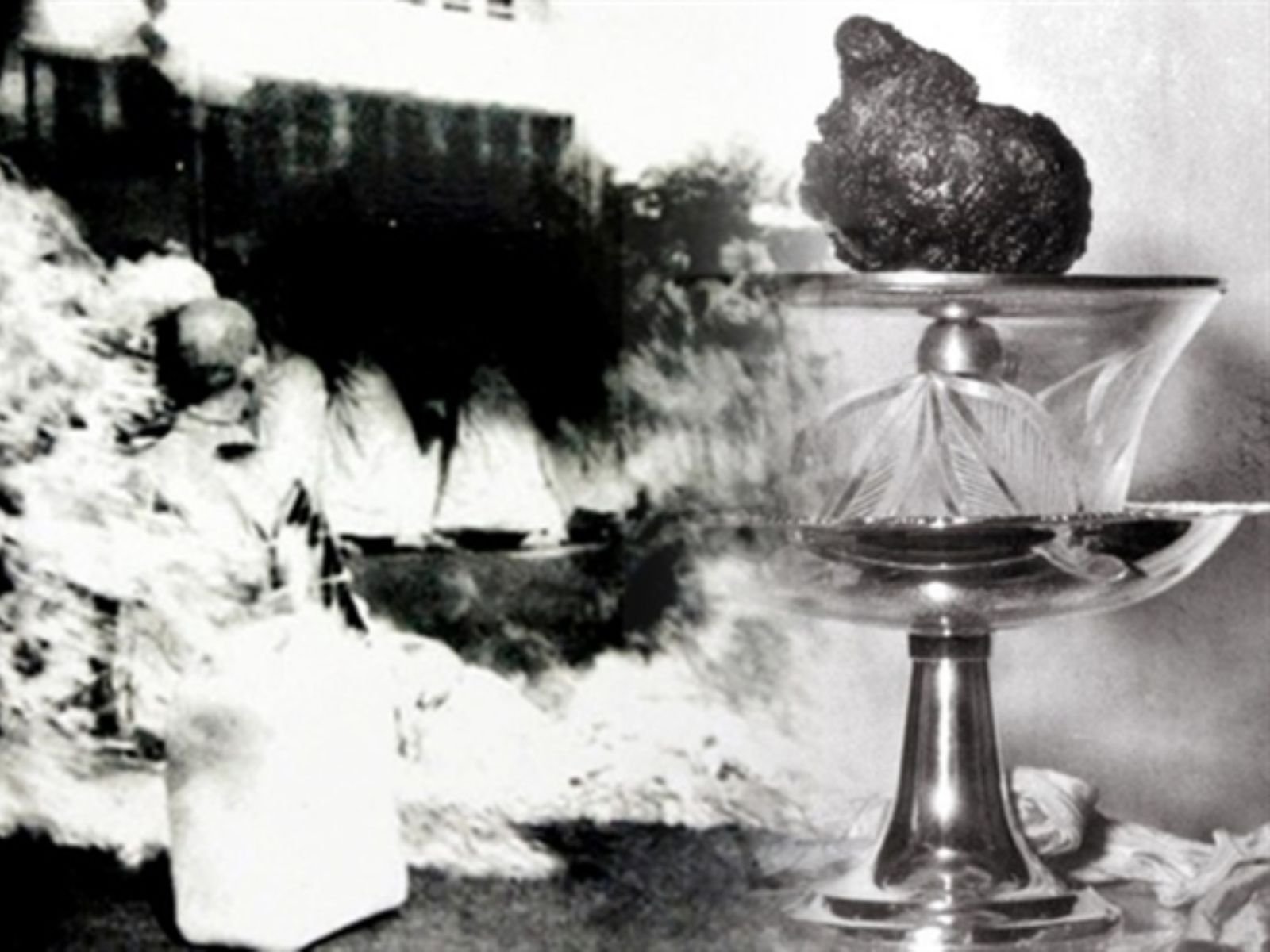
The indestructible heart of Thích Quảng Đức, preserved as a sacred relic. After the monk’s body was cremated, witnesses reported that his heart remained intact, a phenomenon Buddhists took as a symbol of his extraordinary compassion and spiritual purity.
The body of Thích Quảng Đức was cremated but, according to witnesses, his heart remained intact, a phenomenon Buddhists took as a symbol of his extraordinary compassion and spiritual purity. The heart was preserved as a sacred relic. The reaction of Diệm’s regime, however, was devoid of any compassion.
The most infamous came from Trần Lệ Xuân, the de facto first lady of South Vietnam and wife of Diệm’s brother, Ngô Đình Nhu. Known as Madame Nhu, she cynically declared that she “would clap hands at seeing another monk barbecue show” and that “if the Buddhists want to have another barbecue, I will be glad to supply the gasoline and a match”. Those cruel remarks only served to isolate the regime further and harden international opposition.
Fall of a Tyrant: The Political Impact
Browne’s photograph on the front pages of newspapers around the world had an immediate and devastating political impact on Diệm’s regime. United States President John F. Kennedy reportedly said: “No news picture in history has generated so much emotion around the world as that one.” The image made it impossible for the American government to continue its unconditional support for Diệm. International pressure mounted and the Buddhist crisis intensified, with five more monks self-immolating in the following months.
In August, Nhu’s special forces raided pagodas across the country, arresting and killing monks. The brutality was the final straw. On 2 November 1963, with the tacit support of the United States, a group of ARVN generals led a coup, capturing and murdering Diệm and his brother Nhu. The regime that had persecuted the Buddhists had fallen, largely because of the silent sacrifice of one monk.
The Legacy of the Torch of Justice
The act of Thích Quảng Đức transcended the Buddhist crisis and the Vietnam War. It became a universal symbol of non-violent resistance to oppression. His self-immolation inspired similar protests around the world, from anti-war activists in the United States to demonstrators during the Prague Spring. The image of the “burning monk” remains a powerful testimony to the capacity of a single individual to defy a tyrannical regime and awaken the conscience of the world.
Monument to the Monk in Vietnam
At the site of his sacrifice in Ho Chi Minh City, formerly Saigon, there is now a monument in his honour, a permanent reminder that sometimes the silence of an act can be more eloquent than any speech, and that the flame of a martyr can light the way to freedom.
Read Also
Bibliographic References
- “Malcolm Browne: The Story Behind the Burning Monk.” TIME. https://time.com/3791176/malcolm-browne-the-story-behind-the-burning-monk/.
- Jacobs, Seth. Cold War Mandarin: Ngo Dinh Diem and the Origins of America’s War in Vietnam, 1950–1963. Rowman & Littlefield, 2006. https://www.bloomsbury.com/us/cold-war-mandarin-9780742544482/.
- Karnow, Stanley. Vietnam: A History. Penguin Books, 1997. https://www.penguinrandomhouse.com/books/321129/vietnam-by-stanley-karnow/.
- Prochnau, William. Once Upon a Distant War. Times Books, 1995. https://www.penguinrandomhouse.com/books/136055/once-upon-a-distant-war-by-william-prochnau/.
- “Buddhist Crisis.” Wikipedia, The Free Encyclopedia. https://en.wikipedia.org/wiki/Buddhist_crisis.
- “Thích Quảng Đức.” Wikipedia, The Free Encyclopedia. https://en.wikipedia.org/wiki/Th%C3%ADch_Qu%E1%BA%A3ng_%C4%90%E1%BB%A9c.