If the radiance of a thousand suns were to burst into the sky, that would be like the splendor of the Mighty One… I am become Death, the shatterer of Worlds. – Robert Oppenheimer, in an American television interview two decades after the Trinity Test.
A Race Against Time: The Manhattan Project
At the heart of the Second World War, while the world burned in conflict, a silent race with unimaginable consequences was unfolding in the laboratories and deserts of the United States. The fear that Nazi Germany might develop a weapon of unprecedented power, based on the newly discovered nuclear fission, drove the creation of the Manhattan Project in 1942. Under the military leadership of General Leslie Groves and the scientific direction of the theoretical physicist J. Robert Oppenheimer, the project brought together the most brilliant minds in science in a colossal effort. With a budget that would exceed 2 billion dollars and employing more than 130,000 people, the objective was singular: to build the first atomic bomb in history before the enemy did. The intellectual epicentre of this undertaking was the Los Alamos Laboratory, a secret town built on an isolated mesa in New Mexico, where theory would be turned into a force capable of redrawing the map of global power.
The Brilliant Minds Behind the Trinity Test and the Manhattan Project
Although J. Robert Oppenheimer is the figure most prominently associated with the Manhattan Project, the creation of the atomic bomb was the result of the collaborative work of a constellation of scientific geniuses. Among them was Enrico Fermi, the Nobel laureate Italian physicist who led the team that built the world’s first nuclear reactor, Chicago Pile-1, proving that a self-sustaining chain reaction was possible.
Hans Bethe, a German-American nuclear physicist, headed the Theoretical Division at Los Alamos and played a crucial part in the calculations of the bomb’s efficiency. Richard Feynman, then a young physicist and future Nobel laureate, led the human computing group and helped design the calculation systems that were vital to the project. There were also figures such as Leo Szilard, who conceived the idea of the nuclear chain reaction, and Ernest Lawrence, inventor of the cyclotron, which was fundamental to the separation of uranium isotopes. These and many other brilliant minds, many of them refugees from fascist persecution in Europe, worked in secret, driven by a mixture of scientific curiosity, patriotic duty and the existential fear of a Nazi bomb.
Two Roads to Destruction: Plutonium versus Uranium
The Manhattan Project pursued two parallel routes to creating enough fissile material for a bomb. The first involved enriching uranium, separating the rare isotope U-235 from the more common U-238. That process, carried out at vast facilities in Oak Ridge, Tennessee, was extremely costly and difficult. The resulting bomb, the “Little Boy” dropped on Hiroshima, used a relatively simple “gun” mechanism, in which a subcritical mass of U-235 was fired at another to reach critical mass and start the detonation. The second route, considered even more complex, was the production of plutonium-239 in nuclear reactors at Hanford, Washington. Plutonium, however, could not be used in a gun mechanism because of its instability. The Los Alamos team, under the leadership of scientists such as Seth Neddermeyer and George Kistiakowsky, developed a revolutionary implosion method. The “Gadget” tested at Trinity and the “Fat Man” bomb dropped on Nagasaki used conventional explosives arranged as a spherical shell to compress a subcritical sphere of plutonium, increasing its density until it reached criticality. The success of the Trinity test was the validation of this implosion design, far more efficient and complex.
The Dawn of the Atomic Age
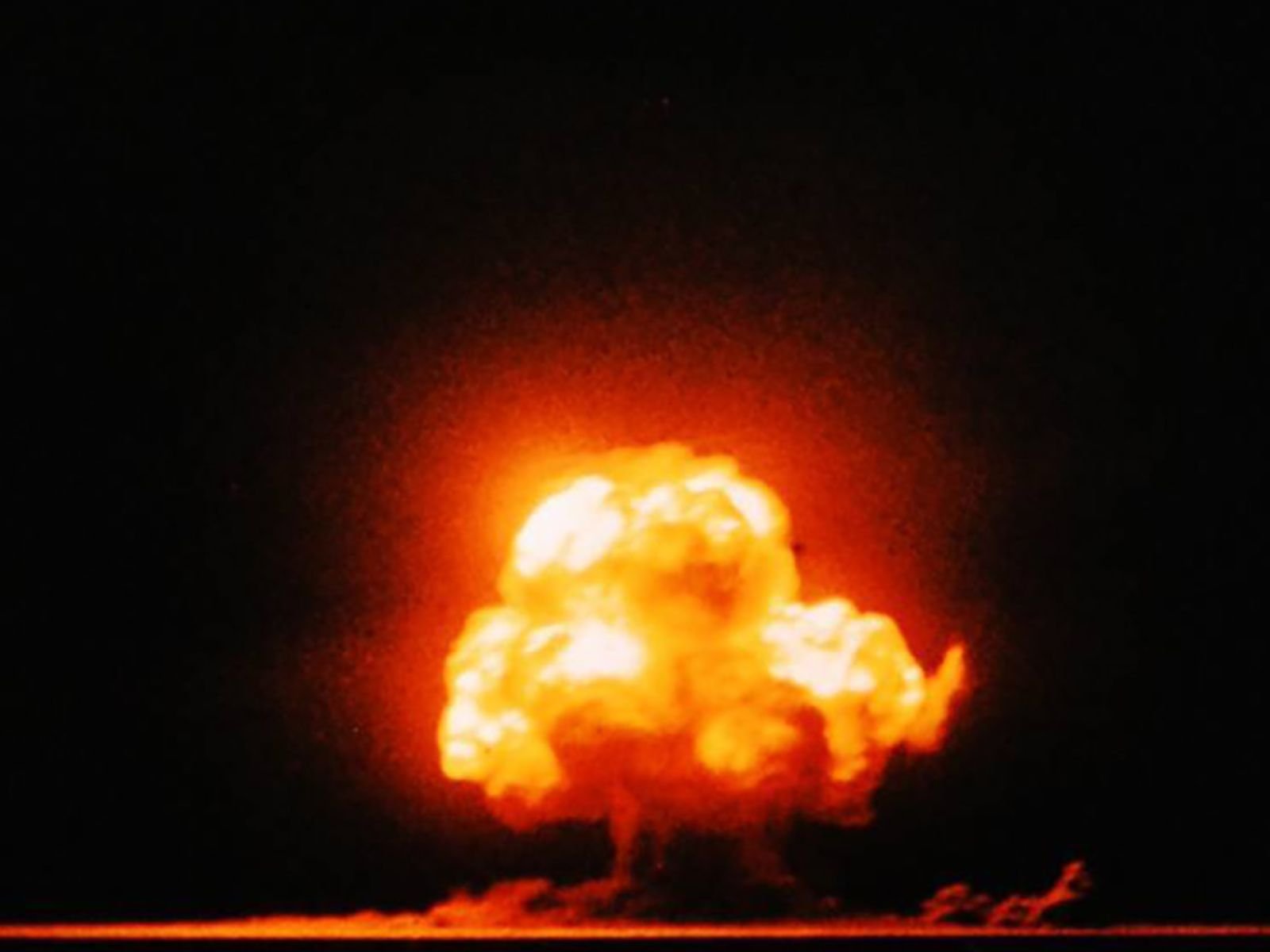
At 5 hours, 29 minutes and 45 seconds on 16 July 1945, the first atomic bomb in history exploded with an energy equivalent to 21 kilotons of TNT (87.5 TJ). It left in the Jornada del Muerto desert, in New Mexico, a radioactive crater 3 metres deep and 330 metres across. At the moment of detonation the surrounding mountains were lit more intensely than by the sun for a brief moment lasting a second or two, and at the base camp a heat as intense as that of an oven was reported. The colours observed ranged from purple to green and eventually white. The sound of the shock wave took 40 seconds to reach the observers, the explosion was felt more than 160 km away, and the mushroom cloud rose to 12 km. The desert sand at the site of the blast fused, creating a green, slightly radioactive glass christened “Trinitite”, a geological artefact of the new age that had just been born.
The ‘Gadget’ and the Observation Bunkers
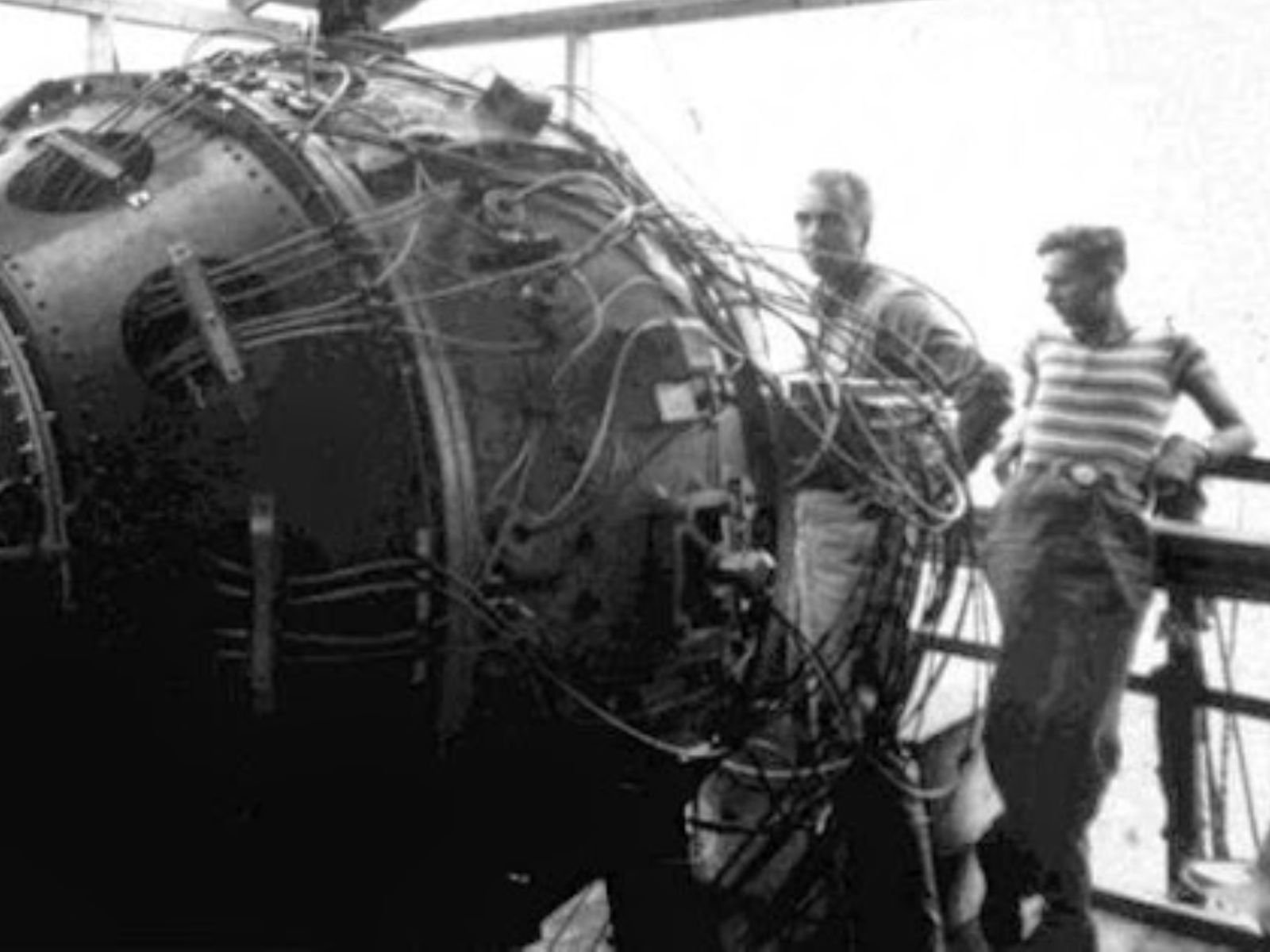
The Gadget, the bomb used in the Trinity Test.
The device that was detonated, nicknamed the “Gadget”, was a plutonium implosion bomb, a complex and uncertain design that made the test essential. To ensure the success of the detonation and the safety of the observers, the “Gadget” was hoisted to the top of a 30-metre steel tower designated Ground Zero. About 260 people were present at the test, none closer than 9 kilometres. Three observation posts of wood reinforced with concrete and covered with earth were built about 10 kilometres to the north, south and west of ground zero (codenamed Able, Baker and Pittsburgh respectively). The Baker bunker served as the control centre for the test, the place from which the chief scientist J. Robert Oppenheimer and his team conducted the final countdown.
The Firestorm and the Radioactive Silence
The explosion itself was a spectacle of primordial force, a terrifying demonstration of the laws of physics. The initial flash, brighter than the midday sun, was followed by an overwhelming wave of heat. The physicist Otto Frisch, one of the observers, described it as “a sight one thought possible only on the Day of Judgement”. The pulsing fireball rose rapidly, turning into the iconic mushroom cloud, a cloud of dust, debris and radioactive fission products that climbed more than 12 kilometres into the stratosphere. What the scientists and the military did not disclose at the time was the extent of the radioactive fallout. Particles containing dangerous isotopes such as iodine-131, strontium-90 and caesium-137 were carried by the wind, contaminating a vast area of New Mexico. That invisible, silent rain poisoned the water and the land, contaminating food and setting off a chain of illness that would affect generations of “downwinders”, the American citizens who became the first, and for a long time forgotten, victims of the atomic age.
The Secret and the Revelation
Alamogordo Air Base issued a 50-word press release, reporting that there had been “an explosion at a remote ammunition dump, in which no one had died or been injured”. This was the official smokescreen to hide from the world the most significant event in modern military history. The local population, who witnessed the blinding light and felt the shock wave, remained in ignorance, without any warning about the nature of the test or the dangers of the radioactive rain that followed. The true cause was publicly confirmed only after the success of the attack on Hiroshima on 6 August of that same year.
The Message to Potsdam and the End of the War
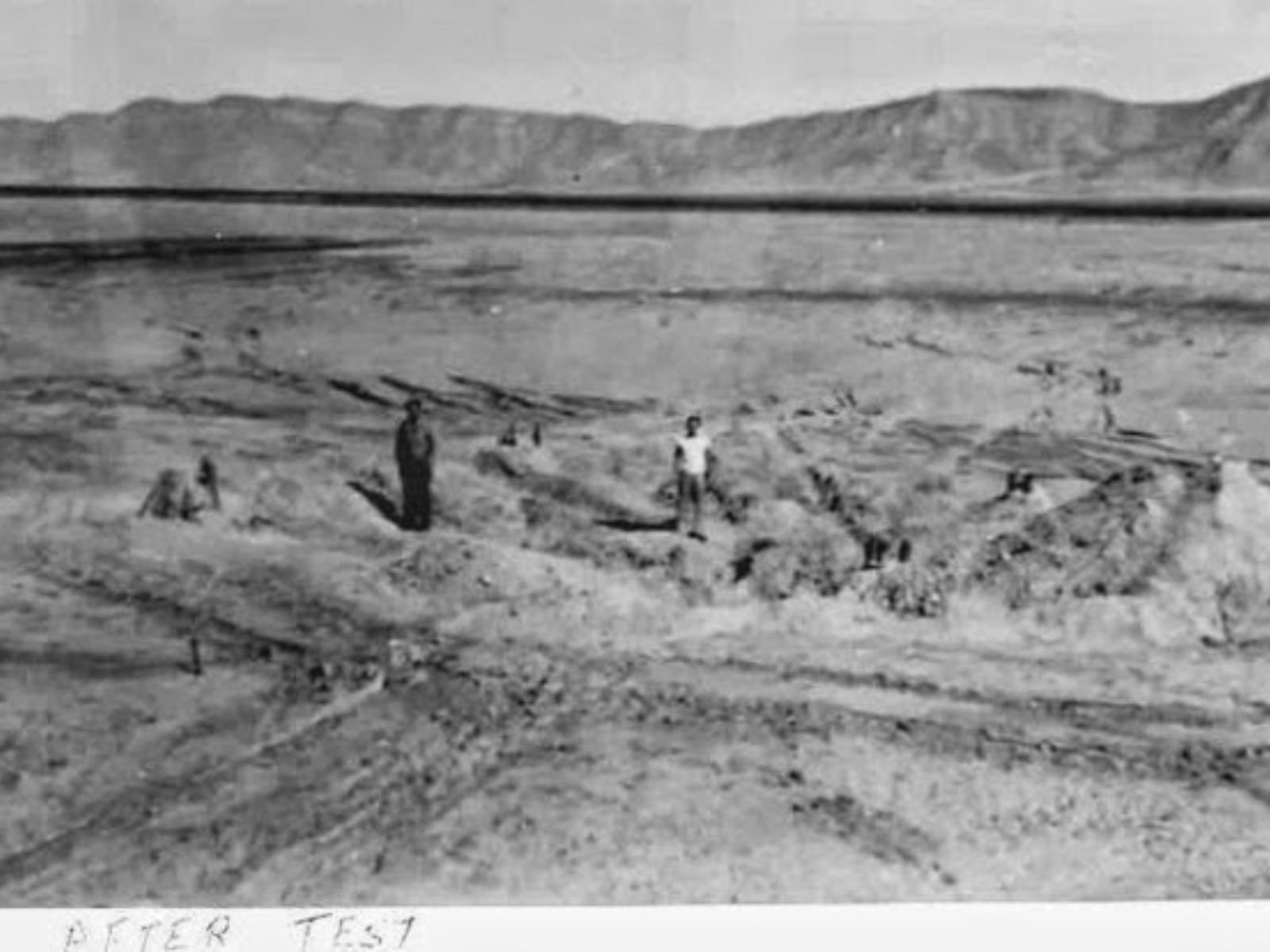
“Ground zero” of the Trinity test being surveyed after the explosion.
The results of the test were forwarded to the President of the United States, Harry S. Truman, who was anxiously awaiting them at the Potsdam Conference in Germany, where he was meeting Winston Churchill and Joseph Stalin to decide the future of the post-war world. The coded message “Operated this morning. Diagnosis not complete but results seem satisfactory and already exceed expectations… Dr. Groves pleased.” arrived at 7.30 in the morning of 16 July. The news gave Truman a powerful new bargaining tool, drastically altering the balance of power at the conference and in the nascent Cold War. In the wake of the success of the Trinity Test, two bombs were prepared for use against Japan.
The first, named Little Boy (a uranium-235 bomb of simpler design), was dropped on Hiroshima on 6 August. The second, known as Fat Man (a replica of the plutonium “Gadget”), was dropped on Nagasaki on 9 August. The bombings of Hiroshima and Nagasaki killed at least 120,000 people immediately and forced Japan’s unconditional surrender on 15 August 1945, bringing the Second World War to an end.
The Invisible Legacy: The ‘Downwinders’
While the world celebrated the end of the war, a silent tragedy was unfolding in New Mexico. The populations living downwind of the test site, known as “downwinders”, were exposed to the radioactive fallout without any warning or protection. For decades the US government denied the harmful effects of the radiation. Later studies, however, such as the one conducted by the National Cancer Institute and published in 2020, estimated that exposure to the fallout from the Trinity test may have caused hundreds, possibly up to a thousand, excess cancer cases in the local population. The communities, mostly Hispanic and Native American, suffered high rates of cancer and other illnesses, a toxic legacy that has only recently begun to be officially acknowledged.
Oppenheimer’s Dilemma and the Atomic Conscience
The director of Los Alamos, Robert Oppenheimer, later said that, on observing the demonstration of the effects of the Trinity Test, a passage from the Hindu sacred text the Bhagavad Gita came to his mind:
“If the radiance of a thousand suns
were to burst into the sky,
that would be like
the splendor of the Mighty One…
I am become Death, the shatterer of Worlds.”
That quotation became the symbol of the profound moral dilemma that would haunt Oppenheimer and many of the Manhattan Project scientists for the rest of their lives. They had unleashed a force capable of annihilating humanity, and the responsibility weighed on their consciences. After the war Oppenheimer became an advocate of international control of nuclear weapons and a critic of the Cold War arms race, a stance that would eventually cost him his political career during the McCarthy era.
The Age of Nuclear Fear
The Trinity Test did not merely end the Second World War; it inaugurated the Nuclear Age and the Cold War. The demonstration of American atomic power accelerated the Soviet nuclear programme, which would detonate its own bomb in 1949, beginning a dangerous arms race. The world came to live under the shadow of “Mutual Assured Destruction” (MAD), a doctrine of deterrence which, paradoxically, maintained a precarious peace through the threat of total annihilation. The legacy of Trinity is therefore twofold: on one hand, an unprecedented scientific and technological feat; on the other, the beginning of a period of existential fear that shaped politics, culture and the global psyche for more than four decades.
The Legacy of Trinity: 80 Years of Nuclear Consciousness
Today the site of the Trinity test is a National Historic Landmark, open to the public only two days a year. A silent stone obelisk marks ground zero, a sober monument to the power that was unleashed there. The story of Trinity is a complex narrative about human ingenuity, the fear of war and the moral ambiguity of progress. It represents the moment when humanity acquired the capacity to destroy itself, a responsibility that has defined global geopolitics ever since. Looking back, 80 years after that dawn in the New Mexico desert, the Trinity Test remains not only the beginning of the atomic age but a perpetual reminder of the fine line between scientific discovery and destruction, and of the wisdom needed to navigate this new world which, in a flash of blinding light, was born of fire.
Read Also
Bibliographic References
- “Manhattan Project.” Britannica. https://www.britannica.com/event/Manhattan-Project.
- “Summary of Findings from the Study of the Trinity Nuclear Test.” National Cancer Institute. https://dceg.cancer.gov/research/how-we-study/exposure-assessment/trinity/community-summary.
- “The Manhattan Project Shows Scientists’ Moral and Ethical Responsibilities.” Scientific American. https://www.scientificamerican.com/article/the-manhattan-project-shows-scientists-moral-and-ethical-responsibilities/.
- “The Trinity Test (1945).” Atomic Heritage Foundation. https://ahf.nuclearmuseum.org/ahf/history/trinity-test-1945/.
- “Trinity Test Downwinders.” U.S. National Park Service. https://www.nps.gov/articles/000/trinity-test-downwinders.htm.
- “The Atomic Bomb’s First Victims Were in New Mexico.” History.