In the early hours of 13 August 1961, Berliners awoke in a transformed city. Where there had been streets, there was now barbed wire. Where there had been neighbours, there were now soldiers. The Berlin Wall, or “Anti-Fascist Protection Rampart” in the cynical terminology of communist propaganda, was not merely a physical barrier; it was the materialisation of the Iron Curtain, a scar of concrete that divided a city, a nation and the world into two irreconcilable ideological blocs.
More than separating capitalism and communism, the Wall separated destinies, families and dreams, becoming the most brutal symbol of the bankruptcy of a system that needed to imprison its own citizens in order to survive.
The Roots of the Separation
The division of Berlin did not begin with the Wall, but with Germany’s defeat in 1945. The city, located in the heart of the Soviet occupation zone, was divided among the four victorious powers: the United States, the United Kingdom, France and the Soviet Union. The ideological differences, however, soon became irreconcilable. While the Western Allies promoted democracy and the market economy, the Soviets imposed authoritarian socialism.
The Berlin Blockade (1948-1949), when Stalin tried to force the Allies to abandon the city, was the first great confrontation of the Cold War. The Western response, the Berlin Airlift, which supplied the city for 11 months, demonstrated the determination not to yield to communist blackmail.
Exodus: The Haemorrhage the Wall Tried to Stem
The building of the Wall was not an act of strength but of desperation. Between 1949 and 1961, some 2.7 million East Germans fled to the West, a “haemorrhage” of brains and labour that threatened the collapse of the German Democratic Republic (GDR). Doctors, engineers, teachers and skilled workers abandoned the socialist promise en masse in search of the freedom and prosperity offered by West Germany’s “economic miracle”.
In 1960 alone, more than 199,000 people fled, an average of 545 a day. The communist regime faced an existential crisis: how do you sustain a state when its own citizens reject it? The Wall was the brutal solution to contain that flight, turning East Berlin into a vast open-air prison.
Construction: An Operation in the Dead of Night
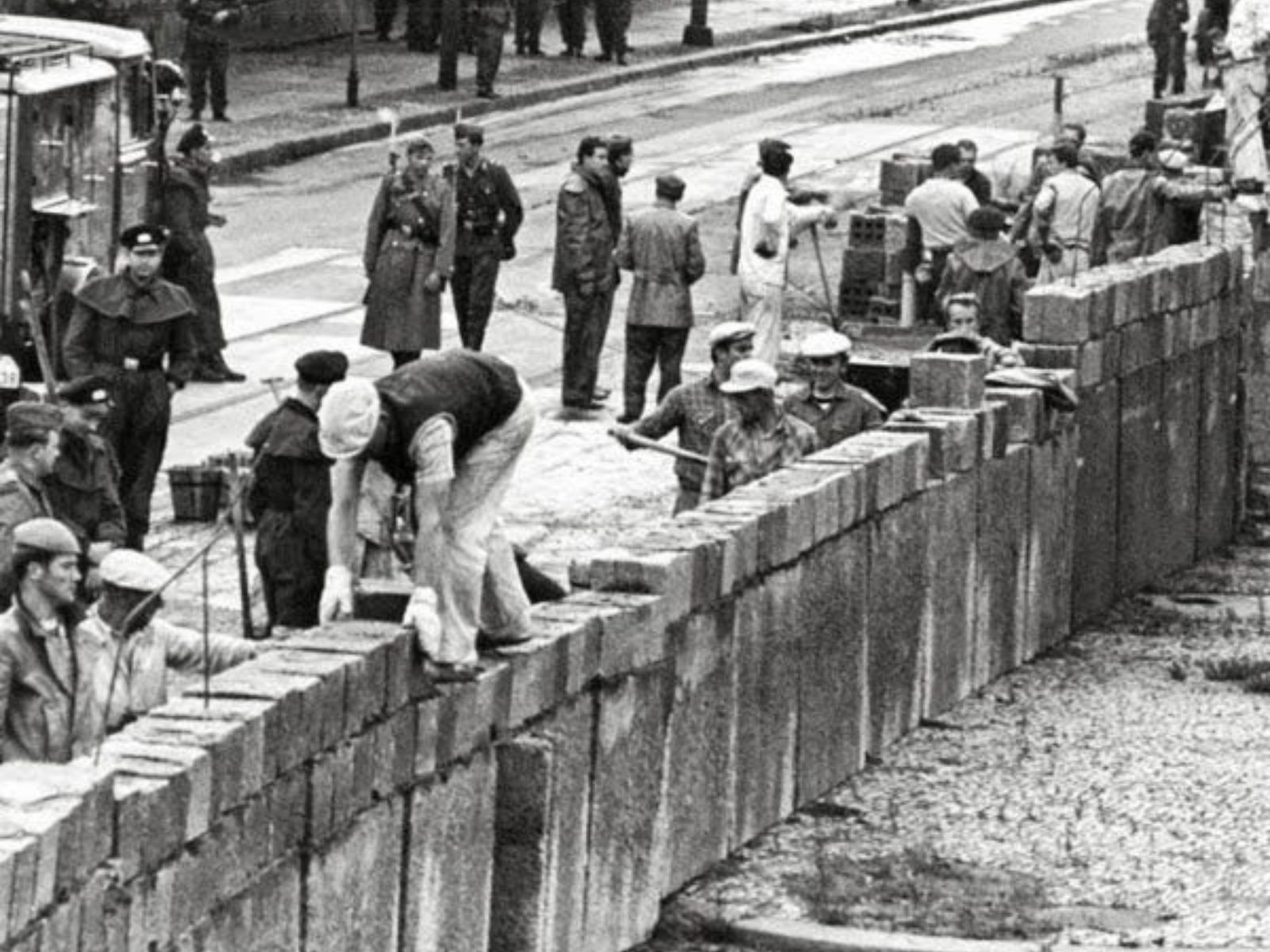
The construction of the Wall was a massive project that employed thousands of workers and consumed tonnes of concrete, steel and barbed wire. Each block added was an extra layer of oppression, one more step in the transformation of East Berlin into a vast open-air prison. The East German government called the Wall the “Anti-Fascist Protection Rampart” (Antifaschistischer Schutzwall), claiming it protected its citizens from the capitalist influence of the West.
Operation Rose, the codename for the construction of the Wall, was executed with military precision. At 2 in the morning of 13 August 1961, East German and Soviet soldiers began unrolling kilometres of barbed wire along the border between East and West Berlin. Within hours, 155 kilometres of barrier had divided the city.
Families were separated overnight. Workers who lived in the East and worked in the West awoke to find themselves barred from their jobs. The initial barbed wire soon gave way to a more sophisticated structure: concrete blocks, watchtowers, guard dogs, landmines and the infamous “death strip”, an area of soft sand where any footprint would be easily detected.
Built in Record Time
What began as an improvised barbed-wire barricade rapidly evolved into a more permanent and menacing structure. The operation had been planned in absolute secrecy by the East German government, led by Walter Ulbricht, with Soviet backing. Streets were blocked with barricades, underground and railway lines were cut, and 97 kilometres of barbed wire were unrolled in a matter of hours.
Berliners awoke that Sunday morning to discover that their city had been divided during the night. East German workers, many of them forced to take part under threat of losing their jobs or even imprisonment, raised the barrier that would imprison their own compatriots. Some workers refused and fled to the West; others obeyed out of fear of reprisals against themselves and their families.
The Purpose of the Wall
The Wall had a single purpose: to stop East Germans fleeing to freedom. Between 1945 and 1961, some 3.5 million East Germans, nearly a fifth of the population, had fled to the West through Berlin. East Germany’s economy was bleeding its most qualified citizens. The Wall was the communist regime’s brutal solution to stem that haemorrhage.
Anatomy of Oppression: How the Berlin Wall Worked
The Berlin Wall evolved over the years into one of the most fortified borders in the world. The final version consisted of two parallel walls of reinforced concrete, 3.6 metres high, separated by a “death strip” up to 160 metres wide. That intermediate zone contained anti-tank obstacles, trenches, guard dogs, landmines, seismic sensors and 302 watchtowers manned by armed guards with orders to shoot to kill.
The system was completed by powerful floodlights that lit the area at night, turning any escape attempt into a deadly nightmare. The Wall was thus not merely a barrier; it was a death machine designed to discourage any dream of freedom.
Checkpoint Charlie: The Stage of the Cold War
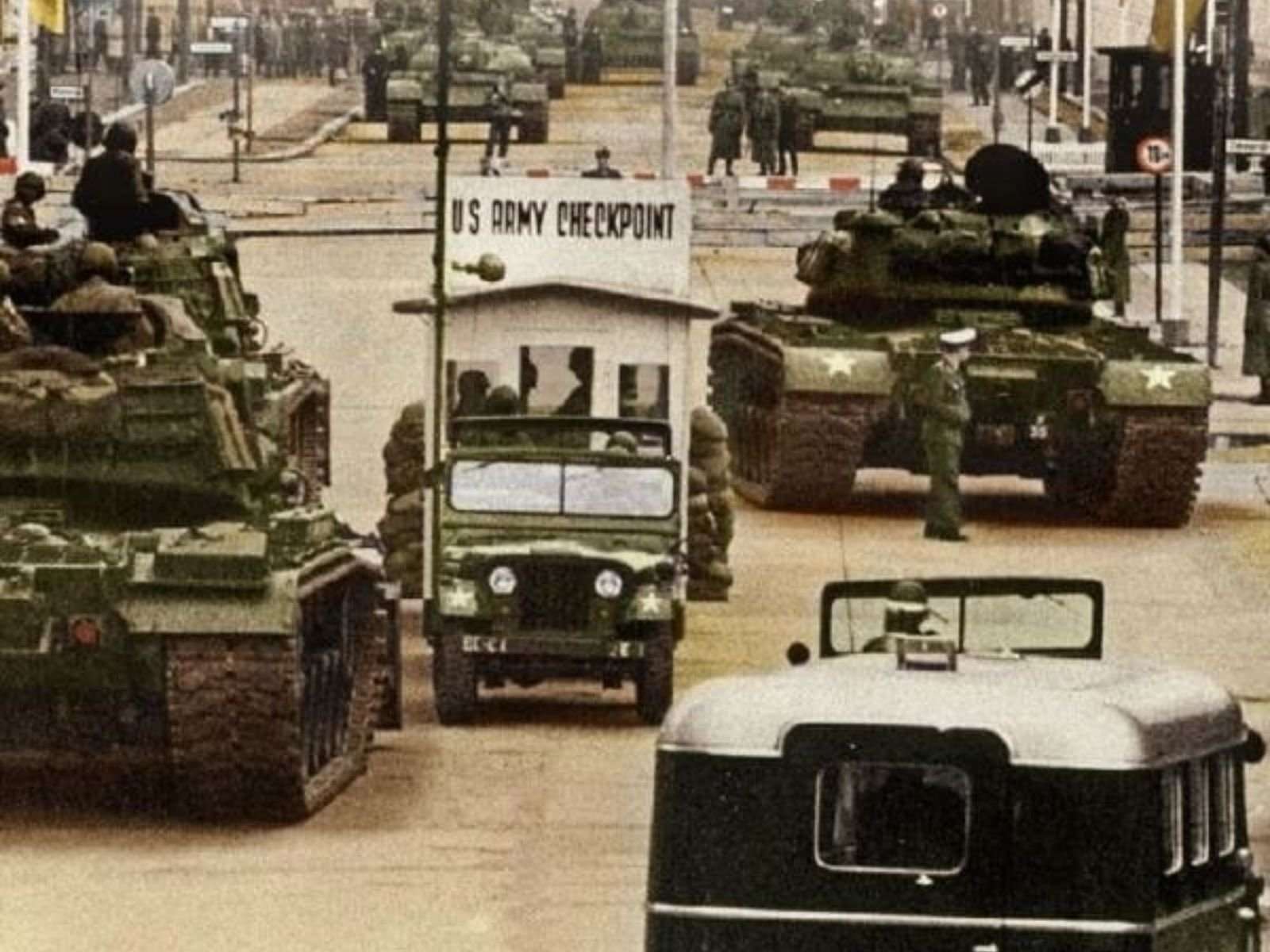
27 October 1961, Checkpoint Charlie, Friedrichstrasse, Berlin. American M-48 Patton tanks and Soviet T-55 tanks face each other a few metres apart, cannon against cannon, in one of the most dangerous moments of the Cold War. This photograph captures the moment of maximum tension: two empires, two ideologies, two incompatible visions of the world, separated by only a few metres of asphalt. It is an image that defines the Cold War: massive military power restrained only by the mutual understanding that using that power would mean mutual annihilation.
In the heart of the divided city, a small checkpoint on Friedrichstrasse became the epicentre of global tension: Checkpoint Charlie. This was the only crossing point for diplomats, Allied military personnel and foreign tourists, a stage on which the two superpowers faced each other daily. In October 1961 the world held its breath as American and Soviet tanks confronted each other for 16 hours, cannon against cannon, a few metres apart.
The Confrontation
The stand-off, sparked by a dispute over an American diplomat’s right to attend the opera in East Berlin, was a chilling reminder of how close the world stood to nuclear war. The American general Lucius Clay deployed ten M-48 Patton tanks, while the Soviets answered with thirty-six T-55s, ten of which advanced to the line of confrontation. For one terrible moment, the Third World War seemed imminent.
16 Hours of Tension
For 16 tense hours, soldiers on both sides remained in their tanks, engines running, cannons loaded and orders to return any fire. The crews could see each other’s faces through their sights. A single accidental shot, a misunderstanding or a sudden movement could have unleashed a war that would destroy civilisation. In Washington, President John F. Kennedy monitored the situation hour by hour. In Moscow, Nikita Khrushchev did the same. Through secret diplomatic channels (including a direct contact between Robert Kennedy and a KGB agent), the two superpowers negotiated frantically.
The End of Hostilities
Finally, on the morning of 28 October, both sides agreed to withdraw simultaneously. The Soviet tanks pulled back first, followed by the Americans, in a careful choreography that allowed both superpowers to claim victory. The confrontation ended without a single shot fired, but the world had come perilously close to the nuclear abyss. Checkpoint Charlie would never again see a crisis of that magnitude, but it would remain the symbol of the divided world until the fall of the Wall in 1989.
War of Shadows: Espionage in Berlin
Berlin became the espionage capital of the world during the Cold War. The divided city offered unique opportunities for intelligence operations, with agents on both sides trying to infiltrate enemy territory. The CIA, Britain’s MI6, the Soviet KGB and East Germany’s Stasi turned Berlin into a chessboard where human lives were the pieces. The famous Berlin Tunnel, a joint Anglo-American operation that intercepted Soviet communications for nearly a year, demonstrated the sophistication of those operations.
Espionage, however, had a human price: double agents, betrayals, summary executions and the constant fear of being discovered. Checkpoint Charlie became famous for prisoner exchanges, including the swap of the American pilot Francis Gary Powers for the Soviet spy Rudolf Abel in 1962.
Two Worlds, One City: Deconstructing the Communist Myth
Life on the two sides of the Wall was a study in contrasts that brutally unmasked the lies of communist propaganda. In West Berlin, the streets pulsed with the energy of capitalism: shops full of imported goods, modern cars, freedom of expression and vibrant Western pop culture. The shop windows gleamed with products East Germans knew only from smuggled photographs.
In East Berlin, reality was grey: endless queues for basic goods, the omnipresence of the Stasi (the secret police), and an atmosphere of fear and distrust. While communist propaganda extolled equality and social justice, everyday life was marked by scarcity, repression and the absence of freedom. Life expectancy was 2.4 years shorter for men and 2.6 years shorter for women. The quality of goods was inferior, joy was a luxury item, and hope a crime against the state.
Police State: The Stasi and the Reign of Fear
The Stasi, officially known as the Ministry for State Security, was the communist regime’s instrument of terror. With 91,000 employees and a network of 189,000 civilian informants, the Stasi kept a file on a third of East Germany’s population. Neighbours spied on neighbours, children denounced parents, and husbands betrayed wives. The aim was to create a society in which no one trusted anyone, where any word critical of the regime could result in prison, torture or death.
The Stasi did not merely repress dissent; it systematically destroyed human trust, the social fabric that holds a society together. As paranoia became the norm, freedom of thought disappeared, replaced by the constant fear of being denounced.
The Death Strip: The Price of Freedom
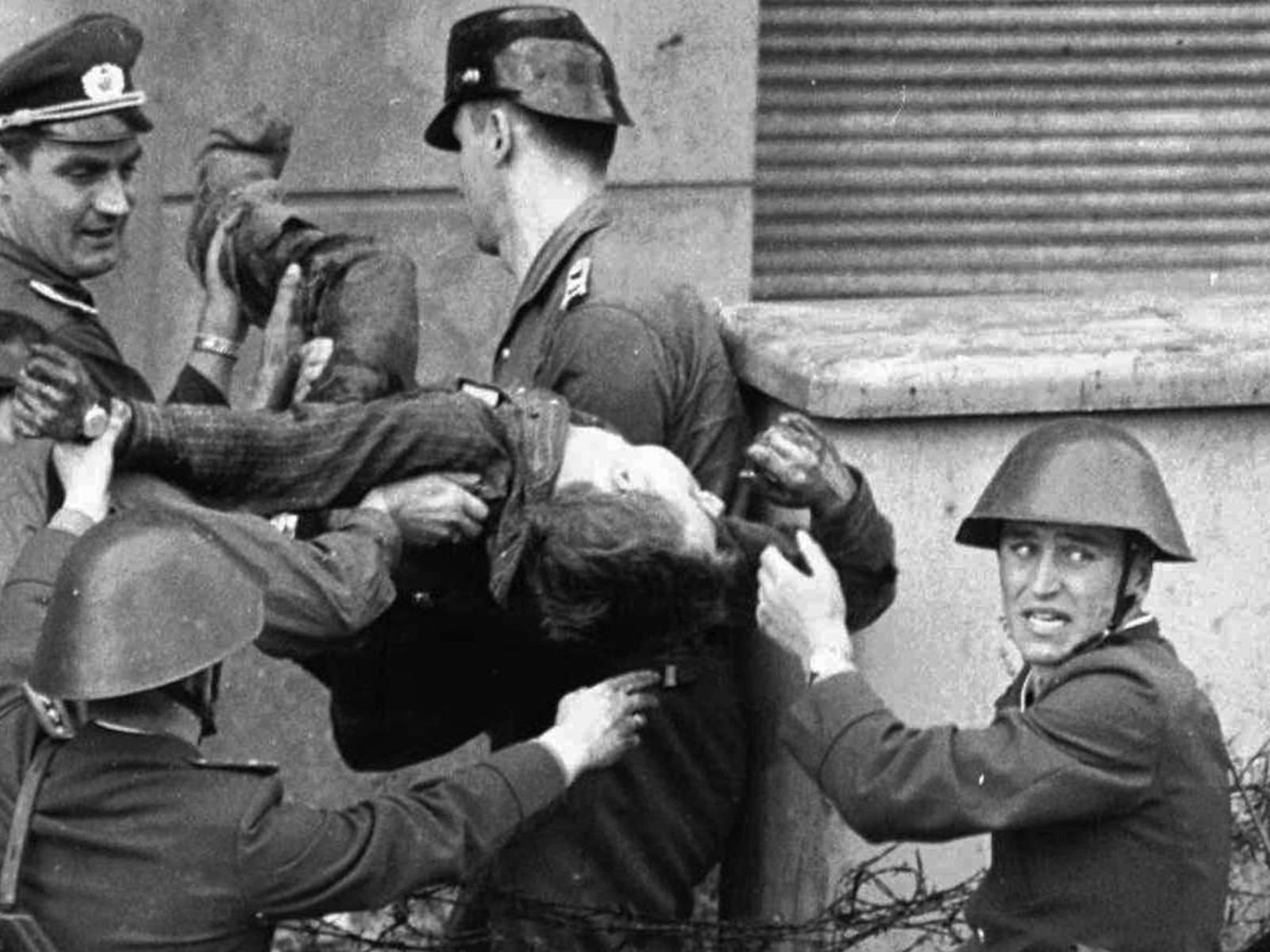
17 August 1962, 2.15 pm. Peter Fechter, an 18-year-old bricklayer from East Berlin, lies bleeding in the “death strip” after being shot by border guards while trying to climb the Wall.
Trying to cross the Wall was a death sentence. The barrier evolved from a simple wire fence into a complex concrete structure 155 km long, with watchtowers, guard dogs, mines and the infamous “death strip”, an area of sand where any fugitive could easily be gunned down.
Around 140 people died trying to reach freedom, like 18-year-old Peter Fechter, who bled to death in the death strip under the helpless gaze of both sides. Yet human creativity and courage prevailed. More than 5,000 people managed to escape, using tunnels, hot-air balloons, modified cars and the help of courageous diplomats. Every successful escape was a victory of human dignity over tyranny.
Peter Fechter
17 August 1962, 2.15 pm. Peter Fechter and his friend Helmut Kulbeik had planned the escape carefully. They ran together towards the Wall near Checkpoint Charlie. Kulbeik managed to climb over and jump to the western side. Fechter was almost at the top when East German guards opened fire. Peter was hit in the pelvis and fell back into the death strip.
For nearly an hour, Fechter cried out for help as he bled. American soldiers and West Berliners could not help him without provoking an international incident. East German guards did not come to his aid. He died before being removed. His death was witnessed by hundreds of people and photographed, becoming a symbol of the regime’s brutality. Peter Fechter was the 27th person to die trying to cross the Berlin Wall.
Stories of Courage: The Great Escapes
The escape attempts across the Berlin Wall produced some of the most dramatic stories of the Cold War. Tunnel 57, dug by university students, allowed 57 people to escape in a single night in October 1964. The Wetzel and Strelzyk families built a home-made hot-air balloon and flew to freedom in September 1979, inspiring the film “Night Crossing”.
Heinz Meixner hid his fiancée and her mother in the boot of an Austin-Healey Sprite convertible and sped past the guards. Conrad Schumann, the East German soldier photographed leaping over the barbed wire in August 1961, became a worldwide symbol of the pursuit of freedom. Every escape story was testimony to the human refusal to accept oppression as an inevitable fate.
Conrad Schumann
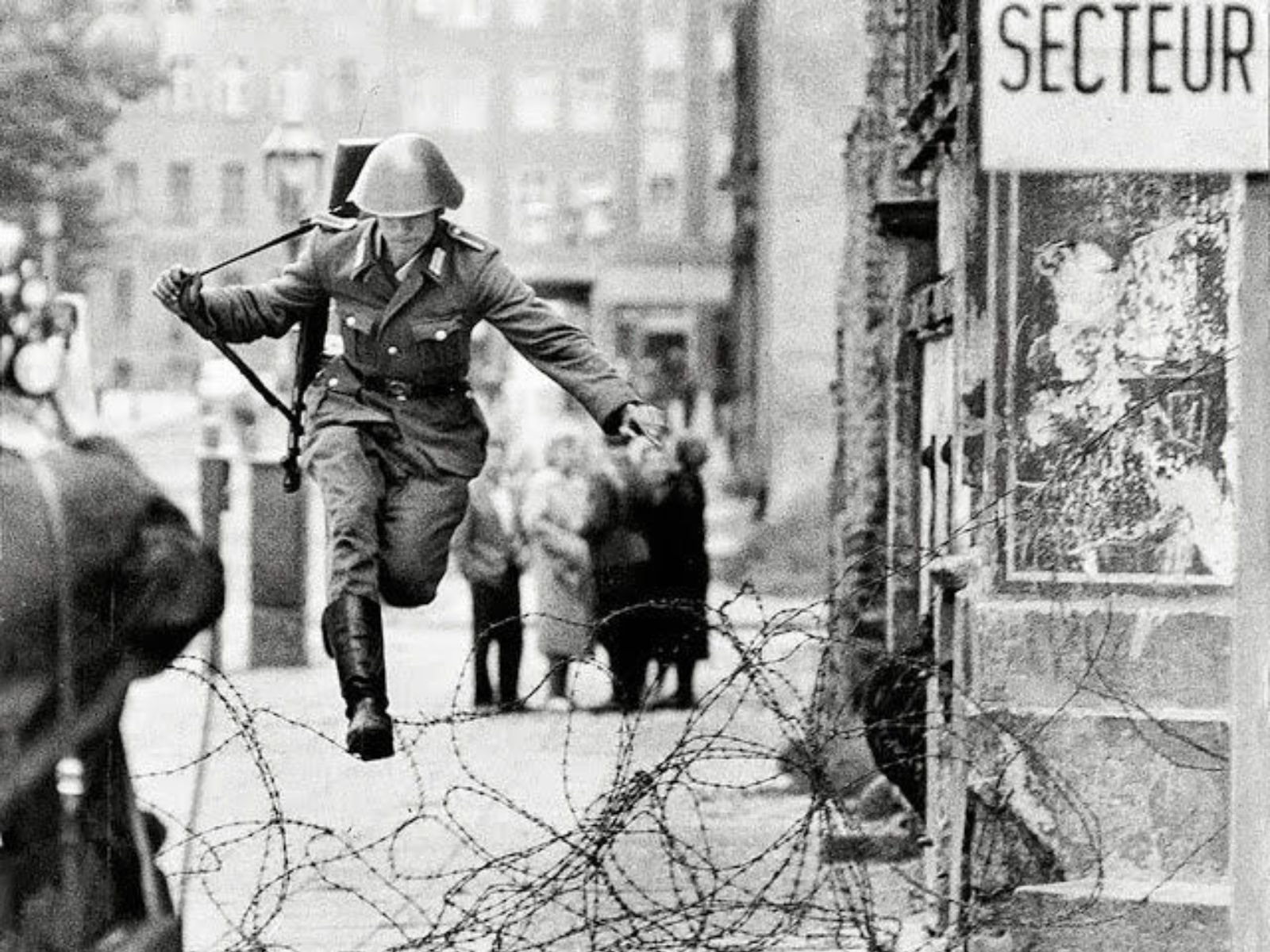
The soldier Conrad Schumann leaps to freedom on 15 August 1961, one of the first and most iconic acts of desertion.
Conrad Schumann, aged 19, of East Germany’s Volkspolizei (People’s Police), made the most important decision of his life in a split second. While guarding a barbed-wire barricade at the corner of Ruppiner Strasse and Bernauer Strasse, Conrad saw West Berliners on the other side shouting “Komm rüber!” (“Come over!”). Schumann had been ordered to prevent escapes, but he himself was trapped. In that moment, with his rifle still slung over his shoulder, he ran and leapt over the low barbed wire, falling into the arms of freedom.
The photograph, captured by the photographer Peter Leibing, became one of the most iconic images of the twentieth century, a universal symbol of the human quest for freedom. Schumann lived in the West for 37 years but never fully overcame the guilt of having abandoned his family and friends. In 1998, aged 56, he took his own life. His story is a reminder that freedom, however precious, sometimes comes at a devastating emotional cost.
Systematic Repression: When the State Becomes the Enemy
The East German regime was not content with preventing escapes; it also brutally punished any attempt at resistance. The families of escapees were persecuted, lost their jobs and were forced to move into smaller flats. Children were separated from their parents and sent to state orphanages where they were indoctrinated against their own families.
Education was an instrument of propaganda, art was censored, and religion was seen as a threat to the state. Communism thus offered not merely a different economic system; it demanded the total submission of the human soul. Repression was not a side effect of the system; it was its essence.
Rising Tensions: Berlin as a Powder Keg
During the 28 years of its existence, the Berlin Wall was the epicentre of countless crises that nearly brought the world to nuclear war. The Cuban Missile Crisis of 1962 had direct repercussions in Berlin, where tensions rose dramatically. In 1968, when Soviet tanks crushed the Prague Spring, West Berlin feared a similar invasion.
The city of Berlin became a symbol of Western resistance to Soviet expansionism, but also a hostage of global geopolitics. Every international crisis reverberated through the streets of Berlin, where American and Soviet soldiers faced each other across a line that divided not just a city, but two incompatible visions of the world.
Collapse: The Decline of the Soviet Union
By the late 1980s, the Soviet empire was collapsing. Mikhail Gorbachev’s perestroika had unleashed forces that could no longer be contained. In Poland, Solidarity was defying the communist regime. In Hungary, the border with Austria was opened, creating an escape route for East Germans. The Monday demonstrations in Leipzig grew week after week, with thousands of people chanting “Wir sind das Volk!” (We are the people!).
The East German regime, deprived of Soviet support, began to falter. On 9 November 1989, a confused announcement by a GDR official about new travel rules triggered the unthinkable. Thousands of East Berliners rushed to the Wall, and the guards, without clear orders and fearing a bloodbath, opened the barriers.
The Fall of the Berlin Wall: The End of an Era
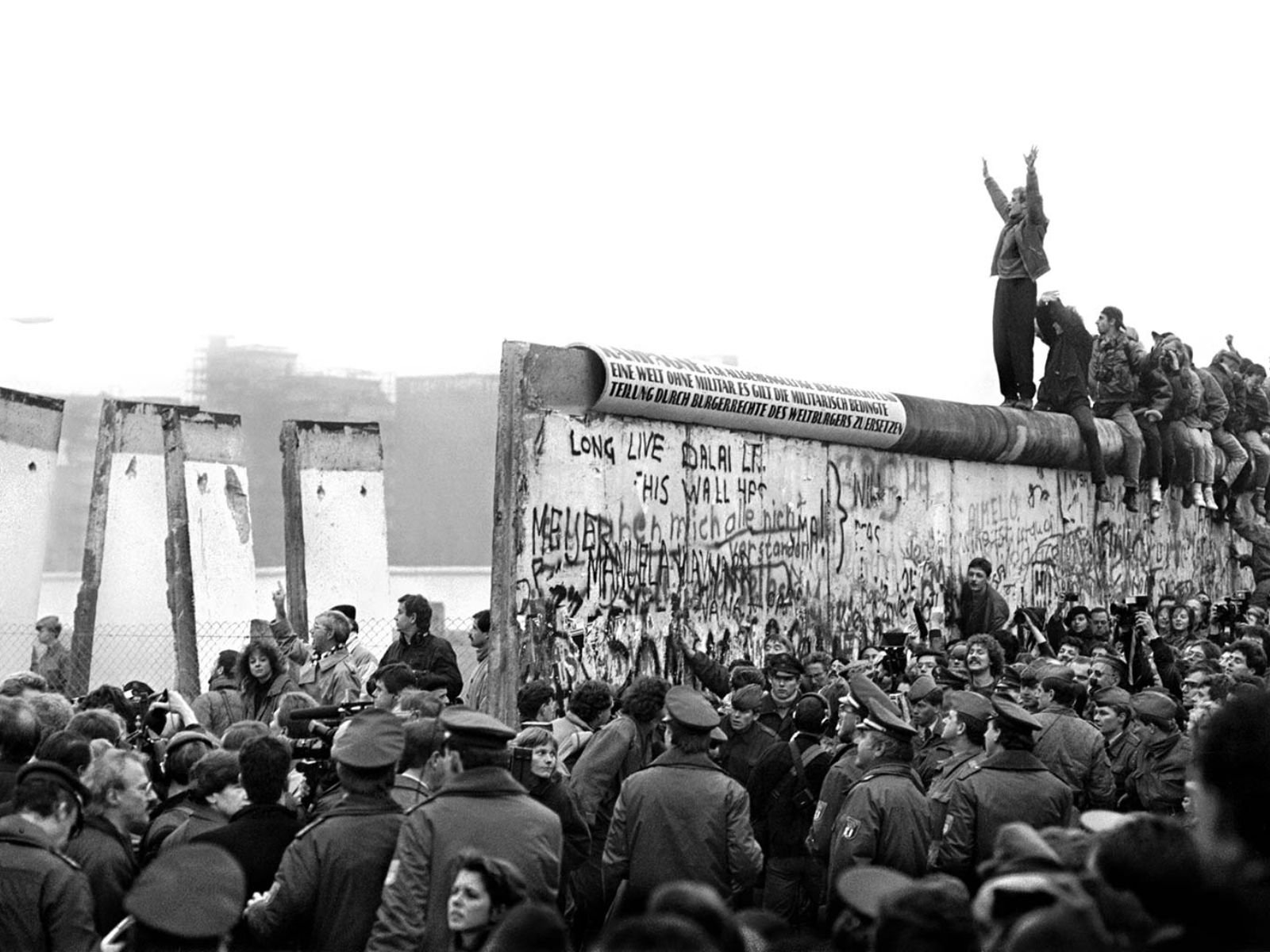
10 November 1989, the day after the gates were opened. Hundreds of Berliners occupy the top of the Berlin Wall in a symbolic act of defiance and celebration. One person raises their arms in a gesture of victory at the highest point, while crowds gather both on and around the barrier that had divided them for 28 years. The Berlin Wall, once an untouchable symbol of oppression, where anyone who came too close risked being shot, has now become the stage for a spontaneous popular celebration.
The scene that followed was one of collective euphoria witnessed by the whole world on television. People from both sides danced on the Berlin Wall, hammering at the concrete with pickaxes and celebrating the end of 28 years of separation. Families were reunited after decades of forced separation.
Young people who had grown up on opposite sides of the city finally met. The champagne flowed, the tears ran, and music echoed through the streets of a Berlin finally reunited. The fall of the Berlin Wall was not just the reunification of a city; it was the collapse of an empire and the end of the Cold War. The world watched in wonder at the power of the human will to be free.
German Reunification: Rebuilding a Divided Nation
German reunification, made official on 3 October 1990, was a complex and costly process. Two societies that had evolved separately for 45 years had to become one. West Germany invested trillions of marks in rebuilding the East, modernising infrastructure, creating jobs and integrating legal and administrative systems. The psychological scars, however, were harder to heal.
Many East Germans felt like second-class citizens, while some Westerners resented the cost of reunification. The term “Ostalgie” (nostalgia for the East) emerged to describe a selective romanticisation of the communist past. Even so, German reunification was both a triumph and a reminder that dividing is easier than uniting.
Legacy: A Scar on Memory
Today, few stretches of the Berlin Wall remain, memorials to an era of division and oppression. The East Side Gallery, a 1.3 km stretch covered in murals, has become a tourist attraction and a symbol of hope. The Checkpoint Charlie Museum preserves the memory of the escape attempts and of the courage of those who defied tyranny. The scar on the urban landscape may have disappeared, but the memory of the Wall’s brutality and of the courage of those who challenged it remains.
The Berlin Wall is an eternal reminder that no barrier of concrete can contain the human desire for freedom, and that systems which depend on walls to imprison their peoples are, in the end, doomed to fail. The story of the Berlin Wall is, fundamentally, the story of the triumph of freedom over oppression, of human dignity over tyranny, and of hope over despair.
Read Also
Bibliographic References
- “7 Things You Should Know About Checkpoint Charlie.” History. https://www.history.com/articles/7-things-you-should-know-about-checkpoint-charlie.
- “A Comparison of Life in East and West Berlin — Posters.” Halsbury Travel. https://www.halsbury.com/resources/a-comparison-of-life-in-east-and-west-berlin-posters.
- “Checkpoint Charlie.” Wikipedia, The Free Encyclopedia. https://en.wikipedia.org/wiki/Checkpoint_Charlie.
- “Checkpoint Charlie.” Britannica. https://www.britannica.com/topic/Checkpoint-Charlie.
- “All the Ways People Escaped Across the Berlin Wall.” History. https://www.history.com/articles/berlin-wall-crossings-east-germany.