The year 1943 marked the turning point of the Second World War, beginning with the German defeat by the Red Army at the Battle of Stalingrad in February. In an encounter over the skies of Europe that same year, German pilot Franz Stigler spared a damaged and defenceless American bomber. Forty-seven years later, Charlie Brown found him. The two airmen remained friends until death.
The Air Offensive over Europe
Although the defeat at Stalingrad marked the beginning of the decline of German offensive operations, Germany still held considerable resources seized in the occupied territories, along with major industrial zones devoted entirely to supplying its armies.
Faced with Germany’s remaining capacity to resist, the Allied powers (chiefly the United States and Great Britain) intensified their aerial bombing campaigns against production facilities and supply lines on German soil, aiming to assist both the Soviet advance in the east and the opening of new fronts for ground combat in western Europe.
The Encounter between Franz Stigler and Charlie Brown
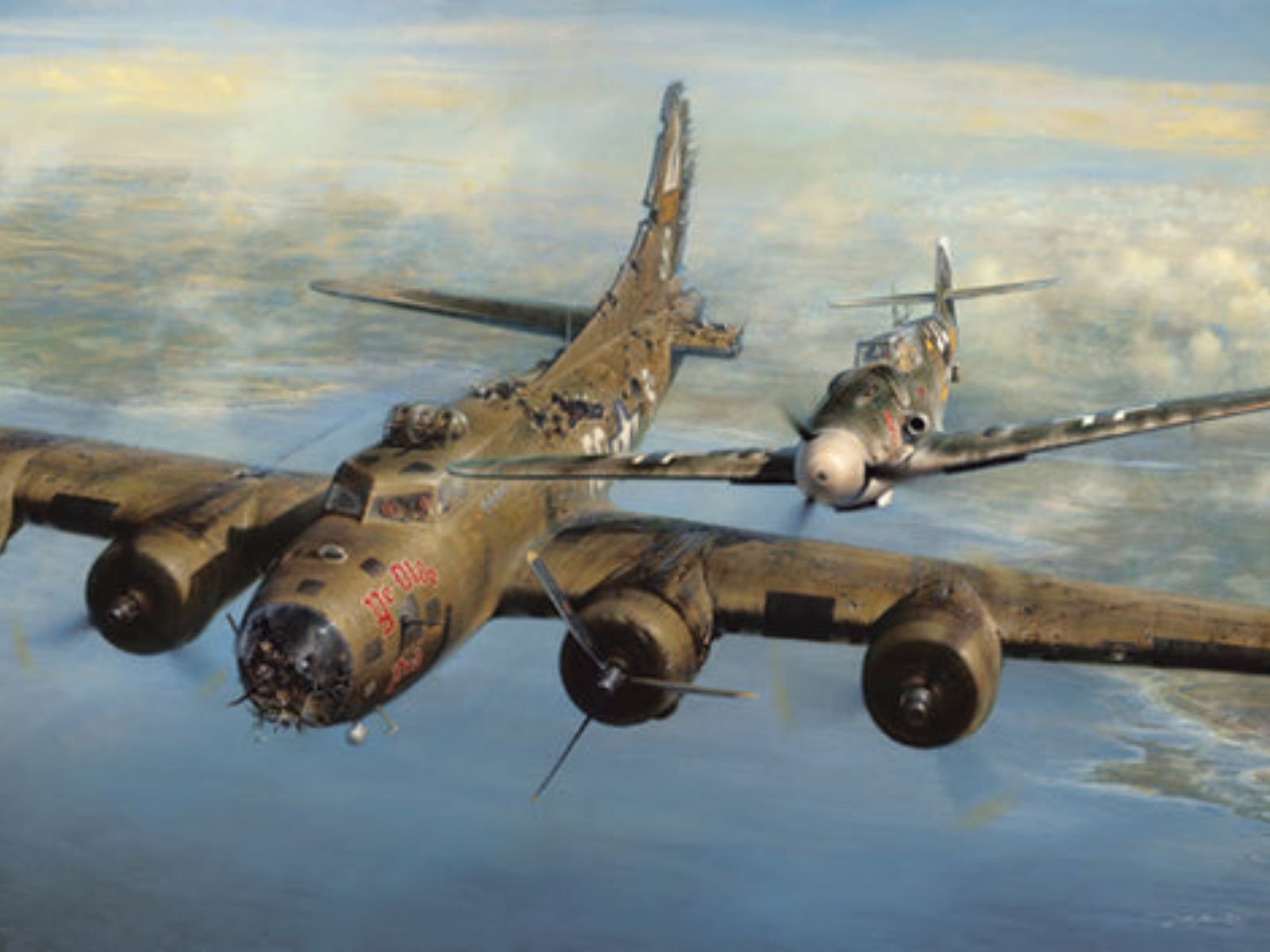
20 December 1943: Franz Stigler, a veteran German pilot, encounters the severely damaged B-17 “Ye Olde Pub” over Germany. Instead of shooting it down and earning the coveted Knight’s Cross, he chooses to escort it to safety, recalling the words of his mentor: “If I ever see you shooting at a man in a parachute, I will shoot you down myself.”
On 20 December 1943, a United States Army Air Forces B-17 bomber nicknamed “Ye Olde Pub” took off from the RAF airfield at Kimbolton, England, on a mission to bomb a Focke-Wulf aircraft factory in Bremen, Germany. The aircraft carried ten crew members under the command of 21-year-old Second Lieutenant Charles L. “Charlie” Brown.
Within minutes the mission succeeded, but not everything went as planned: German forces fired on the American aircraft, killing tail gunner Hugh “Ecky” Eckenrode, wounding six other crew members and destroying two of the plane’s engines. Charlie, leading the formation and in command, briefly lost consciousness from lack of oxygen, and the aircraft began to lose altitude. When he came to, the lieutenant stabilised the plane but realised he was being followed by a German fighter. With a wounded crew and parts of the aircraft destroyed, there was nothing to do but press on. Getting out alive would be a matter of luck.
Franz Stigler
Like many veteran Luftwaffe fighter pilots of the Second World War, Franz Stigler had accumulated years of experience in aerial combat across several theatres. He had already flown a Bf 109 in Tunisia in support of Erwin Rommel’s Afrika Korps and later fought on the Western Front in the defence of Germany. Stigler had flown alongside Hans-Joachim Marseille, one of the greatest German aces, with a total of 388 combat missions and 158 enemy aircraft shot down.
In Africa he took part in legendary engagements such as the Palm Sunday Massacre. During the incident with the American aircraft, Stigler was flying a Messerschmitt Bf 109, one of the most advanced and feared aircraft of the era. That day he had already downed two American bombers and needed just one more victory to receive the coveted Knight’s Cross.
The Aerial Encounter
Instead of firing and bringing down the American aircraft, the German pilot brought his fighter alongside the enemy plane and began to gesture. Realising his enemy would not shoot, Charlie ordered the crew to hold course. The group survived, the aircraft landed in England with only one working engine and almost no fuel, and the lieutenant never stopped wondering why the German had not fired. The Eighth Air Force classified the incident as “top secret” for decades. The German airman likewise never spoke of what he had done, for he risked facing a firing squad.
The Search for an Enemy and the Meeting of a Friend Forty-Seven Years Later
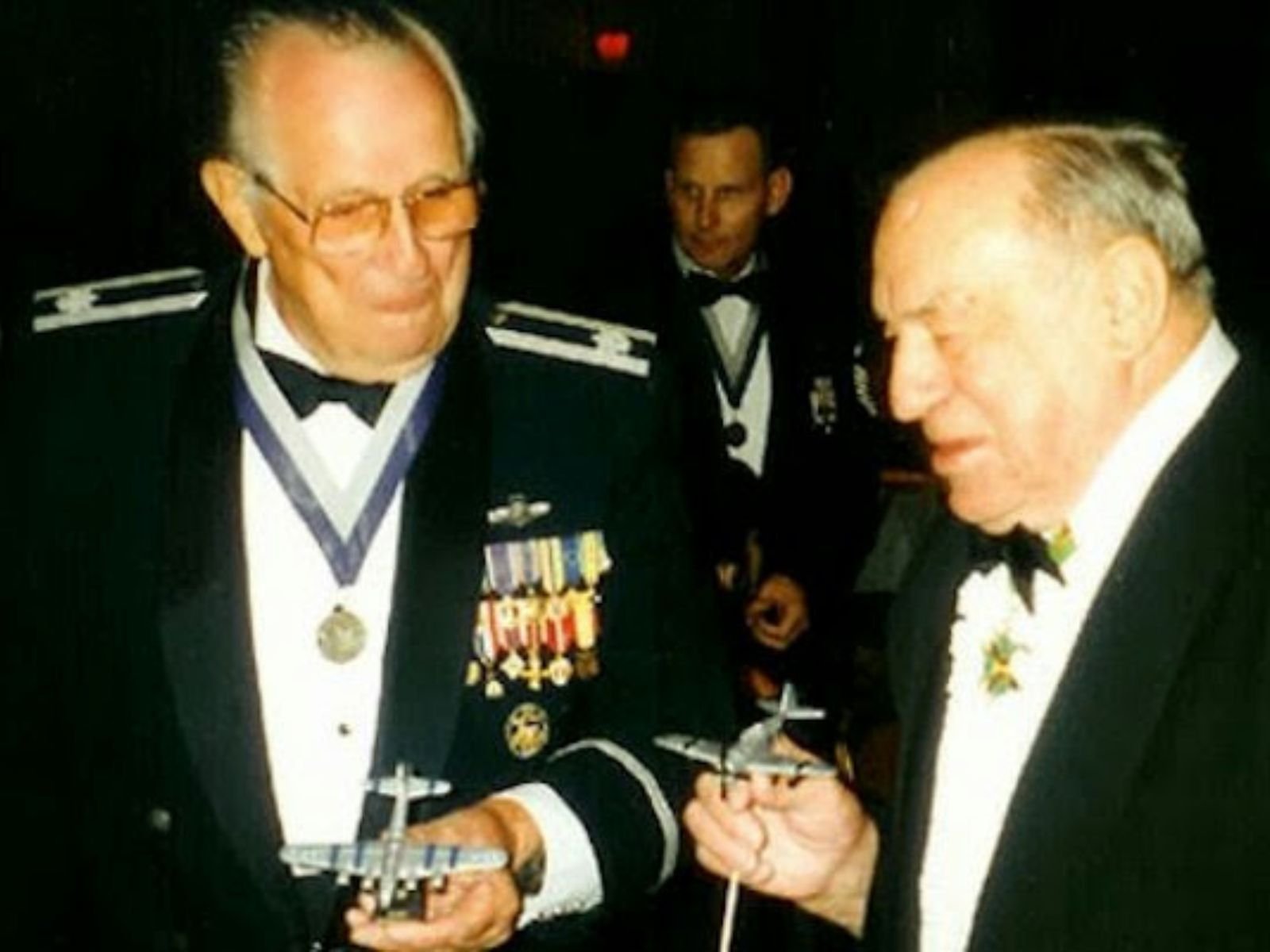
Franz Stigler and Charlie Brown, now friends, reenact the encounter that took place in the skies during the Second World War, many decades later.
In 1986, the Air Force Association sponsored an event in Las Vegas known as the “Gathering of Eagles“, attended by airmen from around the world. During the gathering, Colonel Joe Jackson, a Vietnam War veteran, asked Charlie Brown whether anything unusual had happened to him during the Second World War. In all the years that followed the greatest conflict in history, Brown had not thought about the incident with the then unknown Stigler.
Searching for something out of the ordinary, Brown answered: “I think I was once saluted by a German fighter pilot.” Astonished at what they heard, everyone began to laugh. For a brief moment Brown hesitated and questioned whether it had truly happened or was a product of his imagination. Even so, he decided to share the memory with those present.
Charlie Brown’s Search for Franz Stigler
In 1987, Brown set out to find the man who had spared his life. He paid for an advertisement in a magazine for combat pilots, which read: “I am looking for the man who saved my life on 20 December 1943.” He received a phone call. It was Franz Stigler, the German pilot. Three years later the two met, and Charlie finally got an answer to his question: “why didn’t you shoot?”
The Meeting after Forty-Seven Years
Franz explained that when he drew his fighter alongside the American aircraft, he was ready to fire. Yet he saw that the enemy plane was struggling to fly and that the crew was dying. What honour would there be in downing an aircraft in such a state? A veteran of the conflict, Stigler had served in Africa under Lieutenant Gustav Rödel, who, he said, taught him that to survive a war morally one had to fight with honour and humanity; otherwise a man could not live with himself on returning home. It was a lesson written down nowhere, but the code that guided Franz in combat saved the American airmen on that 20 December 1943.
Stigler also revealed that at that moment he remembered his mentor’s words: “If I ever see you shooting at a man in a parachute, I will shoot you down myself.” To Franz, that shattered B-17, flying slowly and with no means of defence, was like a pilot hanging from a parachute, defenceless and deserving of mercy.
There is no virtue like mercy. Mercy towards an enemy is the hardest mercy of all, and perhaps there is no true justice without mercy. Mercy is the true emblem of nobility.
“Blessed are the merciful, for they shall obtain mercy. (Matthew 5:7)”.
Friends for the Rest of Their Lives
Of the 40,000 German fighter pilots of the Second World War, only 2,000 survived. The two pilots, once enemies, became companions and exchanged letters for years. Their families came to know one another and formed a deep friendship that lasted decades. In 2008, six months apart, both men died. Franz Stigler died in March at the age of 92; Charlie Brown in November at 87.
The story of Franz and Charlie was immortalised in the book “A Higher Call“, written by Adam Makos and Larry Alexander, which became a New York Times bestseller. Two men who crossed paths a single time, each in the other’s sights, spent their final decades as friends and died in the same year, six months apart. The war placed them face to face; it was the decision of one of them that shaped the rest of both lives.
Read Also
Bibliography
- Makos, Adam, and Larry Alexander. A Higher Call: An Incredible True Story of Combat and Chivalry in the War-Torn Skies of World War II. Berkley Caliber, 2012. https://www.penguinrandomhouse.com/books/310811/a-higher-call-by-adam-makos/.
- “Mercy and Chivalry.” Confederate Colonel. https://www.confederatecolonel.com/2012/12/mercy-and-chivalry/.
- “Pilot Stigler.” Stormbirds.