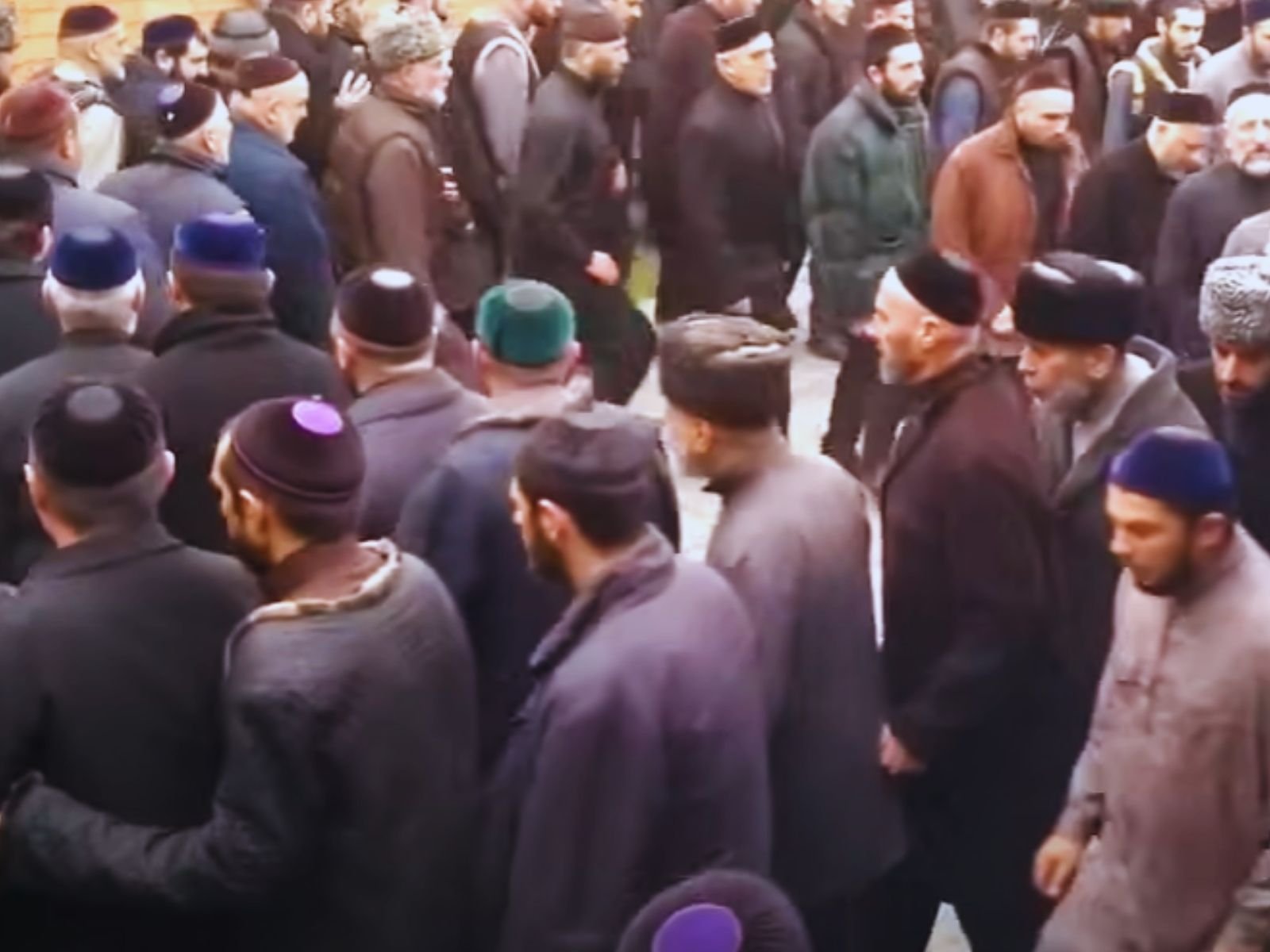
Arranged in a circle, several men move to the cadence of the chanting. The human rows, formed into rings, slide one inside the other. The stamping of feet, the swaying of bodies and the growl rising from their throats fill the space with a raw sound. One voice rises above all the others, intoning sounds in reverence to Allah. This is the sufi zikr ritual, a mystical dance of the Caucasus, from the region of Chechnya, where Islam is the dominant faith.
The Sufi Zikr Dance Ritual
In the sufi zikr ritual, the men move to both sides, at first in a slow march and then quickening their steps. As the speed increases, the circles merge into a hypnotic spinning ball. The floor shakes and roars. Dozens of men take part, most of them young. Many are in a trance. Some step aside exhausted while others take their place. The zikr takes several forms, and its origin is credited to Kunta Haji Kishiev, a shepherd who travelled to the Middle East in the nineteenth century and then returned to Chechnya, where he found converts to Sufism. Initially committed to peace, many of his followers over time joined the resistance against Russian rule. They became a people steeped in tradition and rebellious spirit.
In 1991, when Chechnya declared independence from Russia, the Kunta-Haji brotherhoods took up arms with determination. Sebastian Smith, author of “Allah’s Mountains: Politics and War in the Russian Caucasus”, wrote that during a sufi zikr ceremony a Russian bomber flew over the village at low altitude, making a deafening noise. According to Smith, no one so much as looked up, and the state of trance only deepened.
The Return of Muslim Religious Tradition in Chechnya
Chechnya, which for many years suffered a war against Russia brought on by the collapse of the Soviet Union, saw its traditional forms of religious expression return to public life with the armistice. During the 1990s Moscow, worried about local Sufi traditions, attacked Sunni Muslim groups on Chechen territory, since these Salafist groups defended an Arab interpretation of Islam frequently accused of encouraging terrorist attacks.
With the support of Vladimir Putin, Ramzan Kadyrov Akhmadovich, a former Chechen rebel, became president of Chechnya. With Kadyrov’s rise to power, the Sufi brotherhoods were no longer repressed and reclaimed a place in public life. The zikr rituals had previously been seen as a symbol of aggression, since in the Kremlin’s view the dance meant the trance of the rebels, the ritual of the untameable. Kadyrov said in an interview that he hoped to help restore Sufi traditions, as part of preserving Chechen culture.
Whether the rebellious Sufi spirit will rise again one day remains unknown. In the meantime, the dance continues with the approval of the state.
[VIDEO] Sufi Zikr: The Hypnotic Religious Dance Ritual
Read Also
Bibliographic References
- “Chechnya Becomes Home to Sufi Revival.” Pluralism Project, Harvard University. https://pluralism.org/news/chechnya-becomes-home-sufi-revival.
- “A Whirling Sufi Revival with Unclear Implications.” The New York Times. http://www.nytimes.com/2006/05/23/world/europe/23iht-grozny.html.