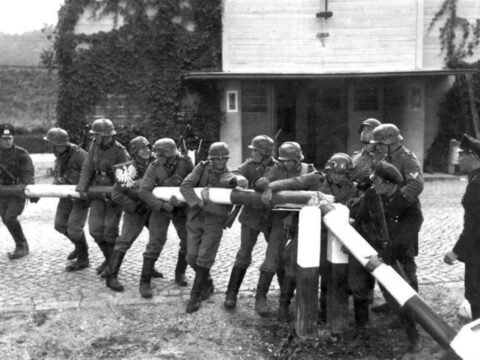
With the breaking of the Molotov-Ribbentrop Pact during the Second World War, Operation Barbarossa began, the codename for the largest military campaign in history in terms of troops mobilised and casualties suffered. In January 1942 the Soviet photographer Dmitri Baltermants captured a devastating image near Kerch, in Crimea, showing people weeping beside the bodies of their loved ones on the ground (cover photo). That grief, however, so often associated with the Russian people alone, was an agony shared by dozens of nationalities.
The myth of Russian sacrifice, which casts the “Great Patriotic War” as an exclusively Russian triumph, erases the memory of millions of Ukrainians, Belarusians, Kazakhs, Uzbeks and so many others who made up the Soviet Union and who, in many cases, suffered even more devastating losses.
Operation Barbarossa: The Beginning of Soviet Losses
In the early hours of 22 June 1941, more than three million German soldiers crossed the Soviet border. The German advance into territory that today belongs to Belarus, Ukraine and Russia was swift and overwhelming. Within days the Soviet Air Force had been all but wiped out (most of its aircraft destroyed on the ground) and Soviet armour in dispersed formation was no match for the German Blitzkrieg. Before long, Operation Barbarossa had become a question of survival for the Soviets.
No country, no people, fought as hard as the Soviet Union during the Second World War. Nowhere else did the memories of the war remain so vivid and so deep. The German invasion brought such a catastrophe that it seemed, at first, that no nation could withstand it. In the siege of Leningrad alone, which lasted more than two years, more human beings died than Americans and Britons throughout the entire war.
A Multinational Tragedy: Breaking Down the Numbers
The figure of “27 million Soviet dead” is frequently quoted, yet rarely broken down. A closer analysis reveals a far more complex and multinational reality. Although Russia suffered the largest number of losses in absolute terms, with almost 14 million dead, other republics suffered disproportionately more. Belarus, for example, lost a staggering 25.3% of its pre-war population, the highest mortality rate of any nation in the conflict. Ukraine, in turn, lost 16.3% of its population, with a total of 6.85 million dead, far exceeding Russia’s 12.7%.
That disparity is explained partly by the geography of the invasion. The entire territory of Belarus and Ukraine was occupied and turned into a bloody battlefield, while the German occupation of Russia, though vast, was concentrated in its western regions. Moreover, the Nazi policy of extermination, the Generalplan Ost, targeted the Slavic peoples specifically, treating Belarusians, Russians and Ukrainians with calculated brutality and producing a colossal number of civilian victims that in some regions far exceeded military losses.
Soviet Republic – Total Deaths – % of Population (1940)
- Belarus – 2,290,000 – 25.3%
- Ukraine – 6,850,000 – 16.3%
- Latvia – 260,000 – 13.7%
- Armenia – 180,000 – 13.6%
- Lithuania – 375,000 – 12.7%
- Russia – 13,950,000 – 12.7%
- Kazakhstan – 660,000 – 10.7%
- Other Republics – ~1,600,000 – ~8%
The Red Army: A Mosaic of Nations
The idea of a purely Russian Red Army is a myth. Of the roughly 34 million men and women who served in the Soviet armed forces during the war, approximately 8 million (23.5%) came from non-Slavic minorities. In 1941 the ethnic composition of the army was approximately 61% Russians, 20% Ukrainians, 4% Belarusians and 15% other nationalities, including Armenians, Azeris, Georgians, Kazakhs, Tatars and Uzbeks. That diversity reflected the Soviet Union itself, a multinational state forged out of the old Russian Empire.
The Faces of the Red Army
Behind the numbers there are faces and stories. The contribution of each nationality was vital and deserves to be recognised in its own right.
Ukrainians
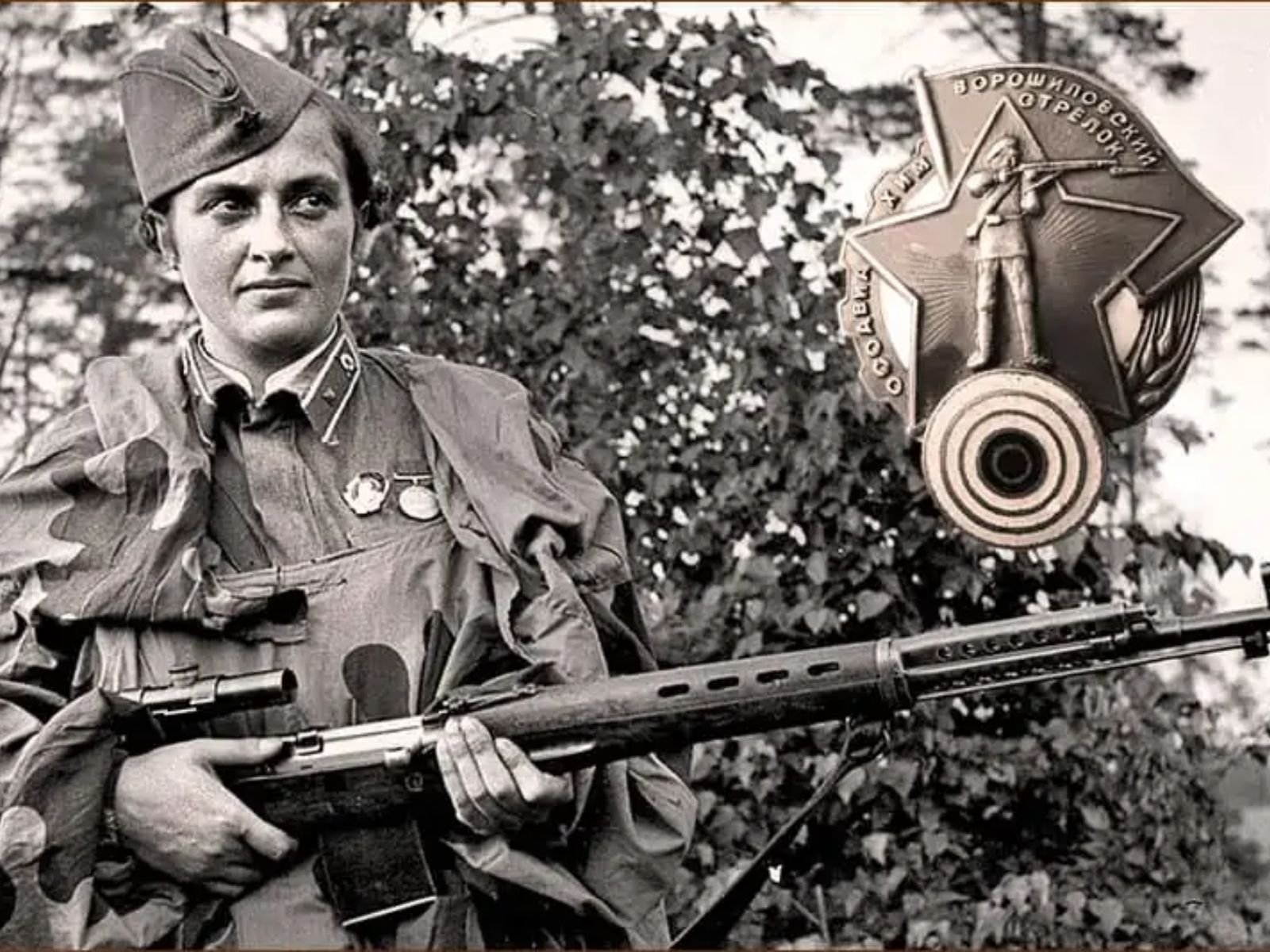
Lyudmila Mykhailivna Pavlichenko (1916-1974) was a Ukrainian sniper in the Soviet Red Army during the Second World War. Known to her enemies as “Lady Death”, she is recognised as the most successful female sniper in history, with a confirmed total of 309 enemy kills.
Around 7 million Ukrainians fought in the ranks of the Red Army, making up almost a quarter of its total strength. They not only defended their own soil but took part in crucial battles at Stalingrad, Kursk and in the liberation of Berlin. Military losses reflect that massive participation: of the 8.6 million Soviet soldiers killed in combat, an estimated 1.4 million were Ukrainian.
On the Ukrainian steppes, where golden wheat once rippled in the wind, there now lay sons and daughters who would never see the harvest of peace. Every Ukrainian village had its own tears, its own orphans, its own widows who would wait for ever for a return that would never come.
Belarusians
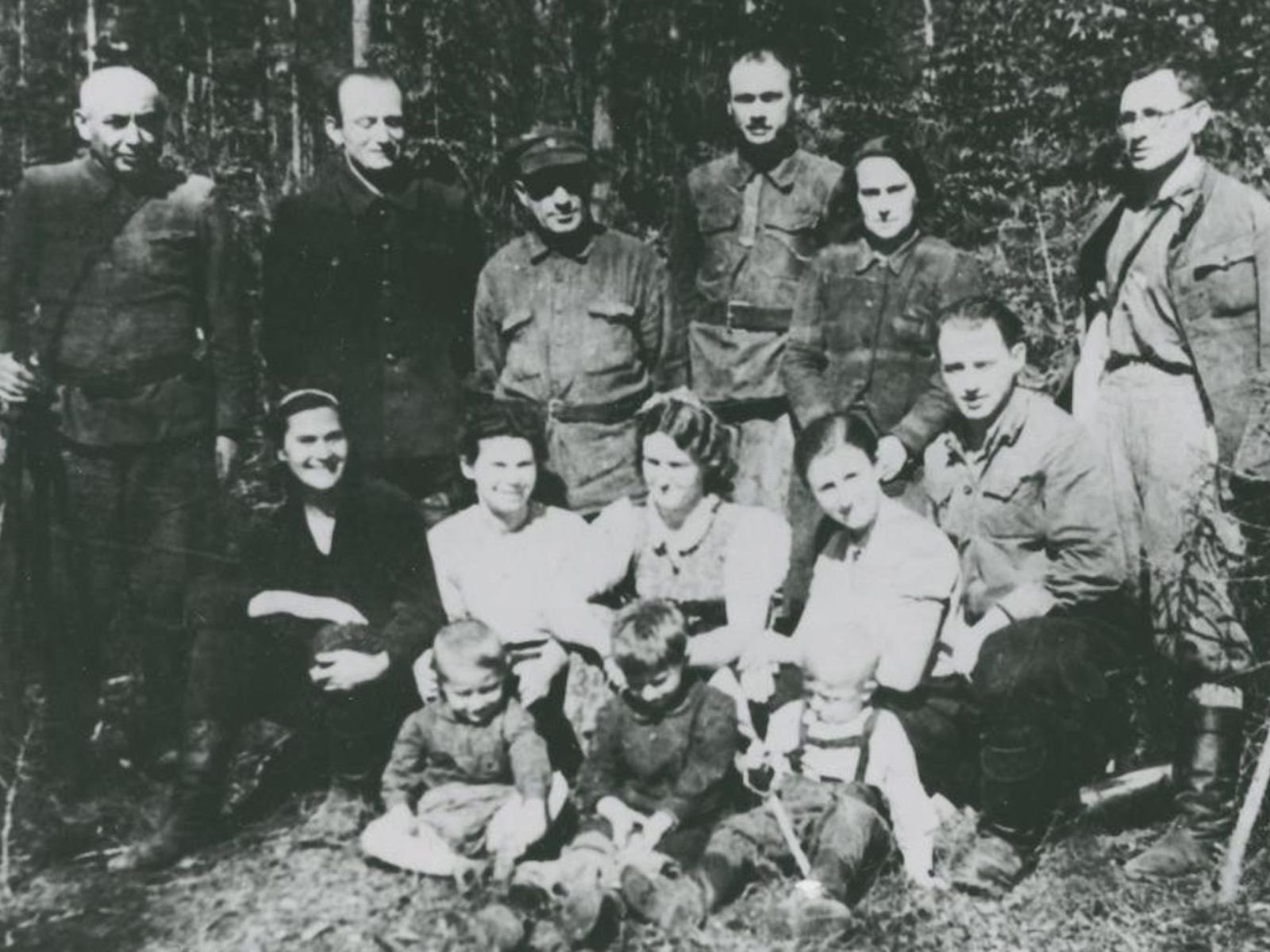
A group of Belarusian partisans during the Second World War.
Belarus was the epicentre of Nazi brutality. Beyond the 620,000 soldiers killed, the country saw 1.67 million civilians perish. The Belarusian resistance was legendary, with one of the largest partisan movements of the war. More than 374,000 partisans operated in the country’s forests, sabotaging German supply lines and tying down entire Wehrmacht divisions.
Belarusians paid a terrible price: the Nazis destroyed more than 5,000 Belarusian villages in reprisal, often burning their inhabitants alive. In the dark forests of Belarus, where the pines whispered endless laments, every tree seemed to hold the memory of a family wiped out, of a child who would never grow up, of an elder who took the stories of generations with him.
The Peoples of Central Asia
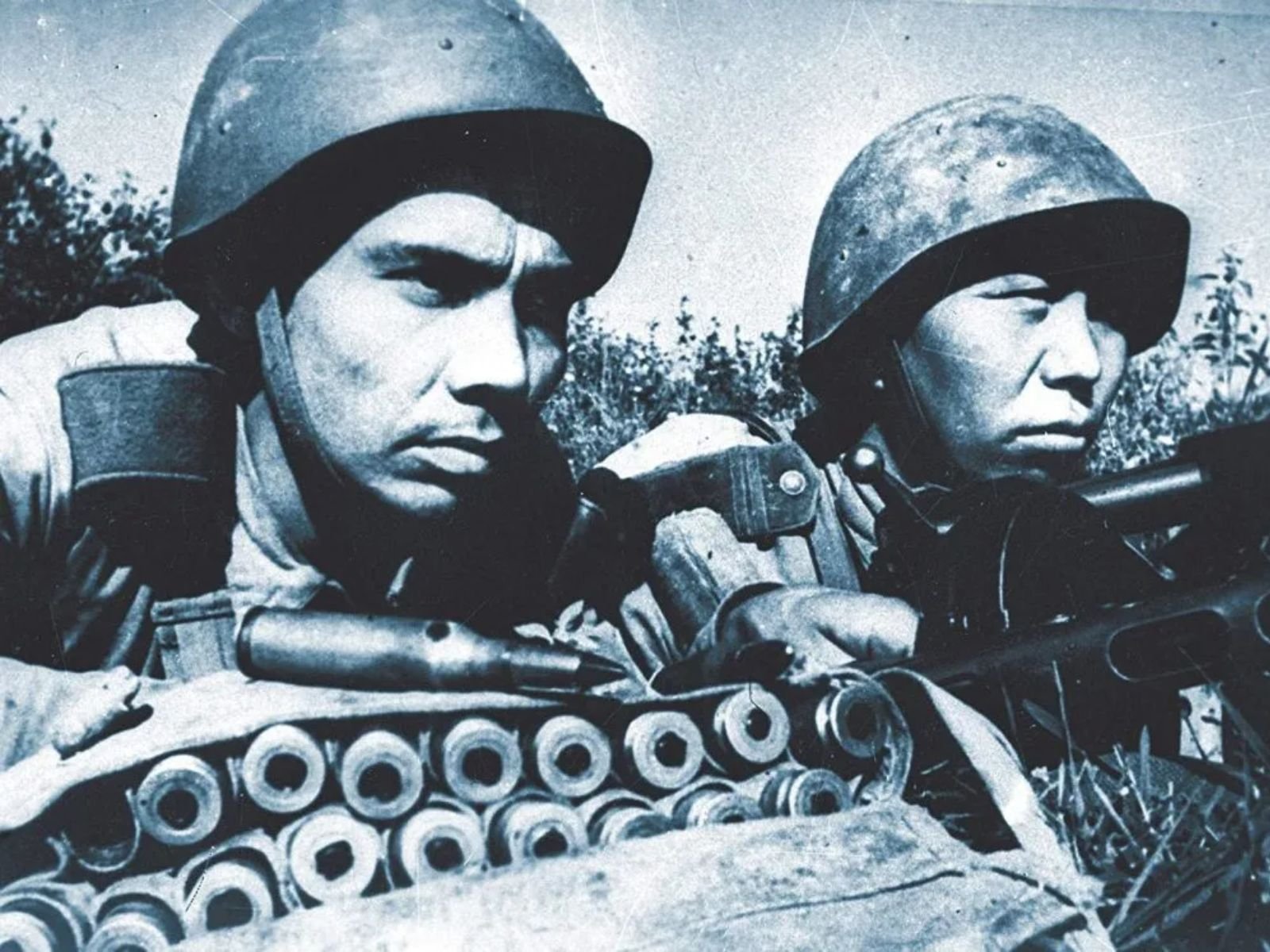
Two Red Army soldiers of Central Asian origin (probably Kazakh or Uzbek) in combat position. The soldiers wear standard Soviet helmets and are equipped with rifles and ammunition belts.
The Central Asian republics also made a significant contribution. More than 1.4 million people were conscripted from Uzbekistan, and almost 1.2 million from Kazakhstan. Around 330,000 Uzbeks and 310,000 Kazakhs died in combat. These soldiers, often with little training and facing language barriers, fought bravely in battles far from their homes, such as the defence of Moscow and the siege of Leningrad. On the vast steppes of Kazakhstan, mothers sang songs of mourning in languages Russian historians rarely mention, while in the cities of Uzbekistan the bazaars stood empty of the young men who had left never to return.
The Poetic Expression of Loss
During the Second World War, Soviet poets used their art to express the immense losses and the profound suffering of the Soviet people. Poems such as “Wait for Me” by Konstantin Simonov captured the anguish and the hope of soldiers and their families. Written in 1941, it became a symbol of devotion and resilience, evoking a soldier’s promise to return to the woman he loved.
Anna Akhmatova, in her work “Requiem“, mourned the pain of the mothers and widows who had lost their loved ones, reflecting the personal and collective tragedy of the war. Poems like these played a crucial part in sustaining morale and solidarity through the years of conflict.
Soviet poetry of the period documented the suffering and exalted the bravery and sacrifice of those who fought. Aleksandr Tvardovsky, in his epic poem “Vasily Tyorkin“, created a heroic figure who embodied the indomitable spirit of the ordinary Soviet soldier. These poems served to unite the nation around a shared sense of loss and resistance.
Poetic literature also helped preserve the memory of the atrocities and of the heroism for future generations. The poetry of the Second World War remains a powerful means of reflecting on the human cost of the conflict, underlining the importance of remembering and honouring those who sacrificed everything.
Wait For Me – Konstantin Simonov
Though they had grown used to countless losses throughout the war, the Soviets did not pretend to be immune to grief. Tens of thousands of people knew the poem “Wait for Me”, by Konstantin Simonov, by heart:
Wait for me, and I’ll come back,
But wait a long while.
Wait when you are filled with sorrow
As you watch the yellow rain.
Wait until the winds
Have swept away the snows.Wait through the stifling heat.
Wait when others give up
And forget the Yesterday.
Wait even when no letters
Reach you from far away.
Wait even when the others
Have grown tired of waiting.Wait even when my mother
And my son believe me dead.
And when friends sit down
Drinking to my memory.
Wait, and do not hurry
To drink to my memory too.Wait, for I will come back,
Defying every death.
And let those who did not wait
Say that I was lucky.
They will never understandThat, in the midst of death,
You, and your waiting,
Saved me.Only you and I will know
How I survived.
It was because you waited for me
As no one else did.
Do Not Call Me, Father
The poem below was written in 1942, shortly after Pavel Grigoryevich Antokolsky lost his 18-year-old son in the Second World War. It became one of the most powerful texts in Soviet literature about the grief of war.
Do not call me, father.
Do not look for me.
Do not call me, do not await my return.
We are on a road never travelled,
Fire and blood have erased the way.We fly, on the wings of lightning,
We, the fallen, comrades in arms,
Never to draw the sword again.
We all went down in battle,
And we shall not return.Will there be a meeting again?
I do not know.
I know only this: the fight is not over.
We are grains of sand in the universe,
And we shall never see the light again.Farewell, my son.
Farewell, my conscience,
My youth and my consolation,
My only son.Let this parting be the end
Of an immense loneliness,
For there is no greater loneliness.
There you will remain for ever,
Far from the light and the air.Your death will not be counted,
It will not be lessened or softened,
You will never rise again,
For ever a boy of eighteen.Farewell, then.
No train leaves that region,
No aircraft can reach it.
Farewell, my son,
For miracles do not happen.And in this world
Dreams do not come true.
Farewell.
I shall dream of you as a child still,
Walking firmly across the earth,
That earth already covered with graves.And this song, my son,
Has come to an end.
The Soviet Union was saved by its soldiers and by its people. But in the ground, without ever seeing peace, lay more than 27 million dead. The victory over Nazi Germany on the Eastern Front was not an exclusively Russian feat but an achievement forged by the blood, sweat and tears of dozens of peoples. Ukrainians, Belarusians, Kazakhs, Georgians and so many others fought and died side by side, defending their homes and contributing to a common goal.
To reduce this epic of suffering and resilience to a single nationalist narrative is to fail to grasp the true dimension of the tragedy and the magnitude of the victory. Honouring the memory of the Soviet victims requires recognising and naming all of them.
Read Also
Bibliographic References
- The World at War. Created by Jeremy Isaacs; narrated by Laurence Olivier; Thames Television for ITV, 1973–74. 26 eps. https://en.wikipedia.org/wiki/The_World_at_War.
- Gilbert, Martin. The Second World War: A Complete History. Holt Paperbacks, 2004. https://us.macmillan.com/books/9780805076233/thesecondworldwar/.
- Hosking, Geoffrey. Russia and the Russians: A History. Belknap Press of Harvard University Press, 2001. https://www.amazon.com/Russia-Russians-History-Geoffrey-Hosking/dp/0674004736.
- Merridale, Catherine. Ivan’s War: Life and Death in the Red Army, 1939–1945. Metropolitan Books, 2006. https://www.amazon.com/Ivans-War-Life-Death-1939-1945/dp/0805074554.
- Weinberg, Gerhard L. A World at Arms: A Global History of World War II. Cambridge University Press, 1994. https://www.cambridge.org/core/books/world-at-arms/122A2C377C4528D26382982044F8E9DC.
- Akhmatova, Anna. Requiem. Munich: Tovarishchestvo zarubezhnykh pisatelei, 1963. https://tamizdatproject.org/publications/requiem-1963/.
- Simonov, Konstantin. Wait for Me and Other Poems. Foreign Languages Publishing House, 1943.
- Tvardovsky, Aleksandr. Vasily Tyorkin: A Book About a Soldier. Progress Publishers, 1945. (English trans. Alex Miller, Progress, 1975). https://books.google.com/books/about/Vassili_Tyorkin.html?id=GlaAAAAAIAAJ.
- Brooks, Jeffrey. Thank You, Comrade Stalin!: Soviet Public Culture from Revolution to Cold War. Princeton University Press, 2000. https://www.jstor.org/stable/j.ctv1ddcxtg.
- “DEATHS BY SOVIET REPUBLIC IN WORLD WAR II.” Association of Accredited Public Policy Advocates to the European Union (AALEP), 2022. https://www.aalep.eu/deaths-soviet-republic-world-war-ii.
- “Red Army.” Wikipedia, The Free Encyclopedia, 2024. https://en.wikipedia.org/wiki/Red_Army.
- “Without Ukraine, There Would Have Been No Victory.” Ukraїner, 2024. https://www.ukrainer.net/en/world-war-ii/.